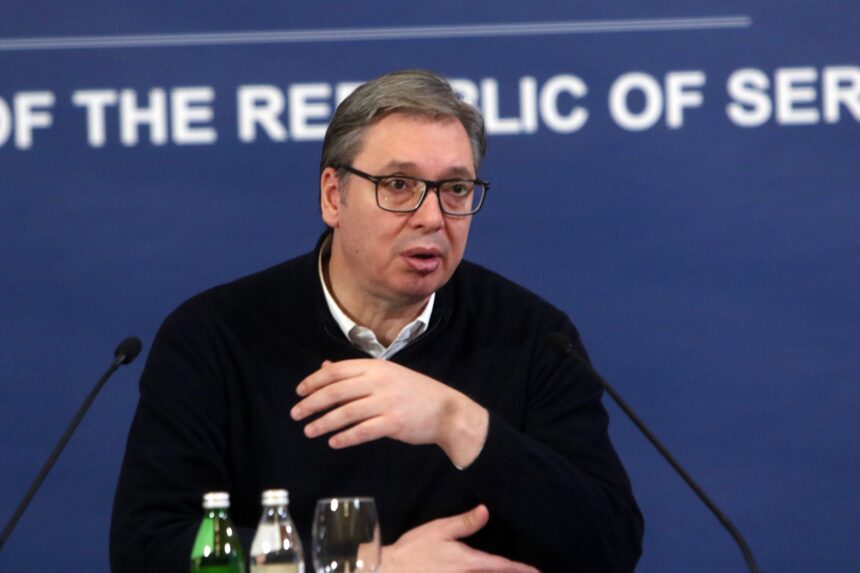
Serbian President Aleksandar Vučić has accused political and media actors in Montenegro of conducting what he described as an organized campaign against Serbia, while saying Belgrade continues to regard Montenegro as a “brotherly state.”
Speaking on Wednesday during an address to the public following the first-instance verdict against former Kosovo Liberation Army leaders, Vučić was asked about recent comments by a Montenegrin minister concerning the KLA and how Serbia should respond to what he described as pressure from neighboring countries.
Vučić said an anti-Serbian media campaign had been taking place in Montenegro for years and claimed that criticism of Serbia was not only tolerated but encouraged among political actors.
“There, all political actors are allowed to say whatever they want against Serbia. And not only is it allowed, it is highly desirable, because, apparently, by doing so they are trying to please many powers on their European path,” Vučić said.
He did not identify specific media organizations or provide evidence for his claim of an organized campaign.
Vučić nevertheless emphasized that Serbia’s position toward Montenegro remained unchanged, describing the neighboring country as both a friendly and “brotherly state.”
“We always view Montenegro not only as a friendly, but also as a brotherly state,” he said.
At the same time, Vučić expressed concern over what he described as a decline in Montenegro’s popularity among the Serbian public.
“I am sorry that they have such an attitude toward Serbia, and I am sorry that they have brought the level of Montenegro’s popularity in Serbia to its lowest point in its history. Let them think about why that is so,” he said.
His remarks come amid continued political disagreements between Belgrade and Podgorica over issues including Kosovo, relations with Serbia, national identity and Montenegro’s foreign-policy orientation.
Vučić’s comments were made as he was also responding to reactions surrounding the Specialist Chambers’ first-instance verdict against former KLA leaders, adding a regional dimension to his broader criticism of what he described as unfavorable political positions toward Serbia.