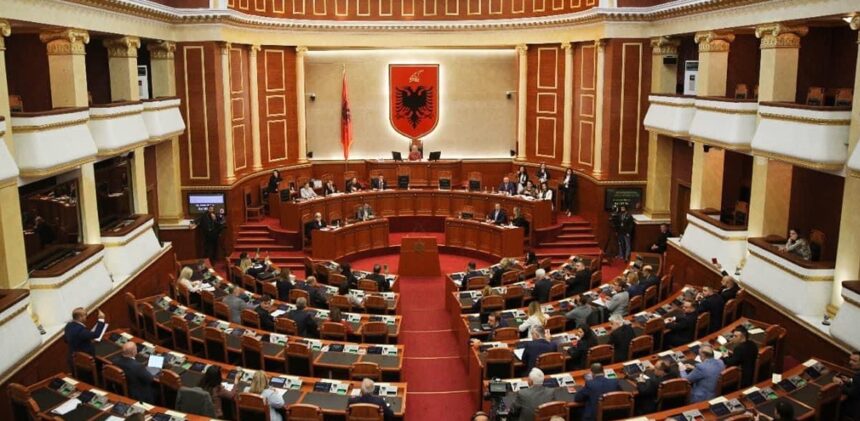
The Parliament of Albania has expressed deep indignation and strong disagreement with the verdict against Hashim Thaçi, Kadri Veseli, Rexhep Selimi and Jakup Krasniqi, describing it as deeply unjust.
In a rare display of political unity, Albania’s political forces spoke with one institutional voice following the sentences handed down by the Kosovo Specialist Chambers in The Hague against the four former KLA leaders.
“Our conviction in their innocence remains unwavering, just as the historical truth remains unwavering: the KLA fought for the freedom and liberation of Kosovo. A judgment cannot rewrite the history of a people. It cannot erase the liberation character of Kosovo’s war or equate the aggressor with the victim,” the joint statement said.
Through a declaration agreed upon by all parliamentary groups, the Parliament of Albania also sent a message to Belgrade and Moscow.
“The Parliament stands against any attempt by Serbia and Russia to politically instrumentalize this process, relativize the crimes of the Milošević regime, and delegitimize the liberation struggle, the independence and the statehood of Kosovo,” the statement said.
For the people and institutions of Kosovo, the parliament stressed that the final word has not yet been spoken.
“The Parliament of Albania stands in full solidarity with Kosovo, its people and institutions, as well as with Hashim Thaçi, Kadri Veseli, Rexhep Selimi and Jakup Krasniqi and their families. This judgment is not the final word. The Parliament expects all legal remedies and further stages of the proceedings to be pursued to the end, ensuring full respect for due process standards,” the declaration stated.
The Albanian Parliament also committed itself to several institutional actions as part of what it described as its responsibility to represent the will of the people.
It said it would raise, in international forums, the crimes committed by Slobodan Milošević’s regime in Kosovo, including alleged acts of genocide, war crimes and wartime sexual violence. It also pledged to seek justice for victims and condemn what it described as the lack of commitment by Serbian authorities to uncovering these crimes, establishing responsibility and ensuring justice for victims.
The declaration concluded by emphasizing that the institutional path remains the means for seeking to address what Albania’s Parliament considers an injustice, in coordination with the Assembly of Kosovo and the governments in Tirana and Prishtina.