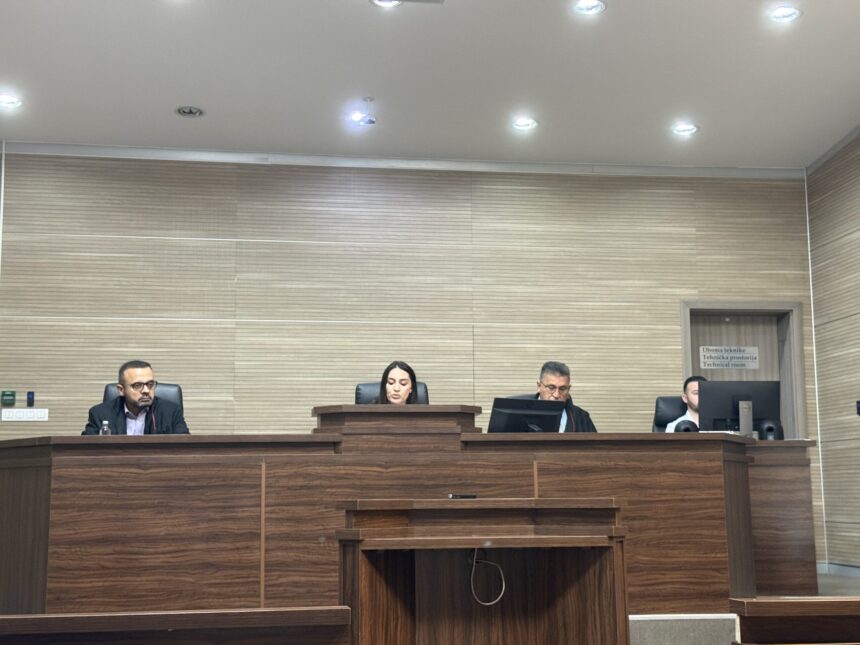
The trial of Millorad Gjoković continued today before the Special Department of the Basic Court in Prishtina, presided over by Judge Donikë Shala Avdyli. Gjoković is accused by the Special Prosecution Office of war crimes against the civilian population during the 1998–1999 Kosovo War.
Gjoković was brought into the courtroom, where a witness is expected to testify during today’s hearing.
According to the indictment filed by the Special Prosecution Office, Gjoković allegedly participated in killings, raids, beatings, arrests, torture, and cruel and inhumane treatment of Albanian civilians during 1998–1999 in the village of Ozdrim and surrounding villages near Peja, allegedly acting in coordination with Serbian military, police, and paramilitary forces.
The prosecution alleges that on May 7, 1999, Serbian forces surrounded Ozdrim and attacked the village from three directions. During the offensive, according to the indictment, six Albanian civilians were killed, while three wounded civilians were initially taken to Peja Hospital and were later allegedly executed and buried in Lutogllavë.
Five other people are also alleged to have been killed during the same operation. Their bodies have not been found and they remain listed as missing persons.
The prosecution file further alleges that around 40 civilians were arrested and taken to a garage known as “Shupa e Shemit,” near the police substation in Ozdrim. They were allegedly held for three days without food or water and subjected to physical torture.
According to the indictment, after three days, only 12 of them were released, while the remaining 28 were divided into three groups and taken to a house in Peja, where the command of the Serbian Army was allegedly located. They were subsequently transferred to Peja Prison and from there to Leskovac Prison in Serbia.
Gjoković, known by the nickname “Mici,” has pleaded not guilty to the charges against him. His defense has denied his involvement in the events described by the prosecution.
The trial was reopened on July 27, 2026, on the day the verdict had been expected to be announced, due to an issue concerning a statement given by witness Nurije Krasniqi at the Institute for War Crimes.