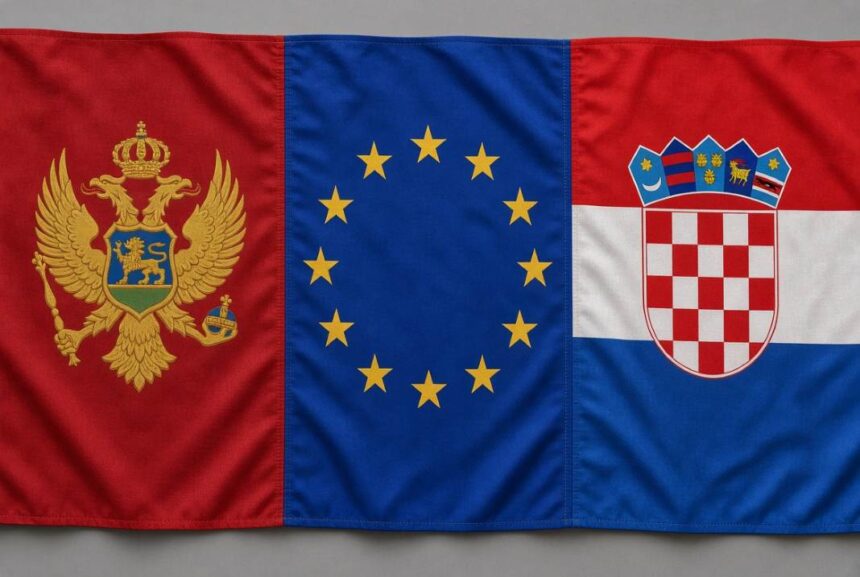
Montenegro’s drive to advance toward European Union membership has come under renewed scrutiny amid reports of reservations among several EU member states and continued pressure from Croatia to resolve a series of bilateral disputes.
Montenegro remains one of the most advanced EU candidates in the Western Balkans. All 33 negotiating chapters have been opened, while 18 had been provisionally closed by July 2026.
Recent reports by the Podgorica-based newspaper Dan said the Netherlands, Croatia, Estonia, Lithuania and Latvia had called for a pause or additional scrutiny before further chapters could be closed. However, the EU Delegation in Montenegro rejected the reports as unfounded, saying there had been no request by EU member states for a standstill in the accession negotiations.
The conflicting accounts have nevertheless highlighted concerns over the pace of Montenegro’s reforms and the role of unresolved bilateral issues in the final stages of its accession process.
Croatia’s six outstanding issues
Croatia has openly linked progress in bilateral relations with Montenegro to the successful completion of the latter’s EU accession negotiations.
In July, Croatia’s Ministry of Foreign and European Affairs said that outstanding bilateral matters needed to be resolved so that they would not burden the final stage of Montenegro’s EU process. Zagreb identified several priorities, including compensation for former detainees of wartime camps, continued efforts to locate 14 people still missing from the Croatian War of Independence, the prosecution of war crimes and the resolution of property claims involving Croatian families.
Croatia has also called for the preservation of the memorial plaque at the former Morinj camp and the renaming of a swimming pool in Kotor, continued discussions on the maritime boundary and the return of the training ship Jadran.
Zagreb has argued that good-neighbourly relations are among the political criteria relevant to the EU enlargement process and has urged Podgorica to accelerate efforts to settle the outstanding questions.
Debate over Montenegro’s reform progress
The latest developments have prompted debate in Montenegro over whether the country can maintain its ambitious timetable for completing the accession negotiations.
Analyst Željko Đukić, of the NGO Multimedijal Montenegro, told Dan that closing all remaining chapters by the end of 2026 would be difficult because of the amount of work still required, including reforms related to the environment and climate policy.
He also pointed to domestic political developments and the upcoming election cycle as potential factors affecting the pace of reforms.
According to Đukić, EU member states are interested not only in whether Montenegro adopts legislation aligned with EU rules, but also in whether those laws are effectively implemented.
His assessment was that additional scrutiny would therefore be consistent with the principle that candidate countries must demonstrate results in practice rather than simply adopt legislation.
Croatia’s concerns extend beyond the accession process
Croatia’s demands also reflect a broader set of unresolved issues stemming from the wars of the 1990s and the dissolution of Yugoslavia.
Zagreb has previously criticized Montenegro over a 2024 parliamentary resolution concerning the Jasenovac concentration camp. Croatian authorities described the resolution as politically motivated and harmful to good-neighbourly relations, while its supporters in Montenegro presented it as an act of remembrance for victims.
The dispute has added another layer to already sensitive bilateral relations between the two EU and Western Balkan neighbours.
Croatian Prime Minister Andrej Plenković has publicly outlined Zagreb’s expectations regarding the six issues, including compensation for former detainees, missing persons, war-crimes cases, property disputes, the Jadran, the maritime border and the Morinj memorial.
Montenegro remains a leading EU candidate
Despite the political disputes, Montenegro continues to make technical progress in its accession negotiations.
The European Commission said in June that Montenegro had provisionally closed 16 chapters, and two additional chapters — competition policy and customs union — were provisionally closed in July, bringing the total to 18. The Commission has continued to describe Montenegro as a frontrunner in the enlargement process.
The EU has also stressed that provisionally closing individual chapters does not mean the process is final, as the overall accession agreement can only be concluded once all chapters have been addressed.
The latest dispute therefore does not amount to a formal suspension of Montenegro’s EU negotiations. Instead, it underscores the increasingly important role of reform implementation, member-state consent and unresolved bilateral questions as Podgorica moves toward the final stages of its accession process.