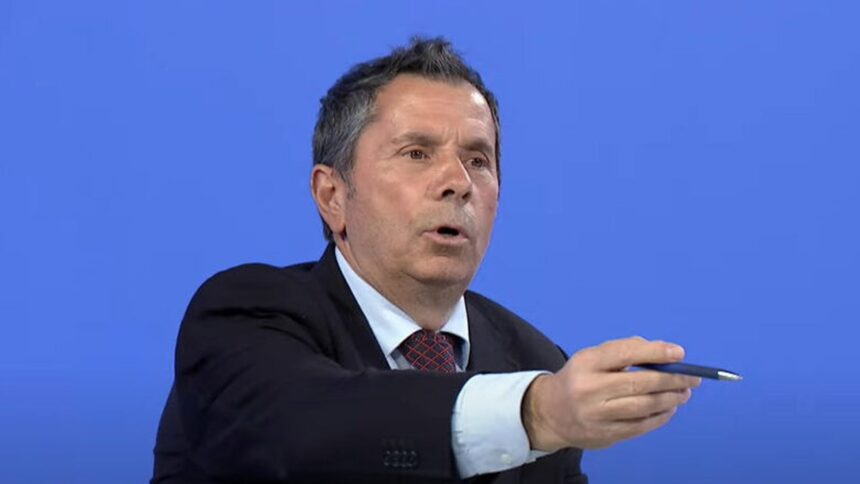
The defense teams representing the former Kosovo Liberation Army (KLA) leaders in The Hague should change their approach at the appeals stage, according to lawyer Tomë Gashi.
He criticized the way the defense was conducted during the trial, arguing that the former KLA leaders did not testify during the court proceedings and that their defense teams made a mistake by, in his view, advising them to remain silent.
Gashi called for the defense teams to be strengthened with local lawyers, while identifying the challenge to evidence originating from Serbia as one of the key issues for the appeals process.
In an interview, Gashi said that the jurisdiction of the Specialist Chambers cannot be changed through other laws, emphasizing that the focus should be on the process of appealing the judgment within the Specialist Chambers themselves.
“Previously, we have seen that the request in this proposal by the PDK is for certain legal matters being tried by the Specialist Chambers to be transferred to the territory of the Republic of Kosovo, meaning that the trials would continue here. This is not feasible because the jurisdiction of the Specialist Chambers is entirely different, established separately from other laws, and the functioning of the Specialist Chambers cannot be changed through any other law. It is impossible. The objective that should be pursued is to do everything possible to change the June 16 judgment at the Appeals level, within the Specialist Chambers themselves. There is no other legal route,” Gashi said.
According to him, the defense teams should be strengthened with local lawyers because, as he stated, they have more direct knowledge of the circumstances in Kosovo before, during and after the war.
“I believe that we should strengthen the teams with local lawyers because local lawyers know best what the situation was like before the war, during the war and after the war. As for the claims that the international lawyers have done their job well, I believe they have not. They are certainly lawyers with strong international reputations and may have won cases in the past, but in cases such as those involving Mr. Thaçi and the other leaders of the Kosovo Liberation Army, their work has not been particularly good,” he said.
Gashi also criticized the defense strategy used in the cases of the former KLA leaders, saying that, in his view, they did not provide defense testimony during the trial and that this was one of the defense’s mistakes.
“One of the reasons, for example, is that I have not seen them being given the opportunity to all defend themselves. It appears that they were advised to remain silent and not testify. I have not seen a single statement from Mr. Hashim Thaçi, Mr. Jakup Krasniqi, Mr. Kadri Veseli or Mr. Rexhep Selimi in which they directly challenged the allegations of the Specialist Prosecutor’s Office, namely the prosecution. They made opening statements in which they denied the charges and the guilt unfairly attributed to them in the indictment, as well as closing statements at the end of the trial, which lasted approximately three and a half years. However, we did not see hearings in which they responded to the allegations of the prosecution,” Gashi said.
He said that, in his view, responsibility for this approach should not be attributed to the former KLA leaders themselves, but rather to their defense teams.
“For this reason, I say that what we have seen is that they did not provide defense testimony, and this is not their fault, but rather the fault of the lawyers who advised them simply to remain silent and not testify. In my view, this was one of the fatal mistakes made by the defense teams of all the leaders of the Kosovo Liberation Army who, unfortunately, are in The Hague. Their defense strategy was extremely misguided,” he told Ekonomia Online.
Another issue raised by Gashi concerns the use of evidence originating from Serbia in the proceedings in The Hague. He said that the defense should have challenged more strongly the admission and use of such evidence.
“Another issue is how it was possible for the lawyers to allow it—they certainly did not want this, but nevertheless they allowed there to be no strong and forceful objections to prevent any KLA soldier, and even more so the KLA leaders, from being tried on the basis of evidence that came from Serbia. It is something terrible, and I believe that no one can expect a favorable decision or an acquittal at any level if evidence from Serbia is allowed to be treated as credible evidence from a hostile state that waged a genocidal war in Kosovo,” Gashi said.
He also referred to the historical developments that, in his view, led to Kosovo’s liberation, linking them to the way evidence from Serbia has been treated in the proceedings before the Specialist Chambers.
“It is known that the entire people of Kosovo contributed to the liberation from Serbian occupation. First there was peaceful resistance led by the historical president Ibrahim Rugova, followed by armed resistance led by the KLA, and then NATO came to our aid and bombed Serbia for 78 days—and rightly so. We know all these stages that brought us to full liberation. But how is it possible for a court established by the Republic of Kosovo in freedom—the Specialist Chambers were established in 2015, seven years after the declaration of independence—to allow documentation from Serbia, namely from a party to the conflict, to be submitted in our courts? This is a total legal absurdity, and I do not know who bears the blame,” he said.
According to Gashi, part of the responsibility also lies in the way the law establishing the Specialist Chambers was drafted and adopted in 2015.
“The initial fault in this matter is that the law allowed it. The deputies did not state in the law on the Specialist Chambers, adopted on August 3, 2015, that Serbian evidence was admissible. However, they voted that under that law, the Specialist Prosecutor’s Office or the Specialist Chambers could obtain evidence from anywhere in the world, wherever they believed such evidence could be found. There should have been a restriction to prevent evidence from Serbia, as a party to the conflict and a hostile party, from being obtained. They did not do this, and it is now coming back to haunt us,” Gashi said.
He emphasized that the law was adopted when Kosovo was an independent state, noting that the Specialist Chambers were not established during the administration of UNMIK or EULEX.
“We were a free state. This did not happen during the time of UNMIK or EULEX, but in a free Kosovo, an independent Kosovo, in the state of Kosovo in 2015, while we declared independence in 2008. I repeat again, it is a legal absurdity how 82 members of parliament who voted for the law establishing the Specialist Chambers could allow KLA soldiers and commanders—those who fought against Serbia with all their strength—to be tried using evidence from Serbia. This is something that the mind of a mentally and physically healthy person cannot comprehend as being compatible with a court having operated properly,” he said.
Gashi said responsibility should be examined at several levels: with regard to the law adopted by lawmakers, the court, and the prosecution, particularly concerning how evidence originating from Serbia was handled and assessed.
“The fault lies with our lawmakers, then with the court, and then with the prosecution for the way they assessed this evidence. Did they discuss its credibility or reliability? I say again: Serbian evidence is diabolical; it only leads to convictions, but it does not bring justice,” Gashi added.
The Specialist Chambers have sentenced the four former KLA leaders to a combined total of 81 years in prison.
Former Kosovo President Hashim Thaçi was sentenced to 25 years in prison. The court found him responsible for crimes including murder, torture, cruel treatment and unlawful detention during the war in Kosovo.
Kadri Veseli was sentenced to 18 years in prison. He was found guilty of war crimes, including unlawful or arbitrary detention, cruel treatment, torture and unlawful killing.
Jakup Krasniqi was sentenced to 25 years in prison. The court found him guilty of war crimes, including arbitrary detention, cruel treatment, torture and unlawful killing.
Rexhep Selimi was sentenced to 13 years in prison. The Trial Panel found him guilty of war crimes, including cruel treatment, torture and unlawful killing.