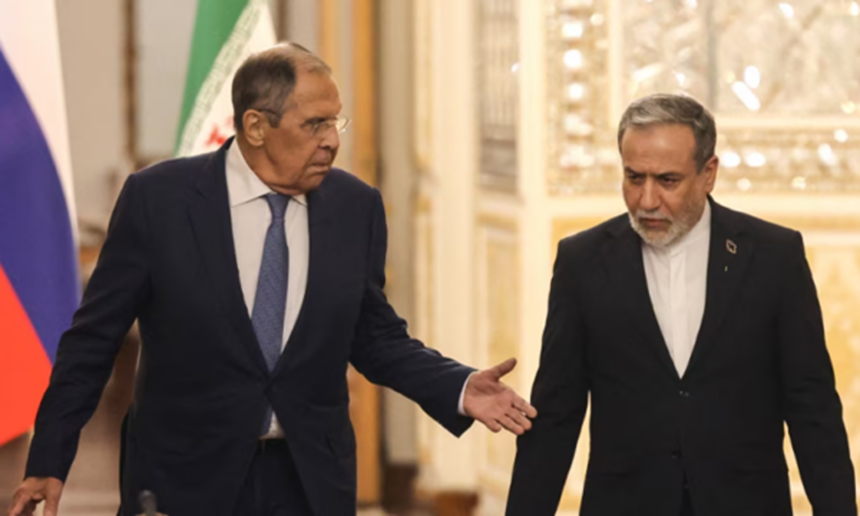
Russian Foreign Minister Sergei Lavrov arrived in Tehran on October 19 for talks with his Iranian counterpart, Abbas Araqchi, and a meeting with President Masoud Pezeshkian, amid questions over whether—and to what extent—Moscow is supporting Iran in its war with the United States.
Lavrov travelled to the Iranian capital directly from Manama, where he had attended a meeting with officials from the Gulf Cooperation Council. Gulf states have urged Moscow to use its influence to pressure Tehran into halting attacks on its neighbours.
Iranian Foreign Ministry spokesperson Esmail Baqaei said the visit was aimed at implementing bilateral agreements. Moscow said the talks would focus on the regional crisis, which it blames on the United States and Israel, as well as trade, energy and transport projects.
Earlier this month, Russian President Vladimir Putin told Pezeshkian that Moscow was ready to contribute to mediation efforts to help bring the war to an end.
However, issues not included in the public agenda are likely to attract considerable international attention. After nearly eight months of fighting against a much more powerful adversary, questions remain over how much support Iran is receiving from Russia which has not directly entered the war and what form that assistance takes.
Those questions grew louder on October 18, when U.S. President Donald Trump wrote on social media that Russia was doing “very little, if anything” to help the Islamic Republic of Iran, considering what it could potentially do.
Earlier in the week, Trump had also written that he did not believe either Moscow or Beijing was helping Iran.
“If they are helping, it is at a very low level, but I don’t believe that they are. They have a lot to lose, and we would know about it—we would find out very quickly,” Trump wrote.
Trump’s October 18 statement formed part of his explanation for backing away from imposing sweeping sanctions against Russia. He argued that such sanctions could drive the Kremlin away from negotiations aimed at ending the war in Ukraine.
The Trump administration recently lifted sanctions on Russian oil exports, prompting criticism from both major U.S. political parties and anger from Ukraine and many of its international partners.
“Russian Support Has Been Present”
Hamidreza Azizi, an Iran analyst at the Brussels-based International Crisis Group, told Radio Free Europe/Radio Liberty (RFE/RL) that although Moscow had stopped supplying heavy weapons and agreements involving Su-35 fighter jets had stalled, Russia had continued providing Iran with military intelligence, enabling “precision strikes against U.S. bases.”
Russia has also helped improve Iranian-made systems, including Shahed drones, through ongoing military-technical cooperation.
“So it really depends on how you define support, but Russian support has been present and has had a tangible impact,” Azizi said.
Some analysts point to an incident they believe demonstrates the importance of Russian assistance to Iran.
In March, Iran attacked Prince Sultan Air Base in Saudi Arabia, injuring 12 U.S. service members.
Experts noted that the unusual precision of the attack may have been enabled by Russian intelligence. Reports subsequently emerged that 14 Russian reconnaissance satellites had passed over the base two days before the strike. U.S. officials later concluded that information from Moscow had made the precision attack possible.
A senior European Union official, who spoke to RFE/RL on condition of anonymity because they were not authorised to comment publicly, said Russian assistance to Iran had always been limited because the war in Ukraine had depleted Moscow’s resources.
The official said there was “absolutely no indication that they are limiting it even further” and described Trump’s statement as “propaganda to somehow explain to the [American] public why he is going soft on Russia and picking on Ukraine.”
Intelligence, Drones and Missiles
Since February 28, when the United States and Israel launched strikes against Iran, media reports citing U.S., European and Ukrainian officials have described an increase in Russian support for Tehran.
Several outlets have quoted sources close to U.S. intelligence who said Russia had provided Iran with information about the locations and movements of American troops, warships and aircraft, primarily through satellite imagery.
Ukrainian President Volodymyr Zelenskyy has said Kyiv has evidence that Russia is providing intelligence to Iran.
According to Andrea Kendall-Taylor, a senior fellow and director of the Transatlantic Security Program at the Center for a New American Security, and Richard Fontaine, the organisation’s chief executive, “Russia’s support for Tehran has been operationally significant but limited in scope.”
“Even as it wages its war in Ukraine, Moscow has found ways to help Iran strike American targets and sustain its fighting, through diplomatic and material support, while stopping short of actions that could draw Russia into a direct conflict with the United States,” they wrote in an analysis published last week in Foreign Affairs magazine.