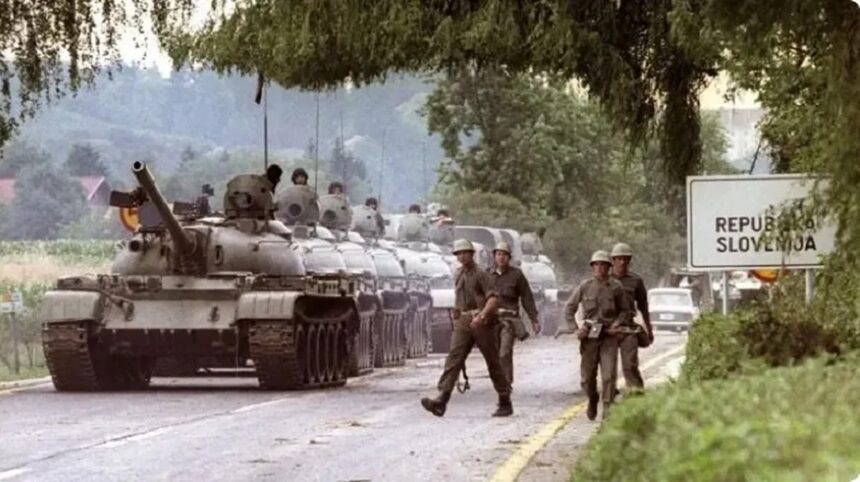
Three months after the end of the Ten-Day War, on October 25, 1991, the last soldier of the former Yugoslav People’s Army (JNA) left Slovenian territory.
The Ten-Day War, also known as the Slovenian War of Independence, followed Slovenia’s declaration of independence on June 25, 1991. The conflict ultimately resulted in Slovenia becoming the first republic to break away from the Yugoslav Federation.
Fighting in Slovenia took place between the Slovenian Territorial Defence and the Yugoslav People’s Army after Slovenia declared its independence. The war lasted from June 27 to July 7, 1991. The Slovenian people resisted the aggression of the so-called Yugoslav People’s Army through various means.
According to Slovenian estimates, the Yugoslav Army suffered 44 fatalities and 146 injuries, while Slovenia recorded 18 people killed and 182 wounded.
Twelve foreign nationals were killed during the conflict, mainly journalists and Bulgarian truck drivers who had been caught in the crossfire. Slovenian forces captured 4,692 Yugoslav Army soldiers and 252 officers of the federal police.
The Yugoslav Army itself acknowledged that its material losses during the brief conflict in Slovenia included 31 tanks, 22 armoured personnel carriers, six helicopters, 6,787 infantry weapons, 87 artillery pieces and 124 air defence weapons that were damaged, destroyed or seized.
Historically, the territory of present-day Slovenia formed part of various state entities, including the Roman Empire and the Holy Roman Empire, followed by the Habsburg Monarchy.
In October 1918, Slovenes exercised self-determination for the first time by co-founding the internationally unrecognised State of Slovenes, Croats and Serbs. In December of that year, it merged with the Kingdom of Serbia to form the Kingdom of Serbs, Croats and Slovenes, which was renamed the Kingdom of Yugoslavia in 1929.
During the Second World War, Slovenia was occupied and annexed by Germany, Italy and Hungary, while a small portion of its territory was transferred to the Nazi puppet state known as the Independent State of Croatia. After the war, Slovenia became a founding member of the Federal People’s Republic of Yugoslavia, later renamed the Socialist Federal Republic of Yugoslavia.
In June 1991, following the introduction of multiparty representative democracy, Slovenia seceded from Yugoslavia and became an independent state.
In 2004, Slovenia joined NATO and the European Union. In 2007, it became the first former communist country to adopt the euro, and in 2010 it joined the Organisation for Economic Co-operation and Development (OECD), an international organisation promoting economic development and improved living standards.