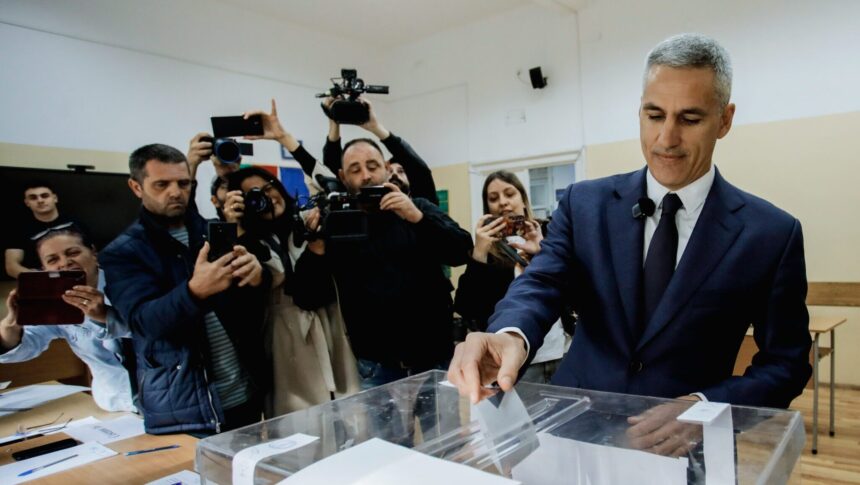
SOFIA, October 26, 2026 — Bulgaria’s presidential election will go to a second round on November 1 after acting President Iliana Iotova secured a narrower-than-expected lead over reformist candidate Andrey Gyurov in a first round marked by record-low voter turnout.
According to the Central Election Committee, with 99.94 per cent of ballots processed, Iotova received 34.8 per cent of the vote, while Gyurov secured 31.9 per cent. Neither candidate obtained the majority needed to win the presidency outright.
Although opinion polls had identified the two as the leading contenders, the results differed significantly from some forecasts that Iotova could secure a decisive victory.
Following the announcement, Iotova said her campaign had focused on promoting peace. Reiterating a theme from her campaign, she said she wanted to see Bulgarian flags on the country’s streets rather than foreign flags.
Gyurov renewed his call for an “honest and civilised” televised debate, after Iotova declined previous invitations.
“We owe it to all the citizens who voted for us but most importantly, those who decided to stay at home, still unconvinced,” Gyurov said.
Record-low voter turnout
The election was marked by exceptionally low participation. According to Alpha Research, only 22.5 per cent of eligible voters cast their ballots.
By comparison, turnout reached 40.5 per cent in the 2021 elections and 56.28 per cent in 2016.
Analysts cited the absence of candidates from several major political parties as one possible explanation, suggesting that their traditional supporters had less incentive to participate.
Alpha Research estimated that only around 30 per cent of regular voters for GERB, which dominated Bulgarian politics for much of the period between 2008 and 2025, took part in Sunday’s election.
The Movement for Rights and Freedoms – New Beginning, associated with sanctioned businessman Delyan Peevski and supported by many Bulgarian Turks, also did not field a candidate.
Local media reported particularly low turnout in areas with significant Bulgarian Turkish populations, alongside a decline in votes cast by Bulgarians living in Turkey.
Security and foreign policy divide candidates
Security concerns and Bulgaria’s position on Russia’s war against Ukraine emerged as major campaign issues.
Debate intensified over the government’s response to drone attacks in the Black Sea region, exposing differences between candidates over the country’s security strategy and its relationship with Russia and Western allies.
On Monday, Prime Minister Radev returned to the issue, framing the November 1 runoff as a choice between “peace and war.”
He suggested that Iotova would be better positioned to ease tensions with Russia, while portraying Gyurov’s pro-European Union and pro-Ukraine positions as risking further conflict.
The runoff will determine who becomes Bulgaria’s next president, with the outcome set against widespread voter disengagement and competing visions of the country’s foreign policy direction.