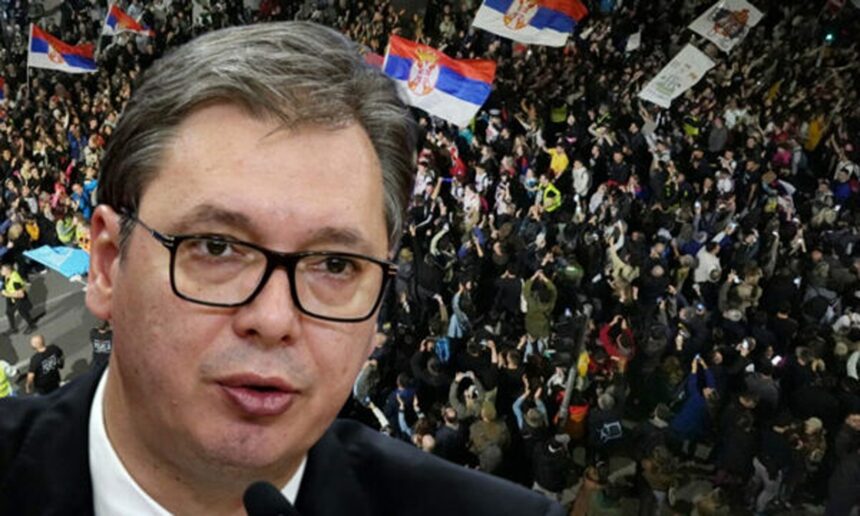
Following the parliamentary election defeat in Serbia, Aleksandar Vučić’s regime could stage a new crisis to weaken the incoming government and evade criminal accountability, analysts and lawyers warn. They caution that the Security Intelligence Agency (BIA) and the Ministry of Internal Affairs (MUP), which remain under the control of officials from the outgoing administration, could be used to conceal evidence and obstruct the transition of power.
Following the Student List’s victory in the parliamentary elections and the defeat of the Serbian Progressive Party (SNS), concerns are growing in Serbia about the risks that could emerge before new institutions are established.
Although Vučić’s regime has lost the election, his allies continue to lead key state institutions, including the Ministry of Internal Affairs (MUP) and the Security Intelligence Agency (BIA).
According to analysts and lawyers, this situation creates opportunities for potential abuses, including staging crises, concealing evidence and destroying files that could establish the responsibility of officials from the outgoing regime.
Warnings of Possible Destruction of BIA Files
Lawyer Božo Prelević has warned that the BIA could exploit the transition period to destroy files that might reveal cooperation between members of the ruling establishment and state institutions, as well as their influence over politics and the media.
He claims that a large part of Serbia’s political scene and media editors have acted as intelligence service informants, arguing that the outgoing regime will try to prevent the new authorities from accessing these records.
Prelević has called for an investigation into who was appointed to diplomatic positions by the BIA and what happened inside institutions that, according to him, violated the law during the SNS’s 14 years in power.
He warned that the outgoing authorities could attempt to protect their allies by destroying documents.
“A New Crisis Could Be Staged”
Political analyst Dragan Popović has assessed that Serbia’s institutions have been weakened and that the transition will not be easy.
According to him, many people have an interest in obstructing the transfer of power, particularly those who could face criminal accountability or lose wealth accumulated during the SNS’s time in government.
Popović said much would depend on the heads of institutions, who could choose whether to conceal evidence, cooperate with the new authorities or attempt to evade responsibility.
He stressed that institutional order cannot be restored overnight, warning that Serbia faces a long and difficult transition.
Meanwhile, Raša Nedeljkov, programme director at CRTA, has warned about links between state institutions and organized crime.
He said some individuals might attempt to conceal wealth acquired illegally, but expressed hope that those responsible could face justice if the new government makes combating corruption and organized crime a priority.
MUP and Police Still Under the Outgoing Regime’s Influence
Lawyer Nenad Tasić has pointed out that the SNS’s election defeat has not automatically brought changes to the Ministry of Internal Affairs.
According to him, current Interior Minister Ivica Dačić and other MUP structures remain in their positions, while the outgoing regime continues to exert influence over security institutions.
Tasić also mentioned Marko Kričak, head of the Criminal Police Directorate, who has faced criticism over police conduct toward citizens and student protesters.
He said Kričak could be dismissed by the police director, although such a move would be difficult under the current circumstances.
According to the lawyer, criminal liability for police officers falls within the prosecutor’s jurisdiction, but he claims the prosecution remains under the influence of the outgoing authorities.
Tasić said the evidence exists, but that it remains to be seen whether the files will finally be brought out of the drawers.
Vučić Could Try to Divide the Incoming Government
Ivan Marović, a former activist with the Otpor movement who participated in the campaign against Slobodan Milošević’s regime in 2000, has warned that Vučić could attempt a political counteroffensive following his election defeat.
According to Marović, Vučić will initially try to soften the impact of the loss and avoid criminal accountability before attempting to weaken and divide the incoming governing team.
Marović believes Vučić understands the weaknesses of the student movement and could exploit issues such as legalism and national interests to provoke a new crisis.
He warned that an incident could occur or a major crisis could be deliberately triggered, forcing the entire public to focus on it and compelling political opponents to temporarily set aside their differences.
According to Marović, such a situation could be used to weaken the student movement and prevent the new government from consolidating its power.
Until a new government is formed, security structures and state institutions remain in the hands of officials from the outgoing regime. Warnings about the possible concealment of evidence and the staging of crises have therefore added to concerns surrounding an already sensitive transition.
Once the Republican Electoral Commission officially confirms the results, a 30-day deadline begins for the constitution of the National Assembly. After the Assembly is constituted, a further 90-day deadline applies for the formation of Serbia’s government.