A coalition of parties can form a government in Israel if they collectively secure a majority of 61 seats in parliament.
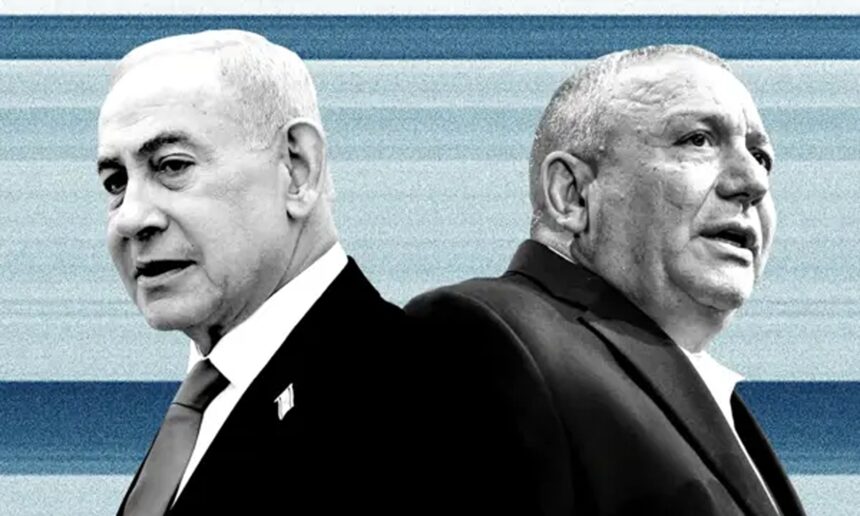
Current exit polls suggest that Benjamin Netanyahu’s bloc will win 50 seats, while the coalition led by his main rival, Gadi Eisenkot, is projected to secure 53 seats. Arab parties are also expected to win 17–18 seats in the 120-member Knesset.
Netanyahu’s Likud party, along with smaller ultra-Orthodox and far-right parties, has no other parties currently willing to join its coalition, Sky News reports.
Eisenkot’s coalition, which includes his Yashar party, Together, the Democrats and Yisrael Beiteinu, faces a similar problem.
As a result, neither bloc appears to have the necessary majority to govern.
What happens if the election produces a deadlock?
If no coalition secures 61 seats, the outgoing government will remain in power until a new coalition is formed and sworn in.
Netanyahu would remain prime minister, heading what is known as a caretaker government.
A deadlock between the opposition and parties led by Palestinian citizens of Israel would therefore represent another political advantage for Netanyahu, who has previously continued governing through a caretaker administration.
Between April 2019 and November 2022, Israel held five elections, while Netanyahu remained in power for much of that period.
This allowed him to shape the security agenda and direct conflicts across the wider region.
What can and cannot a caretaker government do?
Caretaker governments face certain restrictions compared with fully constituted governments. They are expected to exercise restraint when making long-term commitments, but they have greater authority when it comes to replacing ministers.
A caretaker government can appoint a member of the Knesset as a minister to replace a minister who has resigned, been dismissed or died, without requiring parliamentary approval, as would be necessary for a regular government.
“Ultimately, Netanyahu doesn’t need to win the next election. He just needs to make sure everyone else loses,” said Joseph Mansour, a former adviser to a Knesset member.
The caretaker government would remain in power until another election, which is likely to take place at least seven months after the current vote.
A new election could lead to the formation of a new government around two months later. Alternatively, the caretaker government could remain in office again if no coalition manages to secure a majority.
Is Israel heading towards a unity government or another election?
The possibility of a unity government involving Netanyahu and Eisenkot appears remote, as Eisenkot has refused to serve in a government led by Netanyahu, including one in which the premiership would rotate between the two leaders.
Other opposition leaders have also ruled out joining a coalition led by the prime minister.
Eisenkot has called for the leader of the largest party in the opposition bloc to become his candidate for prime minister, although no agreement on the issue has been announced within the bloc, the Jerusalem Post reports.
The exit polls have also raised the possibility of a minority government that could win a confidence vote in the Knesset without holding an absolute majority of 61 seats.
The most straightforward option would be to explore an agreement with one of the Arab parties. However, the biggest obstacle is Eisenkot’s own statement that he would not enter into such an arrangement.
At the time, that appeared to be an unnecessary restriction he had imposed on himself. Polls suggested he would not lose many votes, while such an agreement would give him considerably more room to manoeuvre.
Nevertheless, his pre-election statements could perhaps be interpreted more flexibly, Sky News reports.
An agreement with the Ra’am party appears to be a possibility, particularly as the party is running a Jewish candidate for the first time, who could be appointed national security minister as part of a deal.
Ra’am is currently projected to win seven seats, which would bring Eisenkot’s bloc to a total of 59 — close to, but still short of, a majority.
However, if the exit polls prove inaccurate and the bloc reaches 61 seats, such an agreement could become an attractive option.
Official results will depend on the vote count
Exit polls have differed from final results in previous elections, and the official outcome will be determined once the ballots have been counted.
The political deadlock could ultimately lead to another election, although coalition negotiations may still produce an agreement between the parties.
Within the opposition bloc, Naftali Bennett’s B’Yachad party is projected to become the third-largest party, with 12–14 seats, according to the exit polls.
Avigdor Liberman’s Yisrael Beiteinu is projected to win 7–9 seats, while Yair Golan’s Democrats are expected to secure 9–10.
Within Netanyahu’s bloc, National Security Minister Itamar Ben-Gvir’s Otzma Yehudit party is projected to win 6–7 seats.
The Religious Zionist–Zehut party, led by Finance Minister Bezalel Smotrich, is projected to secure six seats.
The main ultra-Orthodox, or Haredi, parties are expected to win a combined 12–13 seats. According to the exit polls, Shas is projected to win six seats, while United Torah Judaism (UTJ) is expected to secure 6–7.
Reactions from the opposition and government
Gadi Eisenkot, leader of the opposition Yashar party, has said the preliminary election results indicate a complete lack of confidence in Prime Minister Benjamin Netanyahu and his government. He pledged to work to replace the administration as quickly as possible.
In a statement published on X, Eisenkot said the exit polls reflected the position of the Zionist majority and the majority of Israeli citizens towards the current government.
“If these are the final results, then this represents a victory for Israel’s Zionist, state-building majority,” he wrote.
Eisenkot pledged to act immediately to implement the will of the public, replace Netanyahu’s government and establish a government focused on Zionist mobilisation.
Netanyahu has yet to respond, while his coalition bloc is projected to win fewer seats than its rivals.
Meanwhile, his Foreign Minister, Gideon Sa’ar, reacted on social media during the past hour.
“The left’s celebrations are premature,” he wrote on X.
“The smugness of biased commentators is laughable. One thing seems quite clear: Likud is the largest party in Israel.”