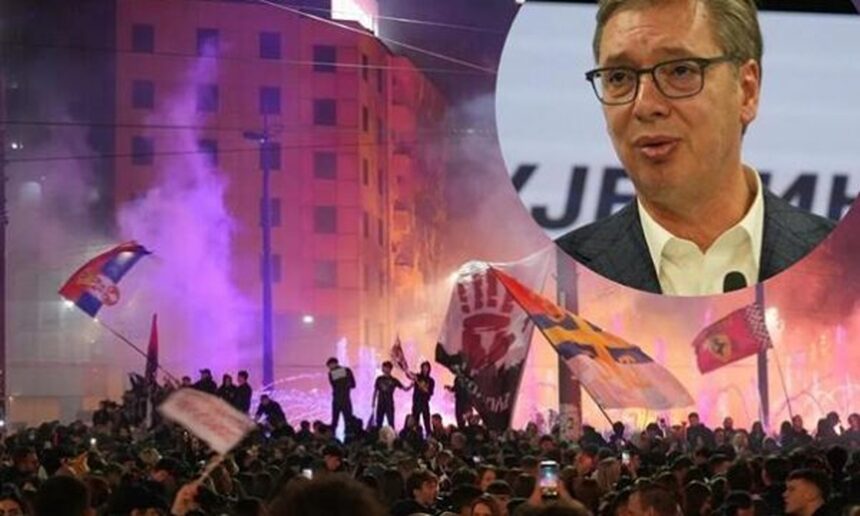
Serbia’s election results have sparked debate not only about who will lead the country, but also about the policies Belgrade will pursue toward its neighboring states.
During his 14 years in power, Aleksandar Vučić has seriously damaged relations with countries across the region, from Bosnia and Herzegovina and Croatia to Albania and North Macedonia.
Analysts Aleksandar Popov, Nataša Kandić and Filip Švarm expect changes following the students’ victory, but warn that the real extent of their influence will become clear only through the actions of the new government.
Analyst Aleksandar Popov believes the election results could mark the end of a political system in which Aleksandar Vučić was, as he put it, “the alpha and omega of everything in the state.”
According to Popov, the students have overshadowed not only the ruling establishment but also the previous opposition.
“Serbia has had no left wing since the time of Milošević. Some have merely falsely presented themselves as left-wing,” he told Vijesti.ba, adding that only a few minority parties might remain part of the next government.
Popov stressed that one of the main lessons of political change is the danger of concentrating power in the hands of a single person.
“Serbia must never again allow one person to become an icon and the alpha and omega of everything in the state. I hope we will not repeat that mistake,” he said.
Popov expects the changes to affect relations with neighboring countries, particularly Bosnia and Herzegovina.
“I hope our policy toward Bosnia and Herzegovina will improve as well, because we have done you a great deal of injustice. It would be good for the new government to improve relations with all our neighbors, so that this region becomes a zone of peace and cooperation rather than a powder keg,” he said.
Nataša Kandić, founder of the Humanitarian Law Center, commented on Vučić’s statement following the election results, when he said: “Congratulations, Nataša Kandić, your politics have won.”
Kandić described the remark as a desperate attempt at political marketing.
Nevertheless, she sees the possibility of improved relations between Serbia and its neighbors as a significant development.
In her view, establishing normal communication in line with the standards of a civilized society is particularly important for organizations documenting war crimes.
Kandić believes the rule of law could create space for confronting the past, but warns that it is still too early to assess how much the new government will do in this regard.
The change of power in Serbia could also affect political relations between Belgrade and Republika Srpska.
Filip Švarm, editor-in-chief of the Belgrade-based weekly Vreme, previously described the relationship between Milorad Dodik and Serbia’s ruling establishment in the following terms:
“Milorad Dodik is the best friend of whoever is in power in Serbia.”
According to Švarm, Dodik enjoyed significant support in Belgrade throughout Vučić’s 14 years in power.
However, that relationship could change with the arrival of a new government.
In Švarm’s assessment, Dodik could lose the opportunity to use support from Belgrade to advance his political interests in Bosnia and Herzegovina.
Švarm said Dodik had already congratulated the students on their victory, although his remarks came after the SNS election rally.
According to him, the future shape of political relations in Banja Luka, Sarajevo and Belgrade will become clearer in the period ahead.