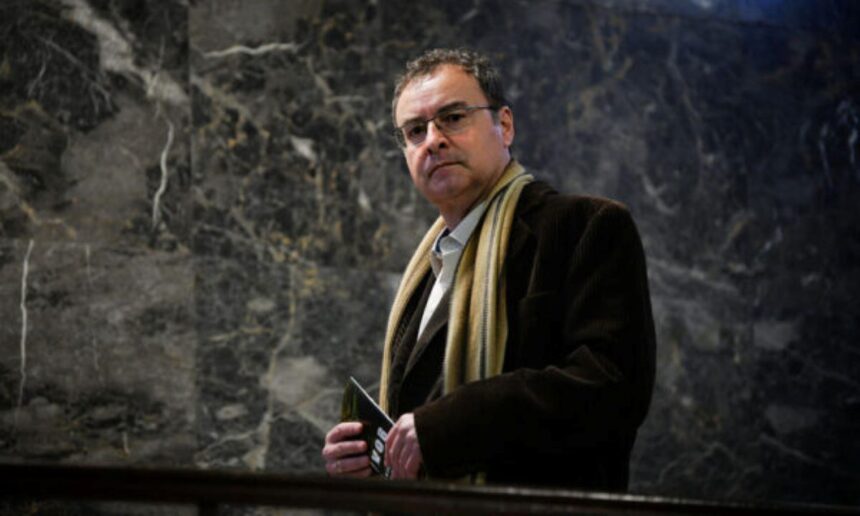
Jovo Bakić, a professor at the University of Belgrade’s Faculty of Philosophy and a parliamentary candidate for Serbia’s student-backed “Students’ List,” has said a future government led by the movement will not recognize Kosovo’s independence but would be willing to negotiate an agreement with Kosovo Albanians aimed at improving living conditions for all communities.
In an interview with Montenegro’s Vijesti, Bakić said Kosovo could become the biggest obstacle to Serbia’s European Union accession process, particularly because of the obligations associated with Chapter 35 of the EU accession negotiations.
Bakić made the remarks three days after the Students’ List won Serbia’s early parliamentary elections on October 25.
Asked whether a new government would revive Serbia’s EU integration process, Bakić expressed confidence that the country could make rapid progress on the rule of law, particularly in Chapters 23 and 24, which cover the judiciary, fundamental rights, justice and security.
However, he warned that negotiations would become more difficult when Kosovo’s status came to the forefront.
“The problem will arise around Kosovo,” Bakić said, arguing that the incoming government could not accept international recognition of Kosovo’s independence.
He said such recognition would contradict Serbia’s Constitution, which the Students’ List has pledged to uphold.
An agreement with Kosovo Albanians, but no recognition
Despite rejecting recognition, Bakić stressed that his position did not rule out dialogue or agreements with Kosovo Albanians.
“We offer Kosovo Albanians an agreement for the benefit of all citizens living there,” he said.
He described improving everyday life for residents as a possible objective, with the benefits extending to both Serbs and Albanians.
Bakić said protecting the position of Kosovo Serbs would be a priority for the incoming government, while adding that Albanians could also benefit from reciprocal arrangements.
However, he described international recognition of Kosovo’s independence as a red line the new government would not cross.
He did not specify what such an agreement would contain, how negotiations would be conducted or how the proposed approach would relate to agreements already reached between Belgrade and Prishtina.
Chapter 35 and the possibility of a referendum
Bakić said Serbia could fulfill many of its EU accession obligations relatively quickly but expressed doubts about whether the same would be possible under Chapter 35, which addresses normalization of relations between Serbia and Kosovo.
He questioned how the chapter’s requirements are formulated and interpreted, suggesting that disagreements over Kosovo could complicate Serbia’s European path.
If the EU made further progress toward membership conditional on decisions concerning Kosovo, Bakić argued that Serbia should first hold an extensive public debate lasting between six months and a year.
During that period, supporters and opponents of EU integration should be able to present their arguments through free media, he said.
He then proposed holding a referendum in which Serbian citizens would decide the country’s future approach to EU membership.
Bakić said the outcome of such a vote should be respected.
European integration alongside ties with Russia
In the interview, Bakić also discussed Serbia’s relations with Montenegro, the fight against organized crime and the foreign policy direction of the prospective government.
He advocated reviving Serbia’s European integration process while maintaining cooperation with Russia, including in the energy sector, and opposed imposing sanctions on Moscow.
His comments suggest that a government led by the Students’ List would seek to pursue EU accession while maintaining existing constitutional positions on Kosovo and preserving relations with Russia.
For Kosovo, the key question is how such a policy would affect the implementation of existing agreements between Belgrade and Prishtina, the normalization process and the future of Serbian institutions in Kosovo.
Bakić did not provide a concrete plan on those issues in the interview.