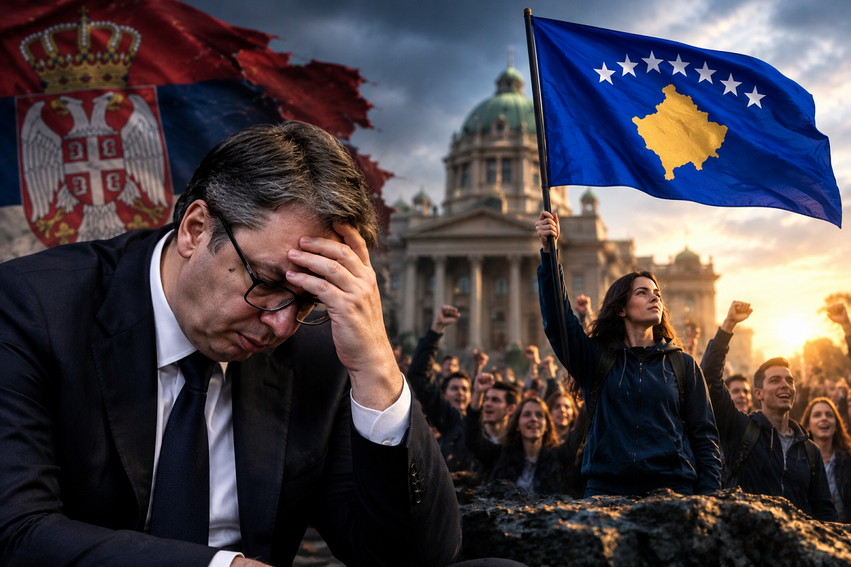
Serbia’s student-backed electoral victory could mark a significant political shift, weakening the influence of nationalist politics and potentially opening the way for a more flexible approach toward Kosovo, according to political analyst and professor Enver Bytyqi.
In an interview with the media, Bytyqi described the result as a rejection of the political legacy of former Serbian president Slobodan Milošević, arguing that the country could move closer to Western institutions under a new generation of political leaders.
He identified the reported departure of the Socialist Party of Serbia (SPS), led by Milošević’s former spokesman Ivica Dačić, from parliament as a particularly significant development.
“The victory of Serbia’s Students’ List in the October 25, 2025, elections is special because it brings an end to the rule of a political class shaped by Milošević’s policies and brings the country closer to the West,” Bytyqi said.
He argued that the emerging political leadership could represent a different political culture from that associated with Aleksandar Vučić and Dačić, although the extent of any policy change remains uncertain.
Bytyqi said the election result reflected a shift in Serbian public opinion and a weakening of hard-line nationalism associated with Milošević’s legacy and the politics of Vojislav Šešelj.
He also argued that the student-backed movement had presented itself in a less confrontational manner during the campaign, emphasizing democratic principles and the use of referendums to express public preferences.
A potentially more flexible approach toward Kosovo
Bytyqi believes a change in government in Belgrade could create conditions for a more flexible approach to relations with Kosovo, although he cautioned that the direction of Serbia’s foreign policy would also depend on wider geopolitical developments.
“I see a softer approach toward Kosovo, and I want to believe that the new government in Belgrade will be more flexible regarding the decisions it will have to make concerning Kosovo,” he said.
According to Bytyqi, Serbia could gradually move closer to Western alliances while seeking to preserve a special relationship with Russia.
He argued that Serbia’s geographical position, surrounded by EU and NATO member states, makes long-term isolation difficult.
“Serbia is geographically surrounded by EU and NATO member states. If the EU and NATO continue to exist and, even better, grow stronger, Belgrade will be compelled to integrate into these two organizations,” he said.
Bytyqi compared the risks of isolation with Albania under former communist leader Enver Hoxha, arguing that Serbia should avoid a similar path.
He added that a new political generation could gradually move away from what he described as nationalist taboos and myths that have shaped Serbian political discourse.
EU and US pressure could revive the dialogue
Bytyqi expects the Kosovo-Serbia dialogue to become a major challenge for both governments, suggesting that international pressure for renewed negotiations could increase following political changes in Serbia.
He referred to calls by the US representative at the UN Security Council for renewed engagement between Prishtina and Belgrade, interpreting them as a possible indication that Washington wants to accelerate efforts to resolve outstanding disputes.
Bytyqi also cited the absence of an explicit reference to the Kosovo-Serbia dialogue in a letter that US President Donald Trump sent to Kosovo President Vjosa Osmani on February 17, 2026, arguing that the issue had previously received less emphasis in Washington’s public messaging.
He believes a new Serbian government could seek to restart negotiations to demonstrate to Brussels and Washington that it represents a more moderate and democratic political approach.
Such a move, he said, could create additional pressure on Kosovo’s government led by Albin Kurti.
“International actors are not interested in political crises continuing in either Kosovo or Serbia. They will want solutions. Without solutions, neither Serbia nor Kosovo can make progress toward the EU,” Bytyqi said.
However, he stressed that renewed dialogue would not necessarily produce a quick settlement.
A final agreement could take years
Bytyqi cautioned against expectations that the dispute between Kosovo and Serbia could be resolved rapidly through negotiations alone.
He argued that both governments would need time to prepare their positions before entering a more intensive phase of dialogue and, eventually, substantive negotiations on a final settlement.
“I do not expect the conflict between Kosovo and Serbia to be resolved simply through dialogue, or for it to be settled so quickly. The process will take its time,” he said.
According to Bytyqi, a period of preparation would likely be followed by intensified diplomatic engagement before genuine negotiations on a comprehensive agreement could begin.
He suggested that a potential resolution might emerge toward the end of the current governments’ mandates or at the beginning of their successors’ terms, arguing that political leaders are often reluctant to take difficult decisions close to elections.
These timelines, however, are his assessment rather than an agreed negotiating schedule.
Bytyqi raises the possibility of Russian recognition
Bytyqi also offered a scenario in which Russia could recognize Kosovo before Serbia, linking the possibility to a hypothetical agreement between Moscow and Western governments over Russia’s claims to Crimea and Donbas.
He said some observers believe Russia is preventing Serbia from recognizing Kosovo, but argued that geopolitical bargaining could theoretically change that calculation.
“There is also the possibility that Russia could recognize Kosovo before Serbia, and then Belgrade, with or without dialogue, would recognize it,” he said.
Bytyqi suggested that such a development could occur if Russia reached an arrangement with Western countries involving recognition of Russian sovereignty over Crimea and Donbas in exchange for a change in Moscow’s position on Kosovo.
This remains a speculative scenario presented by Bytyqi, not an announced policy or an established diplomatic proposal.
Overall, Bytyqi sees Serbia’s electoral developments as a potential turning point that could weaken nationalist politics and create new opportunities for engagement with the West. Whether that shift translates into concrete changes toward Kosovo, however, will depend on the new government’s policies, international developments and the willingness of both sides to pursue a negotiated settlement.