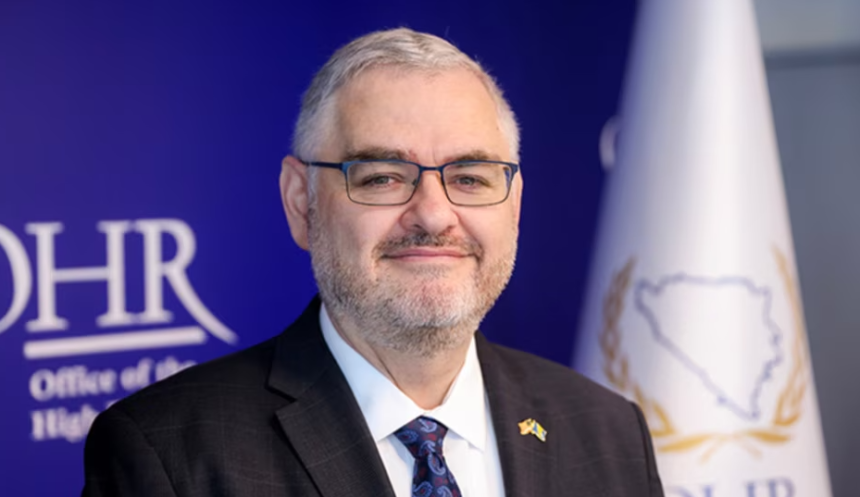
Actions by authorities in Bosnia and Herzegovina’s Republika Srpska entity are gradually pushing it toward de facto separation from the state, as officials bypass national institutions and establish parallel legal and institutional arrangements, according to a report by Acting High Representative Louis Crishock.
The 70th report on the implementation of the Dayton Peace Agreement, covering April 16 to October 15, 2026, is scheduled to be presented to the United Nations Security Council on October 30.
According to the report, blockages within Bosnia and Herzegovina’s state institutions have continued over the past six months, affecting legislative processes, appointments and institutional funding. The report also highlights failures to implement binding decisions issued by state-level judicial institutions and the Constitutional Court of Bosnia and Herzegovina.
“Combined with efforts to bypass state institutions and create separate structures in Republika Srpska, they are reinforcing a scenario of de facto separation,” the report states, according to Radio Free Europe, which obtained a copy of the document.
Crishock warns that these practices weaken state institutions, undermine their ability to fulfill their legal responsibilities and slow Bosnia and Herzegovina’s Euro-Atlantic integration.
The report also states that Republika Srpska’s authorities continued to support the reversal of post-Dayton reforms and suggested the possibility of secession if their political objectives were not achieved.
Ratko Mladić’s Death and the Glorification of War Crimes
The report also addresses the death of convicted war criminal Ratko Mladić on August 27 and the commemorations subsequently held in Serbia and Republika Srpska.
According to the document, some gatherings featured praise for Mladić, while crimes for which he was convicted were denied or minimized. The participation of Republika Srpska officials in these events raised concerns about the rule of law and reconciliation.
“At public commemorations and memorial events in Banja Luka and other locations in Republika Srpska, speakers praised Mladić and denied or minimized the crimes for which he was convicted,” the report states.
Mladić, the former commander of the Army of Republika Srpska, was sentenced to life imprisonment by the International Criminal Tribunal for the former Yugoslavia for genocide, crimes against humanity and war crimes committed during the 1992–1995 Bosnian war.
Elections and Institutional Challenges
The report also reviews Bosnia and Herzegovina’s general elections held on October 4, the first nationwide elections to use electronic voter identification and ballot-scanning technology.
The technology contributed to greater transparency and faster publication of results, according to the report. However, preliminary results indicated the continued dominance of ethnically based political parties and pointed to a potentially prolonged and complicated process of government formation.
The United Nations Security Council will hold its regular semiannual session on Bosnia and Herzegovina on October 30. It will be the first such meeting since Christian Schmidt resigned as High Representative.
In the meantime, the Office of the High Representative’s responsibilities are being carried out by his deputy, Louis Crishock.
The report places renewed emphasis on the challenges facing Bosnia and Herzegovina’s state institutions, warning that the creation of parallel structures and the failure to implement judicial decisions risk further undermining the country’s constitutional order and European integration prospects.