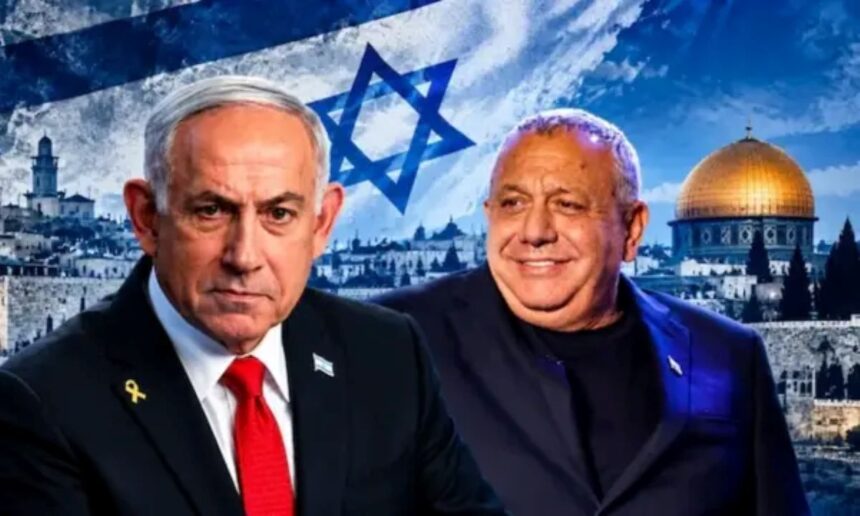
Israel appears to be heading toward another political deadlock after Tuesday’s election, with neither Prime Minister Benjamin Netanyahu’s coalition nor the bloc led by his main rival, Gadi Eisenkot, seemingly able to secure the majority needed to form a government.
With nearly 90 percent of the votes counted, one of the main political camps may have to abandon key campaign promises to break the impasse. As a result, fresh elections are emerging as a possible outcome.
According to an analysis published by the BBC, four main scenarios could determine Israel’s political future.
1. A National Unity Government Led by Netanyahu
The first possibility is that Netanyahu persuades Eisenkot to join a national unity government.
Such an arrangement would require Eisenkot to abandon his central campaign promise: removing Netanyahu from power. Throughout the campaign, Eisenkot presented himself as the main alternative to the incumbent prime minister.
At his election headquarters, Eisenkot called on Netanyahu to “announce his retirement from political life today,” accusing him of fostering a culture of lies, division and incitement.
However, his remarks came before one of the main exit polls was revised. Although the initial projections had placed Eisenkot’s bloc ahead, Netanyahu subsequently overtook him in the updated figures.
Netanyahu could seek to bring Eisenkot’s Yashar party into a unity government with his Likud party, potentially abandoning his far-right and ultra-Orthodox partners in the process.
Yet Netanyahu signaled that he preferred to preserve his existing political alliance. At Likud headquarters, he thanked his “loyal partners” and called for the formation of a “strong right-wing government.”
A renewed escalation of the conflict with Iran could nevertheless increase pressure on political leaders to set aside their differences and form a broad-based government.
Israeli and U.S. media had reported before the election that Netanyahu was advocating further strikes against Iran and had pressured U.S. President Donald Trump to approve American involvement. Critics of Netanyahu could interpret a new military escalation as an attempt to strengthen his political position, although such an interpretation would remain a political allegation rather than an established fact.
2. An Eisenkot Government Backed by Arab Parties
The second scenario would involve Eisenkot forming an opposition government with the support of Arab political parties, potentially marking a significant departure from Israel’s established political arrangements.
Only one independent Arab party has previously been a formal member of an Israeli governing coalition, in 2021, and that alliance lasted only a short time.
Eisenkot and almost all the other Jewish parties in his bloc have ruled out forming a government with Arab parties. Nevertheless, cooperation with them currently appears to be the only route through which the opposition could potentially assemble a parliamentary majority.
Arab parties have emerged as one of the election’s biggest surprises. Projections suggest they could secure a record 19 seats, reflecting increased participation among Arab voters, who account for roughly one-fifth of Israel’s population and often identify as Palestinian citizens of Israel.
Many Arab voters had previously boycotted elections, arguing that participation legitimized a political system in which they believed they were treated as second-class citizens. Turnout increased significantly on Tuesday, driven in part by opposition to what the source describes as Israel’s most right-wing government in history.
The United Arab List, projected to win approximately seven seats, has indicated that it would be willing to join an opposition government. The Joint List, projected to win 12 seats, has said it would support such a government in parliament without necessarily joining it.
At present, Yair Golan of the Democrats is reportedly the only Jewish political leader openly supporting this scenario.
Any such arrangement would be fragile, particularly over issues involving Gaza and the occupied West Bank. The resistance among most Jewish parties to including Arab parties in government also highlights the deep political and social divisions within Israel.
3. Netanyahu Secures a Majority Through Opposition Defections
A third possibility is that Netanyahu persuades right-wing parties within Eisenkot’s bloc to abandon the opposition and join his coalition.
The two most likely candidates for such a move are Naftali Bennett, co-leader of the Beyachad alliance, and Avigdor Lieberman, leader of Yisrael Beiteinu.
Both are right-wing politicians who take a hard line on security and share some political positions with Netanyahu.
However, both called for Netanyahu’s departure during the campaign and demanded mandatory military service for ultra-Orthodox Jewish men.
Those positions put them at odds with the two ultra-Orthodox parties currently supporting Netanyahu’s government, making cooperation difficult.
Some analysts believe Bennett’s and Lieberman’s parties could replace Netanyahu’s ultra-Orthodox partners. But current seat projections suggest that such a coalition would probably still fall short of the majority required to govern.
4. New Elections
If none of the first three scenarios succeeds, Israel could head toward another election.
Such an outcome could indirectly benefit Netanyahu. He would remain prime minister in a caretaker capacity until a new government was formed and could seek to improve his position in another vote.
Some analysts believe Arab voter turnout might not reach the same level again, particularly if the record number of seats won by Arab parties fails to produce meaningful political change. Disappointment could discourage some voters, while the prospect of another election could mobilize more right-wing supporters.
Netanyahu may also be counting on the possibility that approximately 70,000 Israelis who traveled from abroad to vote against him would not return in similarly large numbers for another election.
In addition, some right-wing parties that failed to cross Israel’s 3.25 percent electoral threshold could perform worse or decide not to run, potentially benefiting Likud and its allies.
Israel has already experienced repeated electoral deadlocks. Between 2019 and 2022, the country held five elections as Netanyahu and his rivals repeatedly failed to agree on a governing coalition.
The current impasse raises the prospect of another prolonged struggle over the country’s political direction, with the outcome depending on whether rival parties are willing to compromise on the very positions that defined their campaigns.