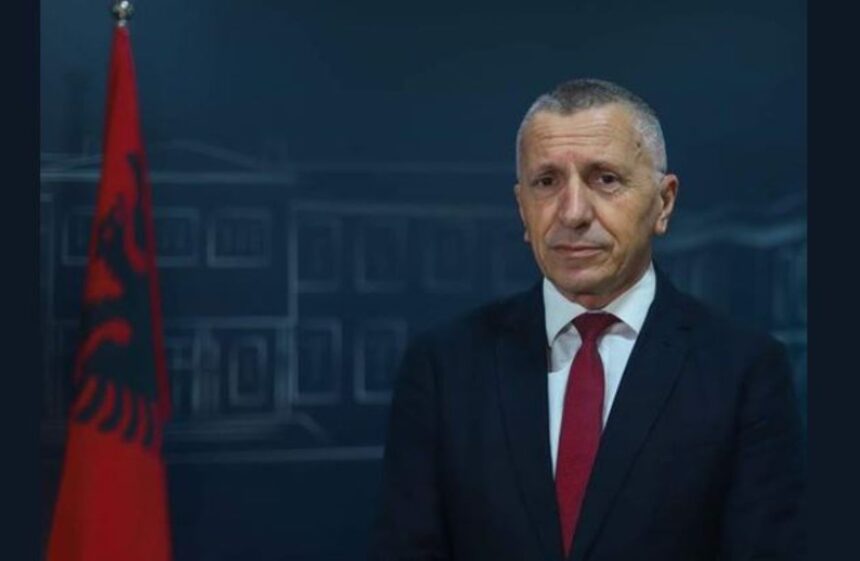
Albanian MP Shaip Kamberi has said he is open to cooperation with Serbia’s student-backed political movement but insists that any partnership must include concrete commitments to address the rights and demands of Albanians in the Preševo Valley.
In an interview with Deutsche Welle following Serbia’s parliamentary elections and the reported victory of the Students’ List, Kamberi said Albanians must be treated as equal citizens and that political cooperation should be measured by tangible results rather than promises or government appointments.
“It’s time for Albanians to be treated as equal citizens,” Kamberi said, emphasizing that his priority is securing substantive improvements in the position of the Albanian community in Serbia.
Two seats and the limits of electoral unity
The coalition representing Albanians in the Preševo Valley won two seats in the Serbian Parliament, coming close to securing a third, Kamberi said.
He described the result as sufficient to continue representing Albanian interests in Belgrade but acknowledged that the coalition had the potential to achieve more.
The decision by eight Albanian political parties to contest the election on a joint list was an important political step, he said, demonstrating that they could overcome internal differences when common interests were at stake.
Kamberi added that stronger voter mobilization and greater engagement with Albanians living outside the Preševo Valley could have improved the result. He also pointed to the consequences of the administrative practice known as the “passivization” of residential addresses, which he said had affected a significant number of Albanian residents and limited their participation in the elections.
He argued that the unity achieved during the election campaign should develop into a lasting political process rather than remain a temporary electoral arrangement.
Student movement creates an opportunity, but not a guarantee
Kamberi said the political changes in Serbia were important for Albanians because decisions made by Serbian institutions directly affect their daily lives.
He welcomed demands for greater democracy, institutional accountability, the rule of law and closer integration with the European Union, particularly if these developments help Serbia move away from the nationalist political platforms of the 1990s.
However, he cautioned that a more democratic Serbia would not automatically resolve the specific problems faced by its Albanian minority.
For Kamberi, meaningful change would have to be reflected in education, employment, fair representation in state institutions, the official use of the Albanian language and national symbols, recognition of diplomas and the elimination of discriminatory practices.
He said the government in Belgrade had continued to ignore demands raised under four signed agreements concerning the Albanian community.
“The change will become tangible when equality no longer remains only a constitutional principle, but is visible in practice,” he said.
Kamberi also warned against assuming that the weakening of President Aleksandar Vučić’s political camp necessarily meant a completed political transformation.
During Serbia’s 36 years of multiparty politics, he said, different political forces had governed the country without demonstrating consistently affirmative policies toward national minorities.
The crucial question, he argued, was not simply who would govern Serbia, but whether the institutions would change how they exercise power and apply equal standards to all citizens.
Seven-point plan at the center of potential cooperation
Kamberi said he would not rule out cooperation with the Students’ List, but stressed that its willingness to engage with the specific demands of Albanians would be decisive.
Statements about building a democratic and equal Serbia were a starting point, he said, but would need to be followed by concrete policies.
He identified the Albanian community’s Seven-Point Plan as the main framework for potential discussions with the new political forces. Adopted in March 2013, the plan outlines demands concerning institutional discrimination, the passivization of residential addresses, fair representation in state institutions, education, the official use of the Albanian language and script, recognition of diplomas and economic development in the Preševo Valley.
Kamberi said the plan could provide a basis for serious dialogue with the next Serbian government and any political force committed to democratic reform.
He also stressed that cooperation must go beyond general statements or participation in demonstrations. It would require direct communication, recognition of the community’s problems and a willingness to negotiate practical solutions.
“Coexistence does not require everyone to think alike. It requires that differences do not become inequality and that no one’s rights depend on their national identity,” he said.
Kamberi added that Serbian institutions had for decades sought to divide Albanians into different political categories, portraying some as “honest Albanians” and others as “separatists.” He said the unity demonstrated by the eight-party coalition showed that political differences did not prevent Albanians from working together on shared priorities.
Address passivization, representation and education
Kamberi outlined several urgent steps that he believes Serbia’s next government should take to improve relations with the Albanian community.
First, he called for a review of the passivization of residential addresses, a practice that he said raises serious concerns about citizens’ rights and their ability to access public services and exercise political rights.
He urged greater transparency, individual examination of cases and effective procedures for appeals and corrections.
Second, he called for fair representation of Albanians in state institutions, particularly the police, judiciary, public administration and public services.
He also highlighted the need to resolve barriers in education, including the recognition of diplomas obtained in Kosovo and access to textbooks in Albanian.
The official use of the Albanian language and script, as well as the use of national symbols in accordance with applicable law, should be treated as guaranteed rights rather than political favors, he said.
Finally, Kamberi called for a dedicated development fund for the Preševo Valley to support investment, infrastructure, job creation and opportunities for young people to remain in their hometowns.
He said these measures would help restore confidence in state institutions, arguing that trust could not be built through declarations alone.
Kosovo and regional relations
Kamberi also said Serbia’s approach to Kosovo and Albanians across the region would be an important test of whether the Students’ List genuinely sought a new political direction.
He argued that stable relations with neighboring countries could not be built on denying political realities, relying on national stereotypes or avoiding difficult issues.
Kosovo, he said, should be treated as a partner with which Serbia needs to establish normal relations through dialogue, mutual respect and implementation of existing agreements.
At the same time, Albanians living in Serbia should be recognized as citizens with full rights and legitimate demands for equality.
Kamberi said the democratic standards advocated by the student movement should also apply to the way Serbia treats Albanians and other non-majority communities.
“You cannot demand democratic standards for yourself and remain indifferent to their absence for others,” he said, calling for an end to what he described as a policy of double standards.
His message to the Students’ List was that any vision of a democratic Serbia with better regional relations must explicitly include the rights and concerns of Albanians in the Preševo Valley.
“We are not interested in positions without real influence”
Asked whether he would consider joining Serbia’s government or another state institution if offered a position, Kamberi said he had never entered politics to secure government office.
During his three parliamentary terms, he said, his focus had been representing Albanians and raising their concerns within Serbia’s institutions, even when those demands ran counter to the parliamentary majority.
He stressed that the question was not whether Albanian representatives would accept a government position, but what political and institutional changes would make such participation meaningful.
Kamberi warned that appointing Albanian representatives without giving them genuine influence over decision-making could turn minority participation into a symbolic exercise.
He pointed to other minority political lists that, in his view, had served as decoration for Vučić’s government without securing substantive improvements for their communities.
“Our priority is the realization of the political demands of Albanians, as outlined in the Seven-Point Plan, not securing government positions,” he said.
Kamberi reiterated that he remained open to dialogue with political forces seeking democratic change, but insisted that any partnership must be based on a program, mutual responsibility and a serious commitment to addressing Albanian demands.
“Government positions do not tempt us,” he said, adding that decades of political engagement had demonstrated his commitment to these principles.