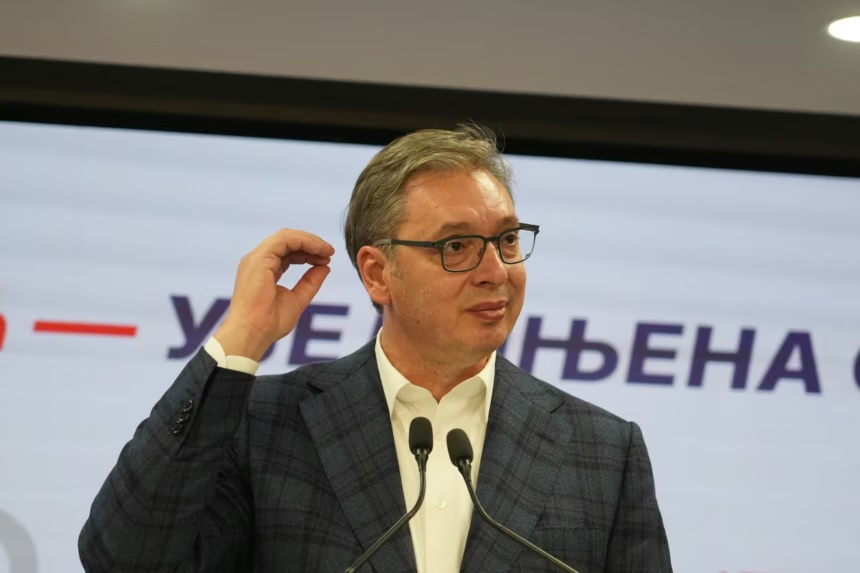
Former Serbian President Aleksandar Vučić has warned that supporters of the Serbian Progressive Party (SNS) may have to “self-organize” if state institutions fail to protect people who hold different political views, prompting concerns that the statement could encourage informal groups to exert pressure on political opponents.
In remarks defending the pro-government newspaper Informer, Vučić said his supporters would be forced to make their own decisions if authorities failed to respond to what he described as violence, beatings, intimidation and attacks against people with opposing views.
“If the state does not react, we will have to make our own decisions in the coming days,” Vučić said. “If the authorities do nothing while the terror against people who think differently continues, we will be forced to self-organize. They should know that they will bear full responsibility for this.”
The statement comes as Serbia faces a political transition following extraordinary parliamentary elections in which the list led by Vučić was defeated, according to the report by Nova.rs. Although Vučić has left the presidency, many senior officials in the country’s security institutions remain in positions they held under his leadership.
Who controls the police?
Ivica Dačić, Vučić’s longtime coalition partner, remains at the head of the Interior Ministry. The police leadership includes Director Dragan Vasiljević, Criminal Police Directorate chief Marko Kričak, Gendarmerie commander Radoslav Repac and Special Anti-Terrorist Unit commander Igor Žmirić.
The report questions why Vučić would threaten to organize supporters outside state institutions when the police and other security bodies remain under the leadership of officials appointed during his political tenure.
It also recalls the presence of groups of Vučić loyalists in Belgrade’s Pionirski Park and around the Serbian presidency during the past two years, suggesting that the prospect of informal, potentially coercive groups is a central concern behind his remarks.
Rajić: A message aimed at loyal supporters
Lawyer Jovan Rajić told Nova.rs that Vučić’s statement was primarily intended to reassure his most loyal supporters that he would not abandon them as the political situation changes.
“He is sending a message that he will not allow anything to happen to those who have remained most loyal to him,” Rajić said.
However, Rajić argued that Vučić would have little ability to protect supporters from the application of the law if state institutions began functioning independently.
He also suggested that the statement could be aimed at people within the party who might otherwise distance themselves from its leadership or disclose alleged wrongdoing.
Rajić described Vučić as being in unfamiliar political circumstances and attempting to limit the damage to his party. He interpreted the former president’s announcement that he would not participate in the next presidential election as an indication that Vučić was aware of the risks facing the SNS.
Rajić warned that any attempt to mobilize supporters into para-police or paramilitary groups would need to be prevented by the competent authorities.
Bursać: An attempt to prevent the party from falling apart
Political scientist Dejan Bursać also interpreted Vučić’s statement as an effort to preserve unity within the SNS amid uncertainty about the party’s future.
“People in the Serbian Progressive Party are certainly frightened now, and with reason,” Bursać told Nova.rs.
He argued that some party members could be concerned about potential legal scrutiny over their conduct while in power. His comments referred to alleged abuses, pressure on political opponents and other actions that could come under investigation; these remain allegations rather than established findings against individual party members.
Bursać said Vučić was trying to maintain the party’s cohesion and prevent supporters from abandoning it as the prospect of investigations and a transfer of power grows.
“This is all an attempt to control the damage in this initial period,” he said, adding that the party’s influence could gradually weaken as the political transition progresses.
According to Bursać, parties that rely heavily on patronage and personal loyalty can face internal fragmentation when they lose access to state power and the resources that sustain their networks.
He cited developments in Hungary as a comparison, arguing that even an established ruling party can lose support after a period of political dominance.
An uncertain transition
The central question raised by Vučić’s remarks is what he means by “self-organization” and whether the statement is intended solely as political rhetoric or could lead to the mobilization of informal groups.
Rajić and Bursać both view the warning primarily as an attempt to reassure loyalists and prevent defections within the SNS. At the same time, the reference to organizing outside state institutions has raised concerns about the possibility of intimidation or political violence.
Serbia’s transition will depend in part on whether state institutions can operate independently of party interests and whether any allegations of misconduct are investigated through lawful procedures.
For now, Vučić’s statement highlights the uncertainty surrounding the SNS’s position following its reported electoral defeat and the challenge of maintaining party loyalty as control of state institutions becomes increasingly contested.