Serbia’s student-backed electoral list, which secured a parliamentary majority in the October 25 elections, has demanded the immediate resignations of senior police and intelligence officials, the president of the Constitutional Court and top prosecutors in Belgrade, while calling for renewed investigations into several high-profile cases and reviews of major public spending projects.
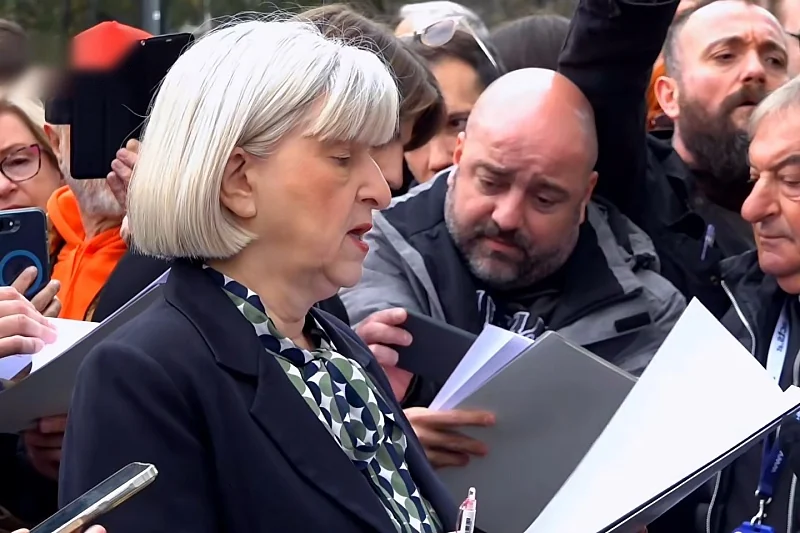
The demands were announced at a press conference in Pionirski Park in Belgrade on Thursday, marking the students’ first public appearance since the election. The event took place at the site of the former pro-government tent encampment known as Ćacilend, which was dismantled on election night after President Aleksandar Vučić acknowledged defeat.
“Citizens gave a clear mandate in the elections for the rule of law, equality before the law and the liberation of institutions. We are beginning to implement that mandate immediately, without waiting for the formation of a government,” the students said, according to Serbian media reports.
Call for whistleblowers inside state institutions
The student movement urged employees in state institutions, courts, banks, public companies and media organizations to report any suspected destruction of documents, suspicious payments, contracts or orders issued by the outgoing authorities.
One student said people working within institutions had already begun contacting the movement with information, including current and former ministers, judges, prosecutors and managers of state-owned companies.
The students announced a dedicated email address, [email protected], for receiving reports. They said whistleblowers were protected by Serbia’s whistleblower protection law and by the student movement.
They also called on public employees to prevent potential abuses during the transition of power.
Demands involving RTS, the media regulator and Telekom Srbija
Students’ List representative Mirjana Nikolić outlined the movement’s specific demands, beginning with public broadcaster Radio Television of Serbia (RTS), the Electronic Media Regulatory Authority (REM) and telecommunications company Telekom Srbija.
Regarding RTS, the students said they had previously demanded the resignations of general director Manja Grčić and news editor Bojana Mladenović, claiming those demands had been met. They are now calling for the resignation of deputy general director Dejan Jovanović and the establishment of an interim management team agreed upon with representative trade unions.
They also want four members of REM’s council to explain why they voted against including pro-government broadcaster Informer in election monitoring and have called for publication of the minutes from that vote.
The movement further demanded that REM immediately initiate proceedings over what it described as repeated insults and hate speech on Informer TV. The students expect a response within seven days and said their parliamentary representatives would seek to complete the regulator’s council, which is supposed to have nine members.
Telekom Srbija chief executive Vladimir Lučić was also asked to submit an immediate and unconditional resignation.
“Money belonging to a state-monopoly company must not be a private fund for financing political propaganda and enriching privileged individuals,” the students said.
They called for a review of spending, the suspension of what they described as unjustified payments and proceedings against anyone found responsible for abuses. They also argued that Telekom Srbija should operate as a telecommunications distributor rather than exercise editorial influence over the country’s media landscape.
Resignations demanded from police and intelligence chiefs
The student-backed list called for the resignation of Police Director Dragan Vasiljević, accusing him of violating professional and ethical standards.
It also demanded the dismissal of Marko Kričak, Repac and Igor Žmirić, along with other police officials whom the students accuse of breaking the law. They called for the reinstatement of officers who they claim were transferred or dismissed for political reasons.
The movement also demanded the immediate resignation of Vladimir Orlić, director of Serbia’s Security Intelligence Agency (BIA), arguing that the agency had operated as a partisan security service.
A similar demand was made of the director of the Military Security Agency (VBA). The students called on the agency’s personnel to stop what they described as pressure on officials and journalists and to return to their legally defined duties.
The accusations reflect the students’ broader demand for security institutions to operate independently of political parties. The claims and allegations made at the press conference have not, in themselves, established individual wrongdoing.
Constitutional Court and Belgrade prosecutors targeted
The students also called for the resignation of Serbian Constitutional Court President Vladan Petrov, accusing him of bias in favor of Vučić’s government and of openly supporting the Serbian Progressive Party (SNS) during the election campaign.
They argued that Petrov had acted more like an SNS spokesperson than an impartial judge responsible for protecting constitutional and legal order.
The movement further demanded the resignations of Nenad Stefanović, chief public prosecutor at the Higher Public Prosecutor’s Office in Belgrade, and his deputy, Miodrag Marković.
The students accused Stefanović of repeatedly violating the principle of impartiality and undermining public confidence through what they described as selective prosecution.
Renewed investigations into major cases
One of the most consequential parts of the announcement concerned calls to reopen or urgently resume investigations into several long-running cases that have generated public controversy in Serbia.
The students named the Krušik arms factory affair, the Doljevac toll-booth crash, the murder of Kosovo Serb politician Oliver Ivanović, the demolition in Belgrade’s Savamala district and the military helicopter crash.
They also demanded scrutiny of financial flows and public spending linked to major infrastructure and development projects, including EXPO, Belgrade Waterfront, stadiums in Leskovac and Loznica, the Miloš Veliki highway, Corridor 10 and Rio Tinto, as well as public spending during the COVID-19 pandemic.
The movement said all contracts and public procurement procedures would be reviewed in accordance with the law.
It also called on Serbia’s Republic Electoral Commission (RIK) to publish the final election results as soon as possible so that the new parliament could be constituted. In addition, it demanded an urgent inventory of the existing situation in ministries, public companies and state funds.
Students reject claims of political revenge
The students stressed that their initiative was not intended as retaliation against the outgoing authorities but as an effort to restore public institutions to citizens.
“We have not come to take revenge, but to return institutions to the citizens,” they said, adding that their demands concerned legality, professionalism and accountability rather than political loyalty.
“Anyone who has broken the law must be held accountable, regardless of the position they hold or have held,” the students said.
They concluded the press conference with the message: “Change begins immediately. Institutions belong to the citizens, and the law must apply to everyone.”
Election results and transition of power
According to the latest figures cited from RIK, with 97.56 percent of polling stations processed, the student-backed list “Students Are Winning” had secured 52.71 percent of the vote and 140 parliamentary seats.
The list “Aleksandar Vučić – United Serbia” received 39.17 percent and 104 seats.
The formation of a new government has nevertheless been delayed because voting is scheduled to be repeated at 53 polling stations on November 1. Although the rerun is not expected to change the overall winner, it postpones the announcement of the final results.
The students’ announcement signals an ambitious attempt to place institutional reform, accountability and scrutiny of public spending at the center of Serbia’s political transition. Whether the demands can be implemented will depend on the formal transfer of power, the new parliament’s actions and the legal procedures governing appointments, dismissals and investigations.