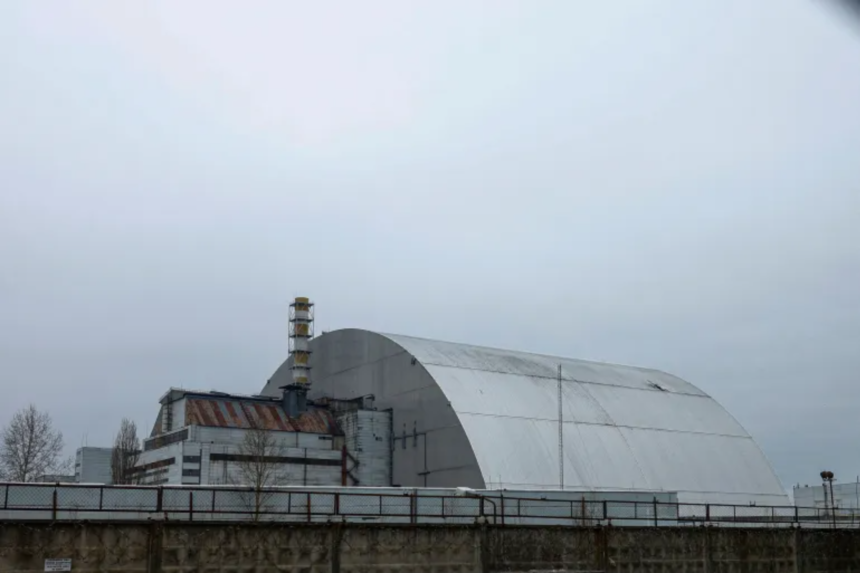
A protective shield over the Chernobyl nuclear reactor in Ukraine can no longer perform its primary function following a drone strike earlier this year, according to the International Atomic Energy Agency (IAEA).
Inspectors found that the massive structure, installed over the reactor after the 1986 disaster, has lost its key operational capacity, including its “isolation capability.”
In February, Ukraine accused Russia of targeting the plant — a claim the Kremlin has denied.
The UN’s nuclear watchdog stated that repairs are “essential” to “prevent further degradation” of the shelter.
However, environmental expert Jim Smith told the BBC that “there is no reason to panic.”
He noted that the risk is “low,” as contaminated dust remains contained by a thick concrete “sarcophagus,” covered by additional layers of shielding.
Following the catastrophic explosion in 1986, large amounts of radioactive material were released into the atmosphere, triggering a health emergency across much of Europe.
In response, the Soviet Union constructed a stone sarcophagus over the reactor.
That structure carried a 30-year lifespan, prompting the installation of a new shield designed to prevent radioactive leakage for at least the next century.
The UN agency said a team conducted an inspection last week after “substantial damage” caused by the drone attack, which sparked a fire on the outer steel shell.
Inspectors noted that no irreversible damage was done to the structure or its monitoring systems and that some roof repairs have already been completed.
Still, IAEA chief Rafael Grossi warned that “timely restoration remains essential to prevent degradation and ensure long-term nuclear safety.”
Since early December, the UN agency has been assessing Ukraine’s energy infrastructure as the country continues to defend itself amid ongoing Russian aggression, Radio Free Europe/Radio Liberty reports.
Overnight, Russia launched airstrikes on the industrial city of Kremenchuk in central Ukraine.
In addition to Chernobyl, the IAEA has inspected electrical substations crucial for nuclear safety.
“These facilities are absolutely essential to ensure the electrical power needed for reactor cooling and other safety systems. They are also necessary for distributing electricity to households and industry,” Grossi added.
The war in Ukraine began on February 24, 2022.
Russian President Vladimir Putin describes it as a “special military operation” aimed at demilitarizing Ukraine.
Western nations have responded with sweeping sanctions on the Russian economy.
The conflict has resulted in thousands of deaths and the displacement of millions.