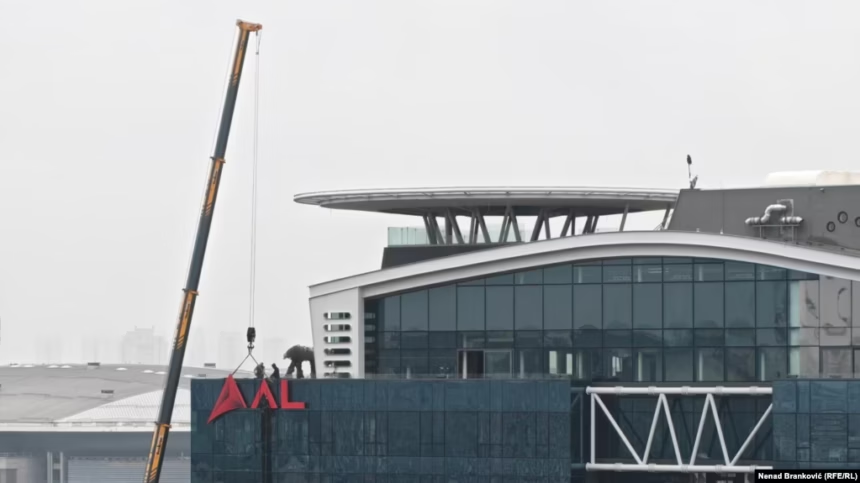
Serbia’s Alta Bank entered bankruptcy on November 3, just one day after its owner, businessman Davor Macura, was arrested on suspicion of withdrawing hundreds of millions of euros in cash from the bank’s vault.
The bank lost its operating license less than a week after the Serbian Progressive Party (SNS), led by Aleksandar Vučić, lost power in parliamentary elections, ending its 14-year period in government.
Macura had been publicly portrayed as a businessman close to the ruling party, while Alta Bank’s rapid expansion was accompanied by growing cooperation with state-owned companies and public institutions.
Radio Free Europe (RFE) found that more than 40 public enterprises and dozens of other state-owned companies held accounts at Alta Bank.
The bank had also attracted scrutiny from European institutions over concerns about the origin of its capital and possible money laundering. In October, a U.S. congressman called for sanctions against Macura.
Economist Goran Radosavljević told RFE that the bank’s collapse raised questions about the role of Serbia’s central bank, arguing that either the deterioration happened extremely quickly or regulators had known about the situation but failed to act earlier because of their dependence on the government.
The rise and fall of Alta Bank
Alta Bank was established under its current name in 2020, when a company owned by Macura acquired the Serbian state’s stake in JUBMES Bank, which had specialized in international financial transactions.
Through subsequent share purchases, Macura’s Alta Group became the bank’s sole owner.
In the years that followed, European institutions raised questions about the origin of the bank’s capital and possible money-laundering activities. Alta denied allegations of wrongdoing.
Economist Aleksandar Stevanović told RFE that the bank’s rapid growth, unusually high liquidity and large cash holdings should have raised concerns among regulators.
“Excessive liquidity and holding enormous amounts of cash should have set off alarm bells. That is completely unusual for a bank,” he said.
According to its latest financial report, submitted to the National Bank of Serbia (NBS) in June 2026, Alta Bank had total assets of approximately €1.82 billion.
Its balance sheet had grown by €170 million in the first six months of 2026 compared with the end of the previous year. Between the end of 2024 and the end of 2025, the bank’s total assets had increased by 60 percent.
Interest and commission income, funds held with the central bank, loans and deposits had also increased.
Radosavljević said regulators should be held accountable for failing to identify and address the bank’s deteriorating financial position.
The National Bank of Serbia has been headed by Jorgovanka Tabaković, a member of the SNS, since 2012. She had not publicly commented on Alta Bank’s collapse or the election result at the time of RFE’s report.
On October 31, the NBS announced that the bank’s financial position had deteriorated significantly and that depositors’ interests were at risk.
Four NBS deputy governors said that they had only learned of the bank’s actual condition during an emergency meeting on the evening of October 30, adding that the situation had differed dramatically from the reports previously submitted to them.
Stevanović questioned the timing of the decision, saying he was convinced the bank would not have been shut down if the election results had been different. That was his assessment, not an established finding.
Suspicions that money was transferred abroad
The Organized Crime Prosecutor’s Office requested information from the NBS about all transactions, currency conversions and transfers of money from Alta Bank accounts to foreign destinations.
The central bank supplied information covering transactions through September 20. In its response, it said that data for the period after that date could be provided only after November 4.
Radosavljević argued that if large sums had been withdrawn or transferred following the election, questions would have to be asked about who had authorized the transactions and whether regulators had intervened.
Investigators are examining whether money was illegally transferred abroad before the bank lost its license. If unlawful transfers are established, the possibility of recovering the funds will depend on where the money ended up.
Stevanović suggested that some of the funds might have been transferred to countries outside the international financial system or previously associated with illicit financial activity in Serbia. This remains an assessment, not a confirmed finding.
Macura was arrested on November 2 on suspicion of withdrawing approximately €383 million in cash from Alta Bank’s vault.
He has not been convicted, and the allegations remain subject to investigation and judicial proceedings.
Cooperation with public enterprises
Alta Bank’s expansion was accompanied by an increasingly significant role in handling payments for public and state-owned companies.
In mid-2025, residents of Belgrade were instructed to stop paying electricity bills into the account of the state-owned power company Elektroprivreda Srbije (EPS) held with the Treasury Administration and instead use the company’s account at Alta Bank.
EPS said at the time that Alta was one of several commercial banks with which it maintained a successful business relationship. The contracts detailing the arrangement were not made public.
Radosavljević said redirecting EPS payments to Alta had increased the bank’s liquidity and strengthened its position in Serbia’s financial system.
Two years earlier, Alta had begun processing electronic electricity bill payments through EPS’s “Uvid u račun” application.
Following the withdrawal of the bank’s license, EPS announced that the application would temporarily become unavailable and introduced new payment instructions for customers.
EPS said its overall operations were not at risk and that it had not kept the money collected from electricity bills at Alta Bank. According to the company, less than 0.5 percent of its total monthly electricity-billing revenue was held there when the license was revoked.
In a statement on November 3, EPS said it would seek to recover those funds through the bankruptcy proceedings. It added that it maintained accounts at nine other banks and conducted most of its payment transactions through the state-owned Postal Savings Bank.
Other public enterprises, including Belgrade Parking Service and Novi Sad’s Informatika, had also directed citizens to make certain housing and utility payments through accounts held at Alta Bank.
More than 40 public enterprises had accounts at Alta
RFE identified more than 40 public enterprises and dozens of state-owned companies that held accounts at Alta Bank.
They included some of Serbia’s largest companies and institutions:
- Oil company Naftna Industrija Srbije (NIS), which has majority Russian ownership and is subject to U.S. sanctions.
- Postal company Pošta Srbije.
- State arms-trading company Jugoimport.
- Telekom Srbija.
- EXPO.
- Srbijašume.
- Transportgas Srbija.
- State Lottery of Serbia.
- Nikola Tesla Airport.
Telekom Srbija told RFE that its operations were not affected, that it had not conducted payment transactions through Alta Bank and that its deposits there were below the insured threshold of €50,000.
RFE also reported, citing unofficial information, that NIS’s operations were not at risk.
Accounts were also held by 13 direct budget beneficiaries, including the Ministry of Agriculture, the Provincial Secretariat for Finance and the cities of Belgrade, Leskovac, Vranje, Prokuplje and Bor, as well as several municipal authorities.
The Serbian Orthodox Church was also among the account holders.
It was not known how much money these institutions and companies had held at the bank when access to its accounts was restricted.
At the end of 2025, Alta Bank had approximately 66,000 clients, including around 56,000 individuals and 10,000 businesses. A year earlier, it had approximately 47,000 clients.
Customers whose deposits exceeded the insured limit of €50,000 will have to seek recovery of the remaining amounts through the bankruptcy proceedings.
U.S. sanctions request and money-laundering concerns
Macura was among four businessmen close to Serbia’s former ruling establishment named in a request for U.S. sanctions.
On October 14, Republican Congressman Joe Wilson sent a letter to U.S. Secretary of State Marco Rubio requesting that Macura be barred from traveling to the United States and accessing the American financial system.
In the letter, seen by RFE, Wilson alleged that Alta Bank had been involved in activities connected to money laundering.
Alta Bank rejected the allegations as false.
Macura had also come under scrutiny from the European Central Bank two years earlier over concerns about anti-money-laundering controls and questions about the origin of his capital.
The Financial Times reported in 2024 that the ECB had spent months examining Macura’s Alta Pay and its acquisition, together with Diplomat Pay, of a stake in Austria’s Addiko Bank. Alta Pay said at the time that it was unaware of such an investigation.
Macura also attracted attention in October 2026 when he was turned back at Podgorica Airport and denied entry into Montenegro.
His company said he had not been given an explanation for the decision. A border police record reportedly cited the protection of national or internal security.
Who is Davor Macura?
Macura began his business career in 2008 as the owner of a currency exchange office in Belgrade’s Zemun district.
Six years later, he established Alta d.o.o. with initial capital of approximately €9.
The company gradually expanded from currency exchange services into payment processing. In 2019, it changed its name to Alta Pay Group, and in 2025 it began operating as Alta Group, with Macura as its sole owner.
According to publicly available data from Serbia’s Business Registers Agency, the company’s capital had increased to approximately €195 million by the time of RFE’s report.
Macura now holds ownership stakes in more than 10 companies, with interests spanning banking, real estate and retail, as well as business operations across the region.
Alta’s operations across the region
Alta expanded beyond Serbia by acquiring a bank and an insurance company in North Macedonia.
After Serbia’s central bank revoked Alta Bank’s operating license, the National Bank of North Macedonia placed Alta Bank in Bitola under temporary administration and restricted clients’ access to their funds.
In Montenegro, Alta did not operate as a conventional bank, but its subsidiary, Alta Pay Podgorica, provided payment services and money transfers. The Central Bank of Montenegro revoked the company’s authorization on November 1.
The consequences of Alta Bank’s collapse therefore extended beyond Serbia, affecting its regional financial operations and customers.
Controversial property and construction projects
Macura also owned the construction company Danica Park, which was shut down in 2024.
The company had owned plots in Belgrade’s wealthy Dedinje neighborhood that are now associated with properties linked to Zvonko Veselinović and Milan Radoičić.
Both men are subject to international sanctions over allegations of organized crime. Radoičić is also wanted internationally in connection with the organization of the armed attack in northern Kosovo.
Investigative outlet BIRN previously reported that Danica Park had owned the plots and acted as the investor in the construction of two luxury villas built next to each other.
The properties are now owned by Veselinović’s current wife and Radoičić’s former wife.
RFE separately investigated how hundreds of square meters of construction work were carried out without the required permits. One two-story villa was built on a plot in Belgrade owned by Ema Radoičić, although no construction work was registered at that location in Serbia’s building registry.
Macura’s other construction company, ABL Solvent, purchased the bankrupt Industrija Motora i Traktora (IMT) complex in Belgrade in 2021 for approximately €70 million.
Plans were subsequently announced for a luxury residential and commercial development. The project drew criticism from some urban-planning professionals over investor-driven development and the lack of transparency surrounding the acquisition of the former state-owned property.
Acquisition of Idea, Roda and Mercator
One of Macura’s latest major business moves before the October elections was the acquisition of the retail chains Idea Marketi and related companies.
His holding company, Alta Retail, purchased the retail system from Croatia’s Fortenova Group, including the Idea, Roda and Mercator brands.
According to Idea’s website, the network includes more than 300 stores in over 80 Serbian cities and employs more than 6,500 people.
In October 2025, plans were also announced for the construction of a 125-meter-high Alta Tower, which was intended to include apartments and the bank’s new headquarters.
A year later, the bank that was supposed to occupy the building had entered bankruptcy.
The collapse of Alta Bank has raised questions about its rapid expansion, its relationships with state-owned enterprises, the role of financial regulators and the movement of potentially hundreds of millions of euros. Investigations into the bank and its owner are ongoing, while the bankruptcy process will determine how much of the money owed to depositors and other creditors can be recovered.