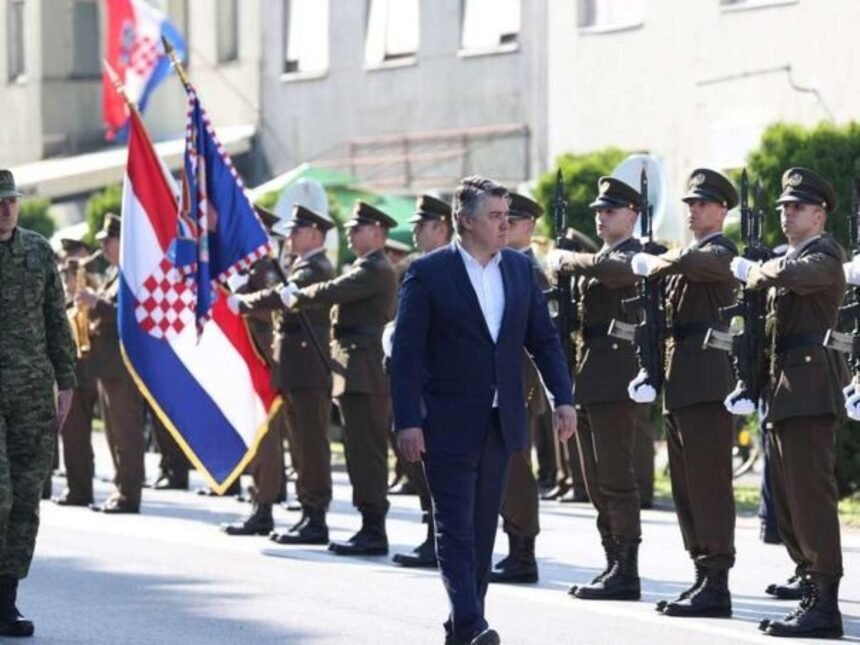
The intense conflict between President Zoran Milanović and Prime Minister Andrej Plenković over the participation of the Croatian Armed Forces in the upcoming Bastille Day military parade in Paris has opened a volatile new chapter in the ongoing institutional warfare between Pantovčak (the Presidential Office) and Banski Dvori (the Government).
This dispute has escalated far beyond standard political bickering, dragging the Chief of the General Staff, Lieutenant General Tihomir Kundid, into a high-stakes constitutional and political ultimatum.
The Arguments: Who Controls the Armed Forces?
The core of the dispute rests on completely conflicting interpretations of the Croatian Constitution and defense laws, with each side claiming sole legal authority.
- Zoran Milanović (President & Commander-in-Chief): He firmly relies on the constitutional provision stating that the President represents the Armed Forces both at home and abroad, meaning no troops can cross international borders without his explicit authorization. Defending his veto from Supetar, Milanović stated: “Orders are not issued by the HDZ cartel, nor Plenković, nor Anušić. They are issued by me… Plenković can send majorettes to Paris—I respect them—but the soldiers are not going.” He described himself as the ultimate “VAR room and arbiter” when decisions harm national dignity.
- Andrej Plenković (Prime Minister) & Ivan Anušić (Minister of Defense): Speaking from the island of Hvar, the Prime Minister argued that attending a parade is a ceremonial stay, not a combat mission, a deployment, or part of a “coalition of the willing.” Under the Government’s interpretation of the Defense Act, protocol-based activities abroad fall under the jurisdiction of the Minister of Defense, not the President. Plenković noted that the invitation is a reflection of Croatia’s excellent strategic partnership with France.
Three Reasons Behind Milanović’s Veto
The President outlined distinct geopolitical and financial grievances driving his refusal to clear the deployment:
- Lack of Reciprocity: France did not send an infantry formation to Zagreb’s massive military parade last year (marking the 30th anniversary of Operation Storm), despite Croatia inviting all its NATO allies.
- The Belgrade Aircraft Deal: Milanović fiercely criticized Paris for pocketing over a billion euros from Croatia for Rafale fighter jets, only to subsequently sell the exact same advanced aircraft to Serbia, which he views as a blatant disregard for Croatian regional interests.
- Fear of Escalation: He accused the Prime Minister of turning Croatia into a “French satellite” and warned that participating in these parades is a backdoor attempt to align Croatia with a “coalition of the willing” preparing for potential interventions related to the war in Ukraine.
Chain of Command Under Fire: The Ultimatum to General Kundid
The most critical escalation is the direct executive pressure applied to the military’s top uniform. Prime Minister Plenković issued an explicit public warning to the Chief of the General Staff:
Andrej Plenković: “If it happens that the Chief of the General Staff, Tihomir Kundid, issues some non-existent oral command and fails to fulfill what Minister Anušić announced, he will lose my confidence from that very moment, and I will expect his resignation.”
               [The Constitutional Bottleneck of the Armed Forces]
                                       │
         ┌─────────────────────────────┴─────────────────────────────┐
         ▼                                                           ▼
 [Banski Dvori / Ministry of Defense]                     [Pantovčak / The President]
 Insist the parade is a ceremonial protocol               Invokes constitutional status as
 under administrative ministerial rule.                   Commander-in-Chief. Places an
 Demand the troops be dispatched.                         absolute veto on border crossing.
         │                                                           │
         └─────────────────────────────┬─────────────────────────────┘
                                       ▼
                          [Chief of the General Staff]
                        (Lt. Gen. Tihomir Kundid)
             Trapped between an administrative mandate from the Minister
             and a direct operational ban from his Commander-in-Chief.
This leaves the military leadership in an impossible bottleneck. If General Kundid obeys the President’s operational ban, the Government threatens to pull political support and demand his ouster. If he obeys the Ministry, he violates the direct orders of his Commander-in-Chief. Plenković closed his remarks by slamming Milanović’s foreign policy as “isolationist,” “anti-EU,” and “anti-Ukrainian,” labeling the President’s actions a “massive national embarrassment.”