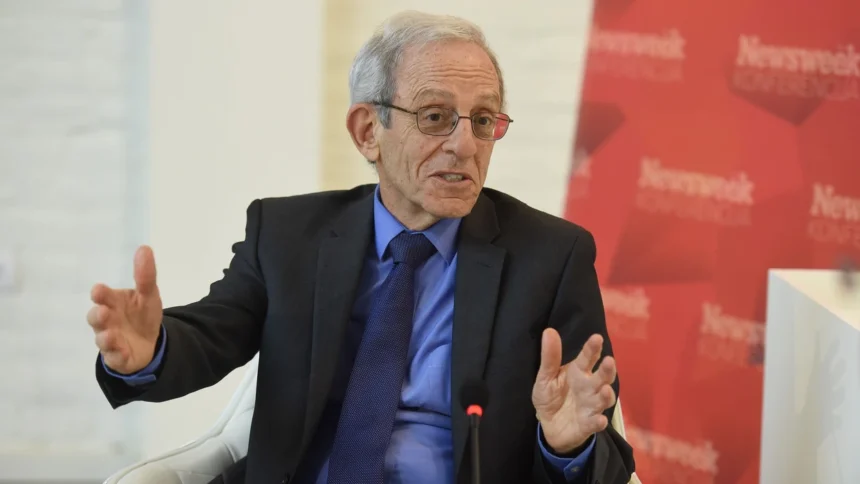
Following his high-level state briefings in the capital, renowned American Balkan expert and Johns Hopkins University professor Daniel Serwer warned that Kosovo’s ongoing institutional gridlock is actively damaging its international image. Speaking to Ekonomia Online (EO), Serwer emphasized that political compromise is no longer optional if the country wishes to project an image of democratic stability to its Euro-Atlantic partners.
The veteran analyst’s remarks arrive during a highly fragile political climate, marked by a prolonged failure among political factions to successfully elect a permanent President and establish a fully functioning, stable government cabinet.
The Damage of Prolonged Political Deadlocks
While acknowledging that long coalition negotiations are a natural feature of parliamentary democracies worldwide, Serwer noted that Kosovo’s repeated political stalemates over the past year have crossed into a counterproductive phase.
The inability of elected leaders to solidify executive governance risks signaling internal weakness to outside observers, especially at a time when regional security threats are heightened:
Daniel Serwer: “Parliamentary systems have moments like these, and you have had many of them over the past year. This has been unfortunate. Frankly, I think it has not been a good year for Kosovo. It is difficult to project an image of institutional stability and resilience when you cannot manage to form a government, when you cannot elect a president. Therefore, I highly hope that this time you will succeed. Compromises will be necessary.”
The Realities of Parliamentary Systems
Serwer underscored that because Kosovo’s constitutional framework requires the President to be elected by a legislative supermajority within the assembly rather than a direct popular vote, the process inherently demands cross-party bargaining. He offered a blunt, direct piece of advice to the country’s deadlocked political elite: “Get to work, form the government.”
                 [ Kosovo's Institutional Roadblocks ]
                                   │
                                   ▼
             [ The Core Bottlenecks to Euro-Atlantic Progress ]
                                   │
       ┌───────────────────────────┴───────────────────────────┐
       ▼                                                       ▼
[Executive Vacuum]                                     [Legislative Gridlock]
Failure to secure a coalition cabinet                  Inability to achieve the necessary
erodes international confidence in stability.          supermajority to elect a state President.
       │                                                       │
       └───────────────────────────┬───────────────────────────┘
                                   ▼
                     [ Serwer's Practical Remedy ]
                   Parties must abandon absolute stances,
                   utilize compromise, and launch governance.
Energy Security and the U.S. Relationship Baseline
Beyond the immediate governance crisis, Serwer weighed in on two key strategic topics central to Kosovo’s long-term sovereign development:
- The Energy Transition Pivot: When questioned about the ongoing regional debates surrounding American natural gas infrastructure investments, Serwer stated he lacked the granular technical data for a full assessment but offered a clear environmental baseline. He noted that natural gas represents a far more favorable transitional alternative than lignite (coal) from an ecological and climate standpoint.
- The Unshakable U.S. Anchor: Reassuring the public amidst domestic anxieties over shifting administrations in Washington, Serwer emphasized that the core strategic alliance between the United States and Kosovo remains entirely rock-solid. He noted that the bilateral relationship is institutional rather than personal, remaining completely durable regardless of which political parties hold power in Prishtina or Washington.