The European Union’s approach toward Serbia has once again exposed growing divisions between its institutions, as the European Parliament sharply criticized Belgrade’s democratic backsliding while the European Commission continued advocating for progress in the country’s EU accession process.
The contrasting positions have reignited debate over the EU’s strategy toward Serbia, raising questions about whether Brussels is sending mixed signals to President Aleksandar Vučić’s government.
The European Parliament recently adopted what has been described as its most critical resolution on Serbia’s EU accession process to date, citing limited or no progress across most negotiating chapters and highlighting continued deterioration in the rule of law and media freedom.
Although European Parliament resolutions are not legally binding, they play a significant role in shaping future debates within EU institutions. The document will serve as a reference point for upcoming parliamentary discussions, be forwarded to the European Council, and contribute to the European Commission’s annual progress report on Serbia later this year.
The report was prepared by European Parliament Rapporteur for Serbia Tonino Picula and received broad backing in Parliament, with 468 members voting in favor, 116 against, and 79 abstaining.
Among its recommendations, the report calls for suspending financial assistance to Serbia under the EU’s Growth Plan for the Western Balkans until substantial democratic reforms are implemented.
At the same time, the European Commission proposed opening Cluster 3 of Serbia’s accession negotiations, covering competitiveness and inclusive growth, arguing that doing so could provide positive momentum for continued reforms.
European Commissioner for Enlargement Marta Kos supported the proposal, pointing to progress in judicial reforms and the implementation of recommendations from the OSCE Office for Democratic Institutions and Human Rights (ODIHR) concerning electoral legislation.
However, the proposal failed to gain unanimous support among EU member states.
Belgium, the Netherlands, Sweden, Finland, Bulgaria, Croatia, Lithuania and Estonia opposed opening Cluster 3, while Luxembourg, Denmark and Latvia also expressed reservations.
Many of the concerns raised by member states mirrored those outlined in the European Parliament’s resolution, including democratic backsliding, weakening institutions, rule of law deficiencies, media freedom concerns, Serbia’s refusal to align with EU sanctions against Russia, and its increasingly close political ties with China.
Vladimir Međak, Vice President of the European Movement in Serbia, described the apparent disagreement between the European Parliament and the European Commission as a reflection of geopolitical considerations rather than conflicting assessments of Serbia’s reform record.
He argued that some EU leaders view Serbia’s accession process through a broader strategic lens, particularly as other candidate countries such as Montenegro, Albania, Moldova and Ukraine continue making progress toward membership.
According to Međak, geopolitical interests cannot override the EU’s accession criteria indefinitely.
“Geopolitics can do many things, but it cannot force a country into the European Union,” he said, arguing that Serbia must demonstrate meaningful improvements in the rule of law, judicial independence and anti-corruption efforts before membership can become a realistic prospect.
Official data from Serbia’s Ministry for European Integration also indicate slow reform implementation. Of 60 planned regulations scheduled for adoption during the first quarter of the year, only 10 were approved. Just one of nine planned laws and one of five implementing regulations were adopted.
President Aleksandar Vučić dismissed criticism surrounding Serbia’s stalled accession process, arguing that the decision not to open Cluster 3 reflected political considerations rather than objective evaluation of reforms.
He also accused Croatia of seeking to weaken Serbia, while Serbian pro-government media heavily criticized Tonino Picula following the publication of the European Parliament’s report.
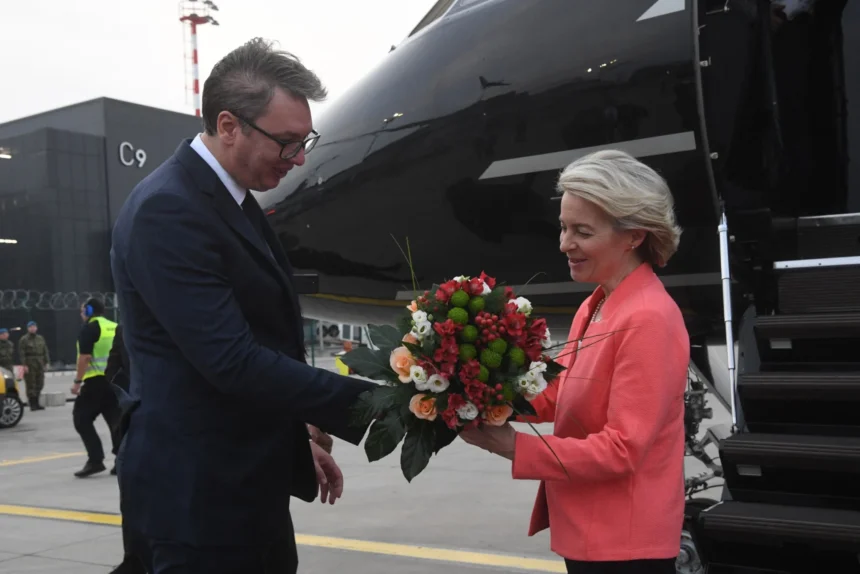
The debate has also highlighted divisions within the European People’s Party (EPP), the political family that includes both European Commission President Ursula von der Leyen and Serbia’s ruling Serbian Progressive Party (SNS) as an associate member.
According to political observers, the EPP faces a difficult balancing act between maintaining dialogue with Belgrade and responding to mounting concerns over democratic standards and the rule of law.
The latest developments underscore the increasingly complex relationship between Serbia and the European Union, where strategic geopolitical interests continue to compete with the bloc’s longstanding emphasis on democratic reforms and institutional accountability.