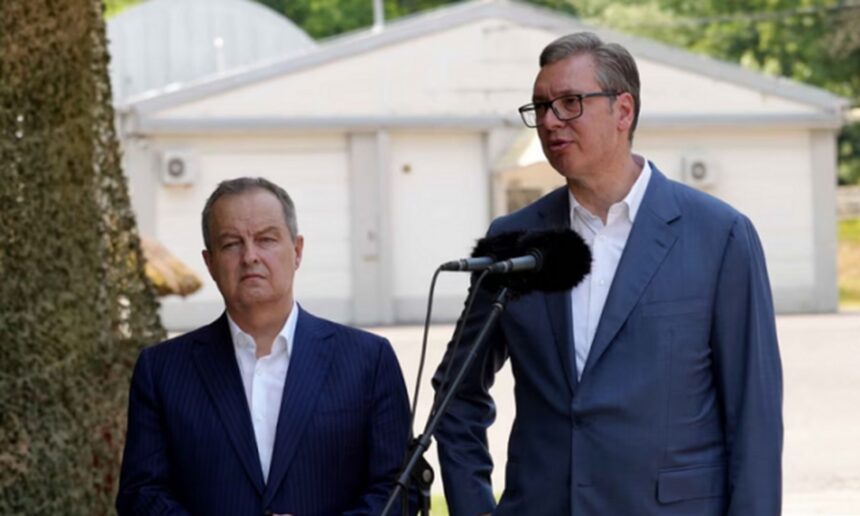
After more than three decades of political survival, including the fall of Slobodan Milošević’s regime and two decades under Ivica Dačić’s leadership, Serbia’s Socialist Party is facing its heaviest defeat.
One of the country’s longest-standing and most adaptable political forces has, for the first time since its founding in 1990, failed to secure a seat in Parliament.
In the October 25 elections, the Socialists won just over 90,000 votes, falling short of the three-percent electoral threshold.
The party was founded by Serbia’s former autocratic president, Slobodan Milošević. For the past 20 years, it has been led by Ivica Dačić, a Russia-oriented politician who is the outgoing Minister of Internal Affairs.
Since the Serbian Progressive Party (SNS) came to power in 2012, the Socialists have been its reliable coalition partner in government. The Progressives, too, suffered their first electoral defeat since taking power 14 years ago, after the Student List won a decisive victory with 2.2 million votes.
The party that led the country into wars in Croatia, Bosnia and Herzegovina, and Kosovo during the 1990s survived the period following the October 5, 2000, changes that brought down Milošević’s regime.
However, in the run-up to the elections, the SPS lost several senior officials, while some of its younger members also abandoned the party.
“The Socialists failed to understand the historic moment Serbia is going through, and this will cost them their political existence,” political scientist Duško Radosavljević told Radio Free Europe (RFE/RL).
Referendum-like atmosphere wipes the SPS off the political scene
According to unofficial election results, the SPS received 2.16 percent of the vote, insufficient to cross the electoral threshold. The elections were marked by high voter turnout of 68 percent, the highest since the federal and presidential elections of September 2000.
Although 18 lists took part in the electoral race, the atmosphere resembled a referendum, with two lists emerging as the main contenders: “United Serbia,” led by the SNS, and the list formed out of mass anti-government protests and student blockades following the deaths of 16 people when a canopy collapsed at the entrance to a railway station on November 1, 2024.
“The Socialists failed to understand this. To the very end, they remained victims of the politics they themselves put into practice during the 1990s, a politics based on the unscrupulous plundering of citizens,” Radosavljević said.
Socialist leader Ivica Dačić said on Sunday evening that he was dissatisfied with the result, attributing it to the “referendum-like atmosphere.”
“The Socialist Party of Serbia, together with its coalition partners, tried in such an atmosphere, with a separate list representing its identity, to occupy a certain political space and, unfortunately, we failed to achieve the desired result,” Dačić said at the SPS election headquarters in Belgrade.
He described the defeat as “a lost battle” and added that “we will continue to fight for Serbia.”
This is the SPS’s worst electoral result since it began its coalition partnership with the Progressives. It also reflects a longer-term decline in electoral support for the party. In the 2012 elections, it received nearly 570,000 votes; two years later, just over 480,000; and in 2023, around 250,000.
Members abandon the party
Some party members had expressed dissatisfaction with the way the SPS was being run. One of the most prominent figures in this group was Branko Ružić, until recently the SPS deputy leader, who was unanimously expelled from the party at the end of August.
As justification for his expulsion, the SPS said Ružić had “repeatedly and over an extended period” violated the party’s statute and failed to implement decisions made by its governing bodies.
Earlier, Ružić had been suspended from his party duties after publicly supporting student protests and attending several rallies.
Ružić declined to speak to RFE/RL about the results achieved by his former party.
A month and a half after Ružić’s expulsion, Boris Milćević also left the SPS, having been a member of the Socialists for 16 years.
Milćević, who had served as Ružić’s adviser when the latter was appointed a minister without portfolio responsible for European integration in 2013, told RFE/RL that his decision to leave the party had not been coordinated with Ružić.
He attributed the SPS’s poor result to exceptionally high voter turnout, as well as the departure of some party members shortly before the elections.
“This dissatisfaction erupted at precisely that moment. It was not a coordinated move, but as that moment approached, opposition to this anti-politics grew stronger and stronger, and it had to come to the surface,” Milćević said.
Milćević left the SPS in October, about two weeks before the parliamentary elections, at a time when opinion polls indicated that the Socialist Party of Serbia was struggling to cross the electoral threshold.
In an Instagram post explaining his decision, he wrote that “the party chose to remain silent in the face of violations of citizens’ human rights and the destruction of institutions.” He also criticised the SPS for having “chosen anti-European politics and the glorification of a war criminal.”
Asked why he had left only two weeks before the elections, despite the party’s coalition with the Serbian Progressive Party dating back to 2012, Milćević said he had previously tried to draw attention to the party’s misguided course through internal party channels.
“We warned the party leadership in good time about the problematic policies it was pursuing, starting in December 2024 and January 2025, when the party’s political direction was discussed. That direction di