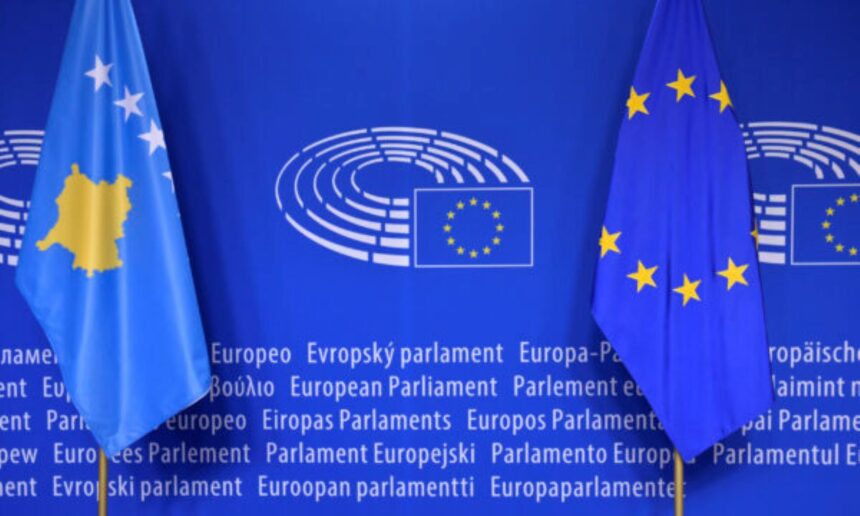
The European Union says it is aware of Kosovo’s decisions to constitute its new Assembly and form a new government, but stressed that it is for the country’s Constitutional Court to determine whether the process complied with the Constitution.
“We are aware of Sunday’s votes, as well as the decisions to constitute the Assembly and form the Government. We are also aware of the request submitted to the Constitutional Court concerning the constitutionality of these decisions. It is for the Constitutional Court to rule on the submitted request,” a European Commission spokesperson told Radio Free Europe.
The EU spokesperson also stressed the need for Kosovo to have fully functioning institutions capable of advancing reforms and moving forward on its path toward EU integration, including under the Western Balkans Growth Plan.
Kosovo’s Assembly was formally constituted on Sunday, September 13, after lawmakers elected deputy speakers from the Democratic League of Kosovo (LDK), the Serb community and other non-majority communities.
Assembly Speaker Albulena Haxhiu declared the legislature constituted despite the absence of a deputy speaker from the Democratic Party of Kosovo (PDK), the country’s second-largest political force.
Hours later, the Assembly held an extraordinary session to vote on the new government led by Albin Kurti. The session was boycotted by PDK, LDK and the Alliance for the Future of Kosovo, while only lawmakers from Kurti’s Vetëvendosje Movement and non-majority communities participated.
PDK challenges Assembly constitutionality
PDK had previously withdrawn the candidacy of Vlora Çitaku for deputy speaker after Vetëvendosje lawmakers failed to support her nomination during the September 11 session.
Although Vetëvendosje subsequently said it would support Çitaku’s candidacy, PDK did not participate in the subsequent proceedings.
Vetëvendosje’s nominee for deputy speaker was elected on September 11, while Haxhiu had been elected Assembly speaker during an earlier sitting on September 9.
Following the constitution of the Assembly and formation of the government, PDK filed a request with the Constitutional Court seeking an interim measure against the newly constituted legislature while the court examines whether the process complied with the Constitution.
PDK lawmakers Arian Tahiri and Përparim Gruda, together with lawyer Faton Fetahu, submitted the complaint on behalf of the party on Monday morning.
Speaking to reporters after filing the request, Tahiri said it was important for the court to first impose an interim measure to prevent what he described as potentially more serious legal and institutional consequences.
PDK argues that Vetëvendosje violated the constitutional 30-day deadline for constituting the Assembly, as well as the procedure requiring Assembly sessions to be convened every 48 hours until the legislature is constituted.
According to a Constitutional Court ruling issued last year, the Assembly must be constituted within 30 days of the certification of election results. That deadline expired on August 7, 2026.
EU calls for consolidated institutions
The EU’s response comes as Kosovo’s new institutions face their first major legal challenge following their formation.
While declining to assess the constitutionality of the Assembly’s formation or the government vote, Brussels emphasized that Kosovo needs fully consolidated institutions to implement reforms and advance its European integration process.
The Constitutional Court is now expected to consider PDK’s request and determine whether the procedures followed in constituting the Assembly and forming the government were consistent with Kosovo’s constitutional framework.