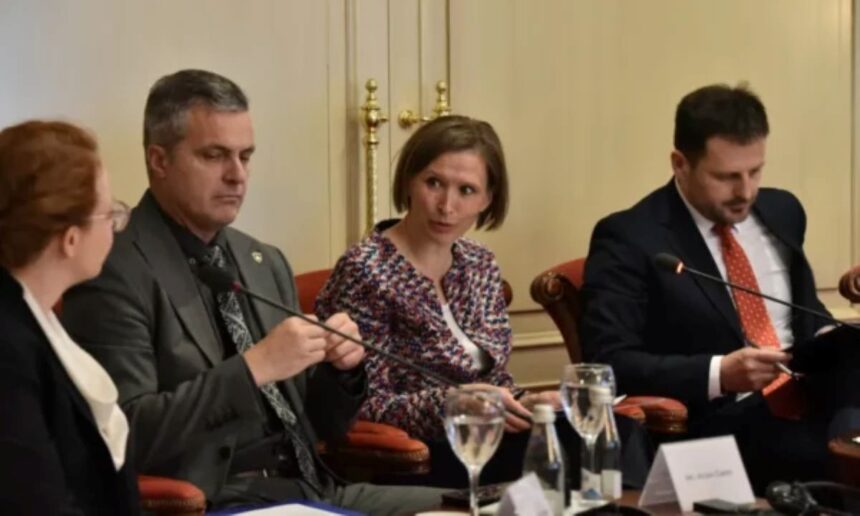
The European Union expects a swift, stable, and highly collaborative formation of new political institutions in Kosovo following the upcoming extraordinary parliamentary elections scheduled for June 7, 2026.
The mandate was explicitly delivered on Thursday by Eva Palatova, the Acting Head of the EU Office in Kosovo, during a high-level justice sector symposium in the capital. Palatova emphasized that Brussels is looking for a deep “spirit of compromise” among Kosovo’s political factions to prevent prolonged institutional gridlock and ensure the country remains on track with critical baseline integration reforms.
World Bank Survey Data Placed Under the EU Lens
The central focus of the symposium was the formal rollout of the World Bank’s latest Regional Justice Survey. Palatova confirmed that the European Commission will directly integrate the empirical data and metrics from this comprehensive regional survey into its official technical mechanisms to objectively measure Kosovo’s structural anti-corruption and judicial progress.
   [WORLD BANK SURVEY DATA: THE DIVERGENT PERCEPTIONS]
   • Citizens & Public:    ▲ 6% Increase in core institutional trust in courts.
   • Legal Professionals:  ▲ Judges and prosecutors report heightened internal independence.
   • Business Community:  ▼ Highly critical; point to lingering systemic bottlenecks.
   • Private Attorneys:    ▼ Express skepticism regarding the speed and parity of rule-of-law execution.
The data compiled from the 2025 assessment cycles reveals a stark, fascinating divergence in how Kosovo’s judicial system is viewed across different layers of society:
- The General Public: Public confidence in the court system logged a 6% increase compared to past baselines, with a majority of everyday citizens reporting a noticeable decrease in perceived corruption within the judiciary.
- The Enterprise Sector: Conversely, commercial businesses and private corporations expressed contrasting views, identifying ongoing operational corruption and regulatory inconsistencies as significant impediments to trade and investment.
The Fundamental Prerequisites: Cluster 1 and Membership Talks
Palatova explained that the data extracted from the World Bank questionnaire is invaluable because it provides an unvarnished window into the actual operational efficiency, equity, and independence of the Kosovo judiciary.
This assessment is directly tied to Pristina’s mid-term strategic objective: successfully initiating formal accession negotiations for European Union membership. Under the European Commission’s active enlargement methodology, Kosovo must satisfy strict requirements within Cluster 1 (Fundamentals), which serves as the non-negotiable anchor for the entire negotiation process.
                  [EUROPEAN COMMISSION ENLARGEMENT METHODOLOGY]
                                       │
                         ┌─────────────┴─────────────┐
                         ▼                           ▼
                    CHAPTER 23                  CHAPTER 24
                Judiciary & Fundamental      Justice, Freedom
                        Rights                   & Security
                         │                           │
                         └─────────────┬─────────────┘
                                       ▼
                       [CLUSTER 1: THE FUNDAMENTALS]
           (Must be stabilized before any other negotiation chapters open)
“We are analyzing the information gathered from this questionnaire with great care,” Palatova stated. “This data directly influences the annual progress reports for all enlargement countries, including Kosovo, driving our technical evaluations and policy recommendations. For Kosovo to achieve its goal of opening EU membership negotiations, it must satisfy the requirements of Cluster 1—the fundamentals—which comprehensively covers Chapters 23 and 24 regarding the judiciary and the rule of law.”
Ministry of Justice and World Bank Vow Targeted Adjustments
Kosovo’s Deputy Minister of Justice, Genc Nimoni, welcomed the World Bank’s findings, characterizing the diagnostic report as an essential tool for the Ministry’s legislative agenda. Nimoni noted that the assessment does not merely highlight areas of institutional progress, but provides a precise analytical roadmap allowing ministries to target remaining operational challenges.
Klaus Decker, Senior Public Sector Specialist at the World Bank, provided a comparative breakdown contrasting the new data with foundational indicators tracked since 2020.
Decker observed that while internal actors—specifically citizens, active judges, and state prosecutors—view the evolution of the judicial framework through an overwhelmingly positive lens, external commercial actors, including private businesses and independent defense attorneys, remain far more critical. This division highlights the clear need for deeper, more inclusive institutional reforms that protect both public rights and commercial legal security.