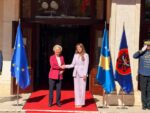
Ukrainian President Volodymyr Zelensky’s first official visit to Serbia and his meeting with President Aleksandar Vučić have sparked criticism in Germany, with the newspaper taz arguing that Kyiv effectively “sacrificed Kosovo” in its effort to strengthen ties with Belgrade.
Zelensky visited Vučić in Belgrade on Saturday in a bid to secure additional political and diplomatic support for Ukraine amid Russia’s ongoing war. The meeting was significant as Serbia maintains close relations with Moscow, has not joined Western sanctions against Russia and continues to pursue a foreign policy that balances ties with Russia, China and the European Union.
According to the German newspaper taz, Serbia’s position makes the meeting particularly sensitive for Ukraine. Belgrade does not recognize Kosovo’s independence, while Kyiv has also maintained a position that does not recognize Kosovo as an independent state.
Zelensky, meanwhile, is seeking broader international backing as Ukraine continues to face Russian attacks.
For Vučić, the meeting also offered an opportunity to strengthen Serbia’s relationship with the European Union at a time of increasing domestic political pressure and changing alliances within the bloc. The departure of former Hungarian Prime Minister Viktor Orbán from the European political scene has also weakened one of Belgrade’s most important political allies in Brussels, taz reported.
The meeting produced several areas of potential cooperation. Serbia and Ukraine are expected to work toward finalizing a free-trade agreement by the end of the year, while the two countries also expressed interest in cooperation on food and energy security and European integration.
Military cooperation, however, was ruled out by Vučić. Serbia remains heavily dependent on Russian gas, making any major shift in its security and foreign-policy orientation particularly sensitive.
The German newspaper argues that the diplomatic rapprochement carries a significant cost for Kosovo, which has strongly supported Ukraine since the beginning of Russia’s full-scale invasion.
Belgrade continues to reject Kosovo’s independence, while the European Commission has repeatedly emphasized that the normalization of relations between Serbia and Kosovo is a fundamental condition for Serbia’s eventual EU membership.
According to taz, Ukraine’s position on Kosovo was also indirectly reaffirmed during Zelensky’s visit. In return, Serbia has reiterated its recognition of Ukraine’s territorial integrity, including Ukrainian claims over territories occupied by Russia.
This creates a potentially important diplomatic exchange: Ukraine receives continued Serbian recognition of its territorial integrity, while Belgrade retains Kyiv’s position on Kosovo.
The German newspaper argues that this could strengthen Serbia’s negotiating position with Brussels during the EU accession process, potentially increasing Belgrade’s leverage over the Kosovo issue.
From this perspective, the meeting in Belgrade represents a delicate balancing act for Kyiv — securing Serbian support for Ukraine while maintaining a position on Kosovo that is viewed in Prishtina as fundamentally at odds with Kosovo’s independence.