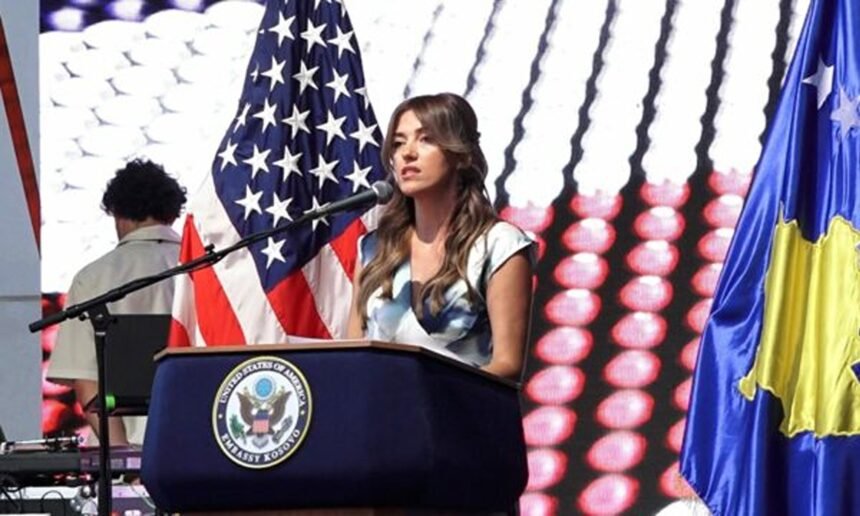
Acting President of Kosovo Albulena Haxhiu praised the historic role of the United States in promoting democracy and freedom during her address at a reception hosted by U.S. Chargé d’Affaires Anu Prattipati to mark the 250th anniversary of American independence, reports Ekonomia Online.
Haxhiu said that America’s Independence Day is more than a historic milestone—it is a reminder of the fundamental principles upon which the United States was founded.
“Tonight, we celebrate 250 years of American independence. Such a milestone could easily become just another ceremony. But in America’s case, it takes us back to a revolution that began with a very concrete political question: Who has the right to govern, and where does that right come from?” Haxhiu said.
She emphasized that the answer given in 1776 remains just as relevant today.
“The answer offered in 1776 was radical for its time and remains challenging even today. Power does not stand above the people; it derives its legitimacy from the people and must be limited by law, representation, and civic equality. Today, these words belong to many democratic struggles, but they entered modern history through a revolution that challenged an empire.”
Haxhiu also highlighted the long-standing historical ties between Albanians and the United States, noting that the Albanian-American community played a vital role in advancing the Albanian national cause.
Referring to the Paris Peace Conference following the First World War, she recalled the support of Woodrow Wilson.
“Albanians understood early on that American principles mattered most when the future of a nation was being decided without its people at the decision-making table. At the Paris Peace Conference after World War I, Albania’s independence faced decisions made by others. President Wilson gave political force to the Albanian cause when he simply and firmly declared: ‘Albania must be independent.'”
She paid tribute to prominent Albanian figures such as Fan Noli and Faik Konica for strengthening the Albanian community in America and bringing the Albanian cause to the international stage.
Speaking about Fan Noli, Haxhiu said:
“In Boston, Fan Noli gave this story new strength and urgency. An Orthodox priest who became one of the defining Albanian figures of the 20th century, he studied at Harvard, translated Shakespeare and Cervantes, organized Albanian public life in America, and later served as Prime Minister of Albania.”
She added that Noli understood the importance of language and national organization.
“Noli understood that language could become an institution before a state was strong enough to protect it. He helped transform a community of immigrants into a national force.”
Haxhiu also praised Faik Konica for his diplomatic efforts.
“Faik Konica, a writer and diplomat whose strength was precision, gave this effort another kind of power. Through the Albanian Federation Vatra and the newspaper Dielli, he helped unite Albanians across the United States and brought their voice into official diplomacy as Albania’s representative in Washington.”
Connecting this history to Kosovo, Haxhiu highlighted the legacy of Hasan Prishtina.
“Hasan Prishtina brings Kosovo into this story. Born in Vushtrri, educated in Thessaloniki and Istanbul, and elected to the Ottoman Parliament, he understood how easily small nations could be discussed and decided upon by others.”
She said Hasan Prishtina championed Kosovo’s right to self-determination long before Kosovo became a state.
“After the First World War, he gave voice to Kosovo’s demand within the broader Albanian call for self-determination. Kosovo was not yet a state, but the principle that would later define its modern history was already there: a people must have the right to determine its own future.”
Recalling Kosovo’s difficult past, Haxhiu stressed that the demand for freedom eventually became more than words.
“Eight decades later, that demand returned under fire. When autonomy had been abolished, public life dismantled, and civilians driven from their homes, a people’s right to determine its future could no longer remain merely a matter of words.”
She described American leadership as decisive in Kosovo’s path to freedom and statehood.
“For the people of Kosovo, American leadership became part of our national history because it changed the course of our history. That freedom became the Republic of Kosovo. It took shape through institutions, elections, courts, security forces, and a constitutional order that belongs to all its citizens. On the 250th anniversary of American independence, we honor the United States above all for the idea on which it was founded—that government must be accountable to its citizens. For Albanians and for the Republic of Kosovo today, that idea became reality through history. It became reality when American leadership helped transform the right to freedom from a demand into a future.”
Haxhiu concluded by emphasizing that the friendship between Kosovo and the United States has been built on shared values, partnership, and a common commitment to protecting democracy.
“Tonight, our congratulations come with the gratitude of a sovereign republic. We remember that American support helped make our freedom possible, and we know that the best way to honor that support is to build a state worthy of it. Across generations, the friendship between Kosovo and the United States has grown through its citizens, its institutions, and the difficult effort to protect freedom in public life.”