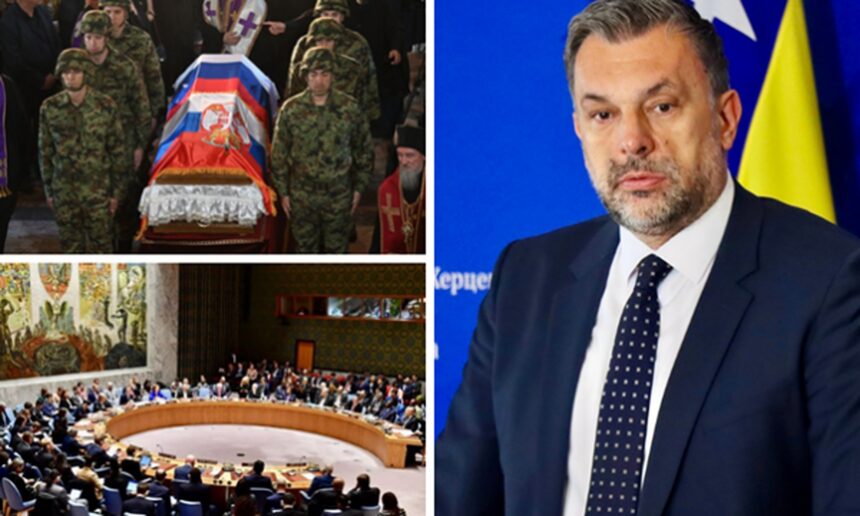
Bosnia and Herzegovina’s Foreign Minister Elmedin Konaković has written to all United Nations member states, urging them to respond to what he described as “deeply disturbing developments in Serbia” following the burial of convicted war criminal Ratko Mladić.
Konaković focused particularly on the way Mladić’s remains were returned to Serbia and the manner in which his funeral was conducted in Belgrade. He said the remains of the former commander of the Army of Republika Srpska, who was sentenced to life imprisonment for genocide, crimes against humanity and war crimes, were transported to Serbia on a Serbian government aircraft.
According to Konaković, the coffin was covered with the Serbian state flag and carried by members of the Serbian Armed Forces.
A memorial ceremony was held at the House of the Serbian Army, while Mladić’s burial in Belgrade was conducted with military honors and a ceremonial gun salute.
Vučić’s Role
Konaković also highlighted the presence of senior Serbian officials, including Defense Minister Bratislav Gašić, Justice Minister Nenad Vujić, Culture Minister Nikola Selaković and Minister without Portfolio Nenad Popović.
He also pointed to the participation of senior officials from Republika Srpska, including its president and prime minister, as well as Bosnia and Herzegovina’s Serb member of the state presidency.
Serbian President Aleksandar Vučić did not attend the funeral. However, Konaković said Vučić publicly defended the actions of Serbian state institutions concerning Mladić’s return and burial and rejected international criticism.
In his letter, Konaković asked UN member states whether the international community would accept similar honors being given by another European state to senior Nazi officials such as Hermann Göring or Wilhelm Keitel, who were convicted at the Nuremberg trials.
He recalled that Mladić was convicted by the International Criminal Tribunal for the former Yugoslavia (ICTY), established by the UN Security Council, and that the judgments against him were subsequently upheld by the International Residual Mechanism for Criminal Tribunals.
Konaković argued that there cannot be different standards for convicted war criminals and that the principle of “never again” cannot be selective.
He said the issue takes on an institutional dimension when state resources, armed forces, military institutions and government officials are used to glorify individuals convicted of international crimes.
Serbia and the Srebrenica Genocide
Konaković also recalled internationally established findings concerning Serbia’s role during the war in Bosnia and Herzegovina.
He referred to UN General Assembly Resolution A/RES/47/121, which condemned violations of Bosnia and Herzegovina’s sovereignty, territorial integrity and political independence by Serbia.
He also cited the 2007 judgment of the International Court of Justice, which found that Serbia had violated its obligation under the Genocide Convention to prevent the genocide in Srebrenica and its obligation to cooperate fully with the ICTY in the apprehension and transfer of Ratko Mladić.
Konaković described this as one of the central contradictions in the current situation: a state found by the UN’s highest court to have failed to prevent the Srebrenica genocide and to have failed to fulfill its obligations regarding Mladić is now accused of enabling state and military honors for a man convicted of genocide.
He also referred to UN General Assembly Resolution A/RES/78/282, adopted on May 23, 2024, establishing the International Day of Reflection and Commemoration of the 1995 Genocide in Srebrenica.
According to Konaković, the resolution condemns actions that glorify individuals convicted of war crimes, crimes against humanity and genocide, including those responsible for the Srebrenica genocide.
He argued that the actions of Serbian institutions following Mladić’s death fall directly within the type of conduct condemned by the UN General Assembly.
At the same time, Konaković stressed that his criticism was not directed at the Serbian people collectively. International criminal responsibility, he said, is individual, while his concern concerns political authorities and public institutions that glorify a convicted war criminal, humiliate victims and undermine reconciliation and regional stability.
Calls for Targeted Sanctions
Konaković proposed three concrete steps to UN member states.
First, he called for public condemnation of the official and institutional glorification of Ratko Mladić, including the use of state resources, military structures and military honors.
He specifically highlighted the display of an image of Mladić accompanied by the message “Towards Potočari,” describing it as a direct incitement to genocidal violence and a warning about the danger of its repetition.
Second, Konaković called for targeted sanctions and other restrictive measures against officials and individuals who organize, support, promote or facilitate the institutional glorification of individuals convicted of genocide and other serious international crimes.
Third, he called for reaffirming the authority and findings of the ICTY, the International Residual Mechanism for Criminal Tribunals and the International Court of Justice concerning the Srebrenica genocide, while rejecting attempts to deny, relativize or politically reinterpret those judgments.
Konaković concluded that the glorification of perpetrators of genocide must have concrete consequences.
“A person convicted of genocide by a UN tribunal cannot be turned into a state-sponsored hero without a response,” Konaković said.
He added that a state found by the International Court of Justice to have failed to prevent genocide cannot honor a person convicted of committing it without consequences.
The Bosnian foreign minister warned that silence under such circumstances is not neutrality, but a risk that the glorification of war criminals could become socially and institutionally acceptable.