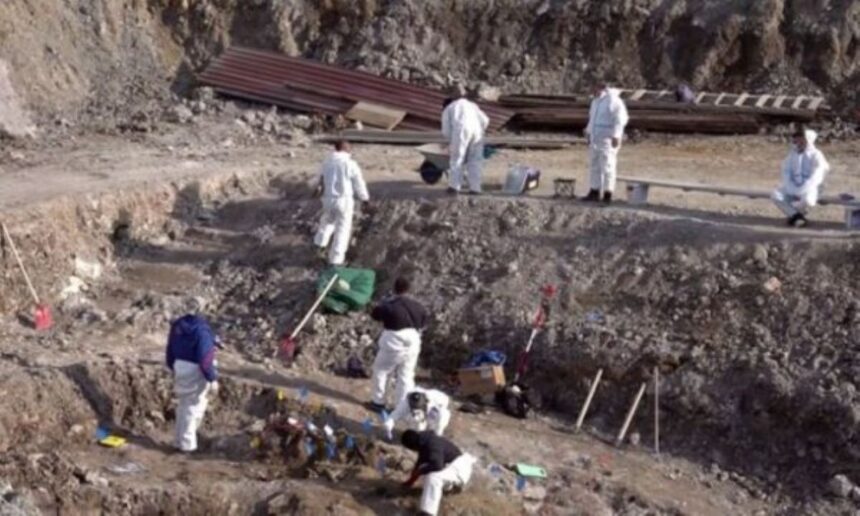
The Government of Kosovo has formally demanded access to classified wartime documents belonging to the Yugoslav Army’s 37th Motorized Brigade alongside the immediate resumption of exhumation operations at the Batajnica military training grounds near Belgrade.
Prishtina frames these two core demands as an essential litmus test for Belgrade’s adherence to the Declaration on Missing Persons, which was signed by both nations under European Union mediation. Conversely, within the framework of the Joint Commission on Missing Persons, Serbia has countered by requesting additional investigations and data regarding individuals who went missing specifically after the official conclusion of the 1999 Kosovo War.
The Central Litmus Test for the 2023 Declaration
The Joint Commission is scheduled to convene for its third official session, mediated by EU Special Representative Peter Sørensen. The Kosovar delegation has made it clear that granting access to these specific military records will prove whether Serbia possesses the political will to implement the information-sharing commitments it agreed to.
                      BILATERAL ARCHIVAL & EXHUMATION DISPUTE

   KOSOVO'S DEMANDS (WAR-TIME)                  SERBIA'S COUNTER-CLAIMS (POST-WAR)
 ─────────────────────────────                 ───────────────────────────────────
 • Access classified archives of               • Demands reciprocal transparency
   the 37th Motorized Brigade.                   on post-war missing person cases.
 • Renew forensic excavations at the           • Requests deep-dive investigations
   Batajnica tactical training site.             into disappearances after June 1999.
Kushtrim Gara, the head of the Missing Persons Unit within the Prime Minister’s Office, stated that the classified wartime files are vital to discovering the locations of victims killed during massacres perpetrated across the Drenica region. At the time of these atrocities, the 37th Brigade was under the direct command of General Ljubiša Diković.
“Many victims of the massacres in Rezala, Čikatovo e Vjetër, and Zabel i Ulët—all carried out by this specific brigade—were eventually discovered in mass graves in Raška. The complete wartime archives of this brigade were entirely reclassified by Belgrade in 2014, precisely when our forensic teams were conducting excavations at their former base in Raška.”
— Kushtrim Gara, Head of the Kosovar Missing Persons Unit
New Intelligence Points to Another Mass Grave in Batajnica
Kosovo’s insistence on returning to the Batajnica military complex stems from recently secured intelligence and analytical data compiled by forensic experts. Kosovar authorities strongly suspect that a distinct, unexcavated location adjacent to the active tactical shooting ranges contains the hidden remains of roughly 58 missing individuals.
Historical data reveals the vast scale of the original cover-up operation executed by Yugoslav forces:
- Timeline of Concealment: Between 2001 and 2002, the remains of 744 Kosovo Albanian victims were exhumed from nine secret mass graves inside the Batajnica complex.
- Logistical Distance: The victims were systematically transported hundreds of kilometers away from their original execution sites in Kosovo to hidden pits just outside Belgrade.
EU Demands Unconditional Cooperation
The Office of the European Union Special Representative for the Belgrade-Pristina Dialogue issued a direct call to action, strongly urging both capitals to demonstrate unconditional cooperation. Brussels emphasized that the Joint Commission serves as the primary practical framework designed to resolve operational gridlocks and alleviate decades of suffering endured by grieving families.
Under the reciprocal clauses of the 2023 Declaration, Kosovo remains obligated to comprehensively investigate cases brought forward by Belgrade, particularly those concerning the disappearances of Serb, Roma, and other non-Albanian minorities during the volatile post-war transition period.