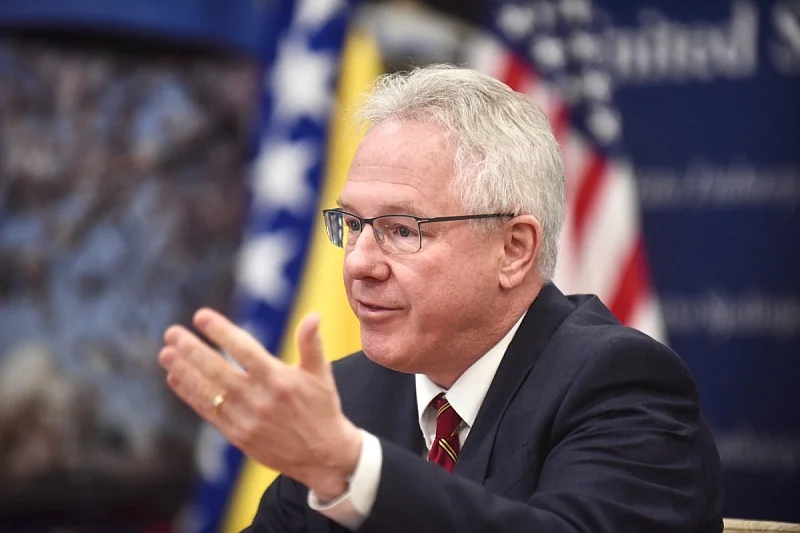
Former U.S. Ambassador to Bosnia and Herzegovina Michael Murphy has argued that the long-standing strategy pursued by the United States and European Union toward Serbia has failed and that the West needs to fundamentally rethink its approach to Belgrade.
In an assessment of the situation in the Western Balkans, Murphy said Washington and Brussels had for years operated under the assumption that resolving Serbia’s political trajectory would automatically help resolve broader regional problems.
“There has long been a fascination in the U.S. and EU with the idea that if Serbia is ‘fixed,’ the Western Balkans are fixed as well,” Murphy said, noting that Serbia is the region’s most populous country and largest economy.
He acknowledged that a decisive shift by Serbia away from the policies associated with the breakup of Yugoslavia and toward the West would represent a major positive development for the region.
However, Murphy argued that Western efforts since the fall of Slobodan Milošević have repeatedly overlooked actions by Serbia that he believes have undermined regional stability.
‘Turning a blind eye to destabilization’
“Since the fall of Milošević, U.S. and EU efforts to ‘win’ Serbia have too often ignored or looked the other way while Serbia took actions harmful to regional stability, particularly in Bosnia and Herzegovina and Kosovo, but also in Montenegro,” Murphy said.
He argued that Washington and Brussels had placed excessive faith in the EU’s economic and political incentives as a tool for transforming Serbia, saying that approach had clearly failed.
“Again and again, the U.S. and EU convinced themselves that ‘this Serbian leader’ was different, only to end up disappointed,” Murphy said.
He also criticized what he described as a failure to recognize the persistence of Serbia’s traditional political outlook.
“Despite American and European investments, the country remains tied to its old policies and worldview, including many of its dangerous beliefs from the Milošević era and its pro-Russian stance,” he said.
Murphy’s assessment comes amid continued debate in Washington and European capitals over Serbia’s position between Russia and the West, as well as its policies toward Kosovo, Bosnia and Herzegovina and other countries in the Western Balkans.
‘Time for a new and different approach’
Murphy concluded that Western governments need to abandon the assumption that Serbia’s political transformation will inevitably follow from engagement and incentives.
“Unfortunately, it has been much easier for the West to persist in the illusion that Serbia has changed than to accept the need for a policy that treats Serbia as a challenge to Western interests, which it is,” he said.
“The Western strategy of fixing Serbia, and thereby fixing the entire Western Balkans, has failed. It is time for a new and different approach,” Murphy concluded.
His remarks amount to a direct challenge to a central assumption that has shaped Western policy in the region for more than two decades: that Serbia’s eventual alignment with European institutions would itself become the key to long-term stability in the Western Balkans.
Murphy’s argument instead suggests that Washington and Brussels should assess Serbia’s actions on their own merits and pursue a policy based less on expectations of gradual transformation and more on concrete regional security and foreign-policy interests.