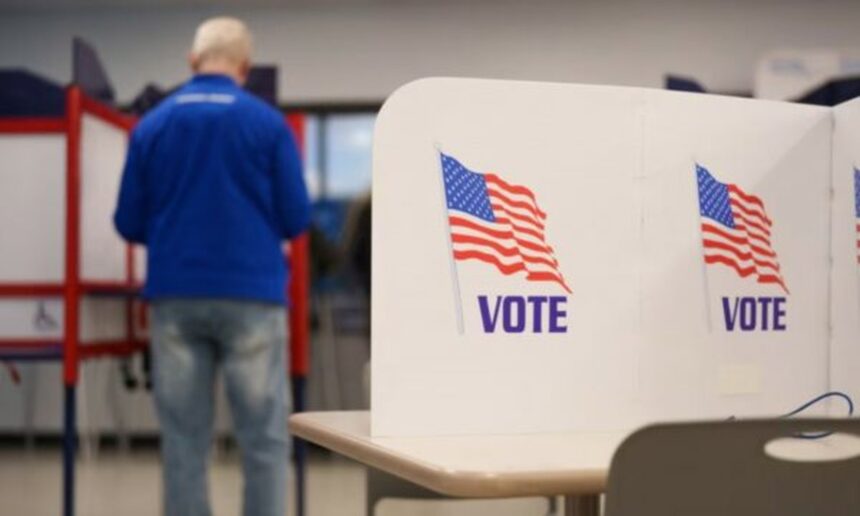
The United States is holding its midterm elections today, halfway through President Donald Trump’s term in office. American voters will elect all 435 members of the House of Representatives and 35 senators, while approximately 250 million citizens are eligible to vote.
Although the presidency itself is not at stake, the outcome of these elections will determine which party controls Congress during the second half of Trump’s term.
Republicans currently hold majorities in both chambers of Congress. In the Senate, they control 53 seats, while Democrats hold 45. Two independent senators caucus with the Democrats. In the House of Representatives, however, the Republican majority is considerably narrower.
Nevertheless, opinion polls give Democrats a significant chance of taking control of the House of Representatives, as well as an opportunity to win a Senate majority. Such an outcome is commonly referred to as a “blue wave” and is largely associated with declining approval ratings for the current US president.
Republicans, meanwhile, are hoping the polls will prove inaccurate. However, party strategists have already withdrawn substantial funding from several races, focusing their efforts on retaining at least control of the Senate.
Members of the House of Representatives are elected to two-year terms, meaning all 435 seats are contested in every election cycle. Senators, by contrast, serve six-year terms, with approximately one-third of Senate seats up for election every two years.
This year, 33 regular Senate races and two special elections are being held in Florida and Ohio. The special elections will fill the seats vacated by Marco Rubio, who now serves as US Secretary of State, and JD Vance, who is the US vice president.
At the same time, voters in 36 states will elect new governors. Depending on the state, ballots will also include races for attorneys general, state legislators, judges and other local offices.
The new session of the US Congress will begin on January 3, 2027.
Who Is Eligible to Vote?
Based on data from the US Census Bureau, the Pew Research Center estimates that approximately 250 million adult American citizens are eligible to vote in these elections. This represents an increase of 8.4 million eligible voters compared with the 2022 elections.
According to Pew, more than half of this increase comes from voters of Hispanic origin, whose number has now reached 39 million.
White voters continue to make up the largest share of the electorate, accounting for 61 percent of the total. However, this proportion has declined significantly compared with 2006, when they represented 74 percent of eligible voters.
When Are the Results Expected?
According to the schedule published by the 270toWin platform, the first polling stations will close in parts of Indiana and Kentucky at 6:00 p.m. local time, corresponding to midnight in Bosnia and Herzegovina. The first results are also expected around that time.
Most states in the eastern part of the United States will close their polling stations by 2:00 a.m. Bosnia and Herzegovina time. The first major wave of results is expected during this period.
In California, polling stations will close at 5:00 a.m., while the last polling stations will be those in Alaska’s western Aleutian Islands, which are scheduled to close on Wednesday at 7:00 a.m. Bosnia and Herzegovina time.
However, determining the final results in some races may take several days.