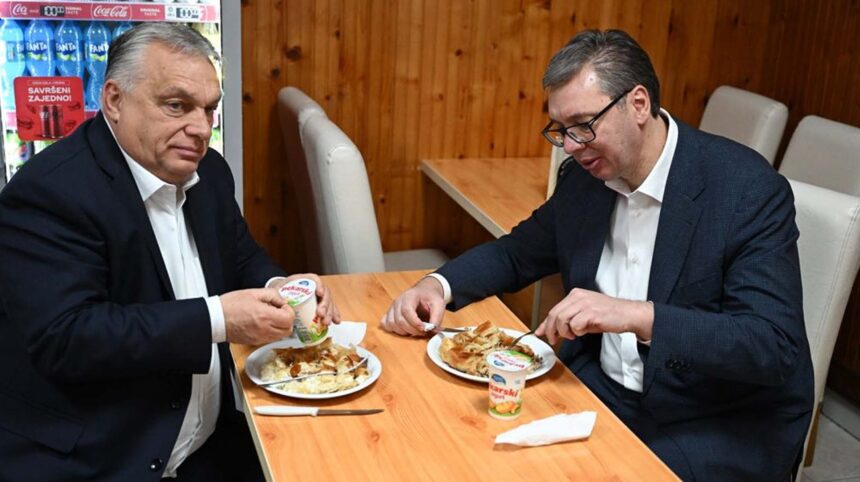
For years, Aleksandar Vučić and Viktor Orbán represented two closely connected political models in Europe: nationalist rhetoric, concentrated executive power, pressure on independent institutions and a foreign policy that maintained close relations with Vladimir Putin’s Russia while continuing to benefit from cooperation with the European Union.
Their political partnership was more than a friendship between two leaders. Orbán became one of Vučić’s most important political allies inside the EU, repeatedly defending Belgrade when concerns were raised about Serbia’s democratic standards, media freedom and refusal to align with European sanctions against Moscow. Their relationship demonstrated how governments could publicly promote European cooperation while maintaining political positions favourable to the Kremlin.
Both leaders built their political influence around nationalist narratives and the portrayal of political opponents as threats to national interests. In Serbia, Vučić’s Serbian Progressive Party (SNS) consolidated control over political institutions and built extensive networks of influence. In Hungary, Orbán’s Fidesz reshaped the country’s political and institutional landscape during sixteen years in power. Although their systems were not identical, both faced sustained criticism over democratic backsliding, institutional independence and media freedom.
The political setbacks suffered by these leaders have exposed the vulnerabilities of this model. But removing a leader does not automatically dismantle the structures he created. Their political networks, loyalists and influence over public institutions do not disappear simply because a new government takes office.
In Serbia, the collapse of the Novi Sad railway station canopy, which killed 16 people in November 2024, became a defining moment. The tragedy sparked demands for accountability and developed into a wider protest movement against corruption, non-transparent public projects and the concentration of political power. Students, teachers, farmers and ordinary citizens challenged a government that had presented itself as politically unassailable.
Hungary experienced its own political turning point. After sixteen years of Orbán’s rule, public dissatisfaction over corruption, economic pressures and political scandals helped create the conditions for Péter Magyar and the Tisza movement to challenge Fidesz’s dominance. In both countries, new political movements mobilised voters frustrated with established political structures.
But the relationship with Russia remains particularly important. Vučić maintained close relations with Putin, refused to join EU sanctions against Russia following its full-scale invasion of Ukraine and continued to rely on Moscow’s diplomatic support on international issues, including Kosovo. Orbán, meanwhile, repeatedly challenged European consensus on Russia and maintained close political and economic relations with the Kremlin. Their cooperation helped preserve a political space in Europe in which Moscow could maintain important partnerships despite its war against Ukraine.
Orbán’s political influence was also valuable to Vučić inside the European Union. Budapest frequently defended Belgrade at a time when Serbia faced criticism over its democratic record and foreign-policy alignment. The relationship between the two leaders therefore had consequences beyond their bilateral ties: it helped reinforce a political alliance that complicated the EU’s efforts to maintain a consistent position on democratic standards and Russia.
However, the political changes in Hungary and Serbia do not automatically erase this legacy. The structures they built, the nationalist narratives they promoted and the relationships they cultivated with Moscow remain important challenges for their successors.
This brings us to the Student List in Serbia. Its challenge to Vučić’s rule has raised expectations of political change, but the movement must now answer a difficult question: will it genuinely break with the political direction established under Vučić, or will it preserve key elements of that policy under new leadership?
The Student List brings together supporters with different political views, including pro-European voices and conservative nationalists. Its positions on Russia have raised important questions about the extent of the change it intends to deliver. If the movement continues to defend close political relations with Moscow and opposes aligning Serbia with European sanctions, then its foreign policy may remain largely unchanged despite a change in government.
The comparison with Orbán is unavoidable. If the Student List replaces Vučić but preserves the same political alignment with Putin’s Russia, continues the same nationalist mobilisation and protects the networks built during SNS rule, then the promised change will have clear limits. Serbia cannot claim to have broken with the past while maintaining the policies that defined it.
Kosovo is another important test of whether Serbia’s political direction will change. Under Vučić, Belgrade has continued to use nationalist rhetoric around Kosovo and to challenge the country’s sovereignty and statehood. The question is whether the Student List will continue this approach or move towards a policy based on respecting Kosovo’s sovereignty, implementing commitments and ending the use of Kosovo as an instrument of domestic political mobilisation. A change in Serbia’s leadership should also mean a change in how Belgrade approaches its neighbours and its international obligations.
The new leadership will also have to confront the consequences of years of political control over institutions, public procurement and the media. It must demonstrate whether it is prepared to investigate corruption, establish judicial independence and hold powerful figures accountable, including those connected to the previous government.
The European Union faces its own test. For years, Brussels maintained close relations with Vučić and Orbán despite repeated concerns about democratic standards. It now has an opportunity to support genuine institutional reform rather than simply replacing one political partner with another. Serbia’s European integration will depend on concrete progress in the rule of law, media freedom, democratic accountability and alignment with the EU’s foreign-policy positions.
The political setbacks suffered by Orbán and Vučić have weakened two leaders who maintained close relations with Moscow and shared important political interests. But their departure alone will not end the influence of the political model they represented.
Orbán’s political era has been challenged, and Vučić’s dominance has been shaken. But will Serbia finally break with the political model that tied Belgrade so closely to Moscow, or will the Student List simply give that model a new face? Replacing the leadership is not enough if the same political networks, nationalist narratives and foreign-policy choices remain in place. The real test is whether Serbia changes its direction — not just the people occupying positions of power.