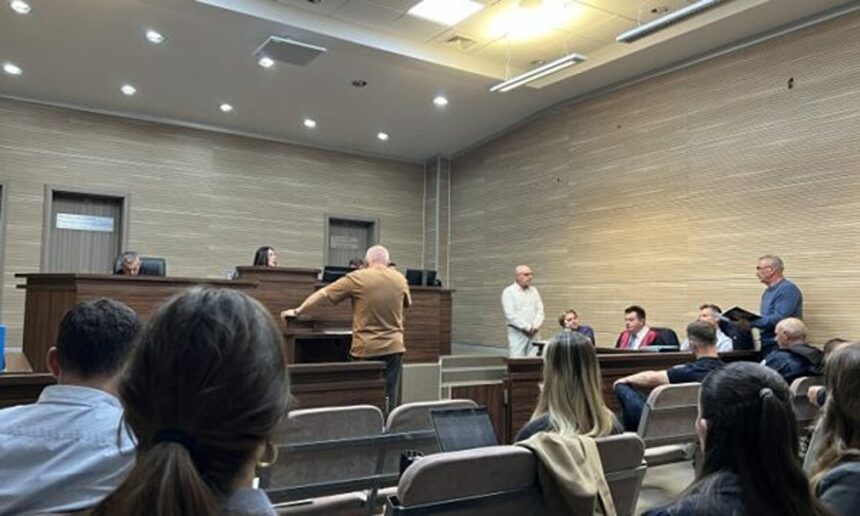
The trial against former Serbian police officials Momir Pantiq and Zharko Zariq continued Tuesday at the Basic Court of Prishtina, where survivors delivered chilling testimony about massacres carried out against Albanian civilians in the Istog region during the Kosovo war.
Witnesses Enver and Rahime Lipaj recounted the brutal killing of nine members of their family in April 1999, describing how Serbian forces allegedly executed them before throwing their bodies into a well and later blowing it up with explosives in an attempt to erase evidence of the crime.
According to Enver Lipaj, the violence escalated immediately after NATO bombing began on March 24, 1999, when Serbian police forces forced civilians from their homes across the Istog area.
He testified that on April 13, 1999, Serbian police units entered the village of Studenicë after earlier movements had been observed through binoculars from UÇK positions near Kamenicë.
“My mother, my two daughters, and other relatives had returned to prepare food. Serbian forces captured them, executed them, and threw them into the well,” Lipaj told the court.
He described the massacre as a “triple crime” — capture, execution, and concealment of the bodies.
“They killed all nine of them, shot them, and then threw them into the well,” he said.
According to his testimony, Serbian forces later detonated explosives inside the well to destroy traces of the massacre and ensure nobody survived.
Among the victims were Lipaj’s mother, his two underage daughters aged 15 and 13, and several close relatives and civilians sheltering at the house.
Lipaj stated that the exhumation process on June 25, 1999, was documented by Italian KFOR troops and international media, including Euronews, with footage reportedly later submitted to the International Criminal Tribunal for the former Yugoslavia as evidence.
During questioning, Lipaj accused Pantiq — then the highest-ranking police commander in Istog — of responsibility through command authority.
“He had the highest hierarchy in the Istog police station. He could have stopped these killings, especially the murders of children, women, and elderly civilians,” the witness stated.
Rahime Lipaj also testified, recalling how family members had returned early that morning simply to bake bread and collect food before Serbian police forces surrounded the area.
The prosecution alleges that Pantiq and Zariq committed war crimes against civilians during 1998–1999, including killings, torture, abuse of prisoners at Dubrava Prison, and sexual violence against Albanian civilians.
According to the indictment filed by the Special Prosecution of the Republic of Kosovo, Serbian police and prison guards under the command structure linked to Pantiq allegedly carried out systematic violence against Albanian prisoners during the Dubrava Prison massacre in May 1999.
The case remains one of the most disturbing war crimes trials currently being heard in Kosovo courts, reopening painful memories of massacres and atrocities committed against Albanian civilians during the war.