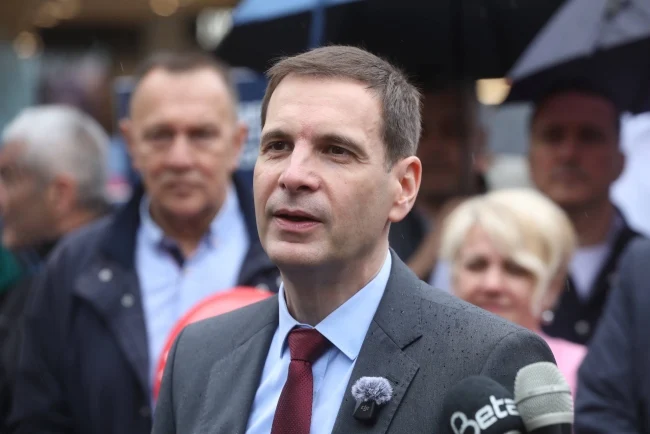
Miloš Jovanović, leader of Serbia’s New Democratic Party of Serbia (Novi DSS), has criticized Ukrainian President Volodymyr Zelenskyy’s planned visit to Belgrade, arguing that the trip and the broader foreign policy pursued by President Aleksandar Vučić are contrary to Serbia’s national and state interests.
In a statement on Friday, Jovanović said Novi DSS supports good relations between Serbia and Ukraine, describing Ukraine as a fellow Slavic country that has not recognized Kosovo’s independence. However, he argued that Zelenskyy’s visit should be viewed within what he described as a broader Western effort to demonstrate that both Serbia and Ukraine are on an irreversible pro-Western course and to reduce Russian influence in the Balkans.
Jovanović questioned claims that economic and trade cooperation would be the main focus of the visit, suggesting that discussions could also involve Serbian arms and ammunition exports to Ukraine.
His comments followed recent reporting on Serbia’s indirect military cooperation with Ukraine and statements by former U.S. Ambassador to Serbia Christopher Hill, who said Washington had supported the purchase of significant quantities of Serbian ammunition for Ukraine through intermediary countries.
Jovanović also warned that closer ties between Belgrade and Kyiv could weaken Serbia’s relationship with Moscow and potentially affect Russian support for Serbia, including on territorial issues and in the energy sector.
He accused Vučić of gradually bringing Serbia under Western influence, arguing that the consequences of this policy were already visible in Kosovo.
“The visit confirms that Aleksandar Vučić is gradually but thoroughly subordinating Serbia to the West, with all the damaging consequences this subordination brings,” Jovanović said.
The Novi DSS leader said his party regretted that Ukraine had become a battlefield for confrontation between the West and Russia, arguing that Serbia had experienced the consequences of Western intervention in the region during the conflicts of the 1990s.
Jovanović called for the war in Ukraine to end through a peace agreement that would serve the interests of both Ukrainians and Russians. At the same time, he argued that Serbia should fundamentally reconsider its foreign policy, particularly its relationship with the European Union.
He said cooperation with the EU was both necessary and desirable, but opposed Serbia’s membership in the bloc.
Zelenskyy is expected to visit Belgrade on Saturday for his first official visit to Serbia. The trip is expected to focus publicly on economic and bilateral cooperation, as well as Serbia’s and Ukraine’s respective paths toward EU membership, while sensitive issues surrounding Serbia’s relations with Russia and Ukraine are likely to remain part of the wider political context.