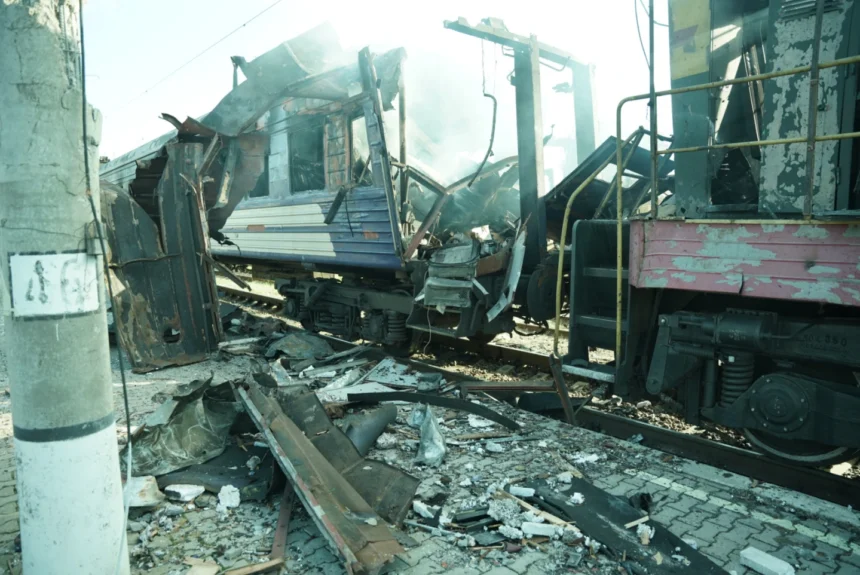
Russia has ramped up its attacks on Ukraine’s railway infrastructure, deploying advanced long-range drones equipped with live video feeds to strike with unprecedented accuracy. These attacks, Ukrainian officials warn, are targeting the country’s most critical logistics network — essential for both civilian and military operations.
Earlier this month, Russian drones hit the Shostka train station in the Sumy region, killing a 71-year-old man, injuring at least eight others, and leaving passenger trains engulfed in flames. The assault, just 70 kilometers from the Russian border, involved two explosive drones that struck in rapid succession.
Rising Frequency and Precision
According to Oleksandr Pertsovskyi, CEO of Ukrainian State Railways, Russia has doubled its railway attacks since mid-summer, moving from roughly one per week to as many as two or three per week.
“What happens is not just about the quantity,” Pertsovskyi told AP. “Now, as they have very precise Shahed drones, they are targeting individual locomotives.”
Ukrainian officials report over 300 attacks on railway infrastructure since August, averaging 10 strikes per week. These have hit power lines, substations, train stations, and rail tracks, disrupting both freight and passenger services.
Ukraine’s rail system carries over 63% of the nation’s freight and 37% of passenger traffic, making it a lifeline for grain, metal exports, and foreign military aid.
New Russian Drone Capabilities
Experts say Russia’s drone fleet has undergone major upgrades, now featuring onboard cameras and radio modems that allow operators to steer drones in real time rather than relying on preprogrammed routes.
“This real-time control makes locomotives — slow and predictable targets — extremely vulnerable,” said Serhii Beskrestnov, a Ukrainian drone analyst.
Modified drones can fly up to 200 kilometers (124 miles) into Ukrainian territory while streaming video directly to Russian operators, enabling precision strikes and damage assessments.
A Ukrainian Defense Ministry official confirmed that Geran-type drones (Russian versions of Iran’s Shahed models) have been found equipped with civilian cameras and communication systems — suggesting Moscow is experimenting with hybrid drone technologies.
Ukrainian Resilience and Rapid Repairs
Despite repeated bombardments, Ukrainian railway crews continue to restore damaged lines within hours. In Kyiv, team leader Maksym Shevchuk, 30, described fixing 12 meters of destroyed track in half a day after a missile strike.
From January to August 2025, freight traffic fell by 11.7% and passenger numbers by 4.2%, according to Ukraine’s State Statistics Service. However, economic analysts credit the country’s rapid repair efforts for preventing a larger collapse.
“The impact so far is negative but marginal,” said Nataliia Kolesnichenko, senior economist at the Center for Economic Strategy, noting effective rerouting and resilience as key factors.
Pertsovskyi emphasized the symbolic importance of keeping trains running:
“It is paramount to show Ukrainians — and the enemy — that these attacks will not achieve their goals.”