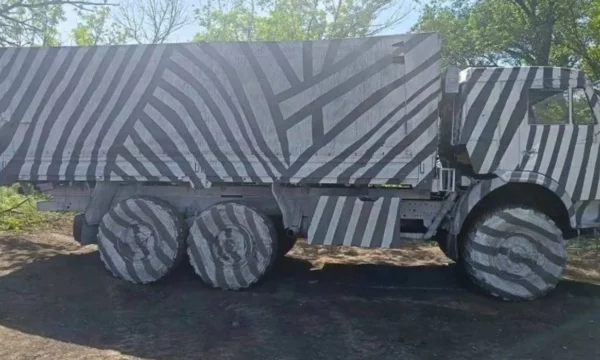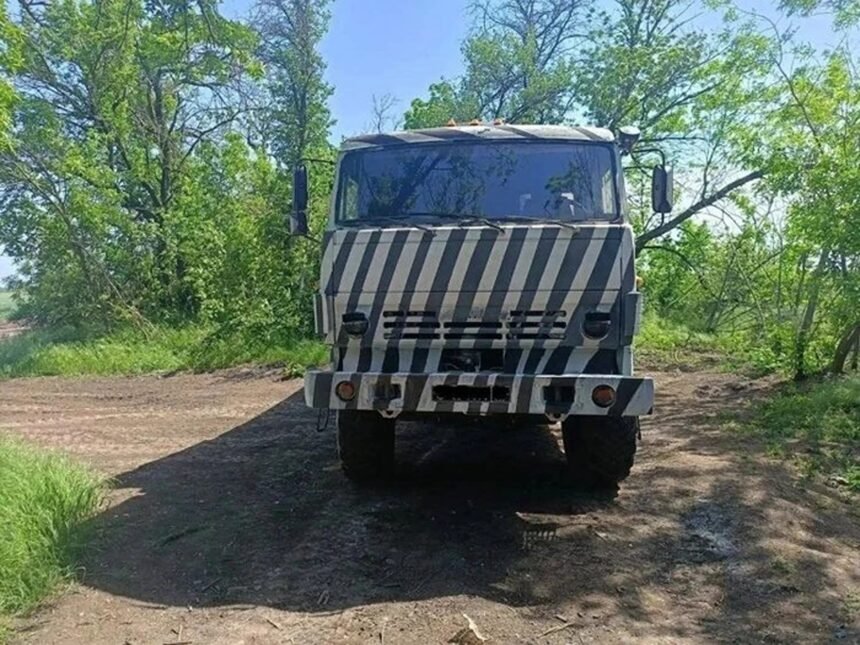
Russia is using “zebra-style” camouflage from the World War I era in an attempt to protect its vehicles from AI-guided kamikaze drones.
The Russian military is applying an old camouflage technique known as “Dazzle,” originally developed during World War I, in order to make its vehicles more difficult to target by Ukrainian attack drones equipped with artificial intelligence.
Images of military Kamaz and Ural trucks painted in irregular black-and-white patterns have spread online, raising questions about the effectiveness of this approach.
The purpose of the camouflage is not to make vehicles invisible to the human eye, but to confuse automated targeting systems.
According to military experts, the technique was first developed in 1917 by British naval artist Norman Wilkinson to reduce the effectiveness of German submarine attacks.
Known as “Dazzle,” it was not designed for concealment, but for deception—making it difficult to judge a target’s direction, speed, and type.
More than a century later, Russia appears to believe this camouflage may still be effective. However, experts remain skeptical about its performance against modern drone technology.
Meanwhile, Ukraine continues to strike Russian targets with drones, as the war increasingly evolves into a technological confrontation between autonomous systems and new countermeasures.