Russia’s state-controlled media network, Russia Today (RT), has launched an aggressive disinformation campaign targeting Kosovo’s law enforcement institutions and acting Prime Minister Albin Kurti. The coordinated information operations arrive just days before Kosovo is scheduled to hold its general parliamentary elections on June 7, 2026.
According to regional media monitors and logs compiled by the KosovaPress news agency, the Kremlin-backed outlet is actively fabricating narratives to create an international perception that the ethnic Serb minority in northern Kosovo is facing “systematic persecution” and “mass judicial sweep operations.”
Fabricating Facts: Rule of Law vs. Kremlin Spin
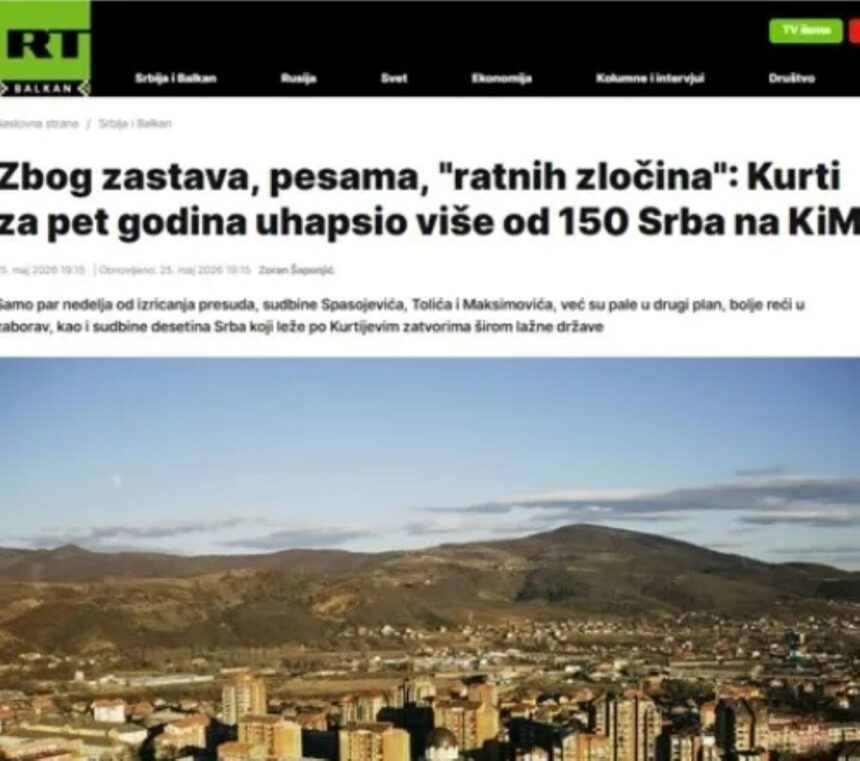
The RT propaganda piece, titled “For Serbian Flags, Nationalist Songs, and War Crimes: Kurti Arrests Over 150 Serbs in Kosovo in Five Years,” seeks to reframe legitimate counter-terrorism, anti-espionage, and anti-corruption operations conducted by the Kosovo Police as ethnically motivated repression.
The state-backed Russian report focuses heavily on the past six days, during which 13 ethnic Serb individuals were lawfully detained by Kosovo authorities under serious criminal warrants.
         [RT PROPAGANDA NARRATIVE]                     [JUDICIAL & LEGAL REALITY]
                     │                                              │
                     ▼                                              ▼
• Claim: Arbitrary political arrests for             • Facts: Lawful detentions based on
  "displaying flags and singing songs."                espionage, terrorism, & war crimes.

• Claim: Systemic voter persecution                  • Facts: Arrest of 7 parallel directors
  targeting the "Lista Srpska" party.                  for illegal voter extortion/blackmail.
The Unreported Facts: Espionage, Terrorism, and Voter Extortion
Security analysts and constitutional experts in Pristina point out that Russian and Serbian state media are systematically stripping the judicial context from these arrests to stoke inter-ethnic tensions ahead of the June vote. The legal realities omitted from the RT narrative include:
- The Banjska Terrorist Case: Kosovo’s courts recently handed down formal prison sentences to three members of an armed militant group involved in the September 2023 terrorist assault in Banjska, Zvečan. The convictions were processed through standard legal channels with full international oversight.
- Counter-Intelligence Defeats: Over the past year, the Kosovo Police and intelligence agencies have dismantled several highly active espionage rings, arresting multiple individuals—including Serbian nationals—on evidence of illicit collaboration with hostile foreign intelligence directorates.
- Democratic Safeguards in the North: The recent arrest of seven directors belonging to Belgrade-backed parallel institutional networks was executed under the Kosovo Penal Code. The individuals are accused of weaponizing financial subsidies and deploying direct blackmail to force local Serb voters into backing the nationalist Lista Srpska (Serbian List) party on June 7.
Weaponizing the “Fake State” Trope
Throughout the publication, Russia Today closely mirrors the vocabulary used by Belgrade officials, repeatedly referring to the Republic of Kosovo as a “fake state.” The Russian state apparatus is also attempting to personalize the democratic friction by attacking Kurti’s political profile—citing the presence of the Albanian flag in his office and his dual voting history in Albania to stoke fears of a “Greater Albania” project among minority populations.
Kosovo’s Ministry of Internal Affairs, alongside international monitoring missions including EULEX and KFOR, have maintained that all security operations are ethnically blind, strictly adheres to European standards of jurisprudence, and remains focused on preserving national security, fighting terrorism, and ensuring a free and democratic electoral cycle.