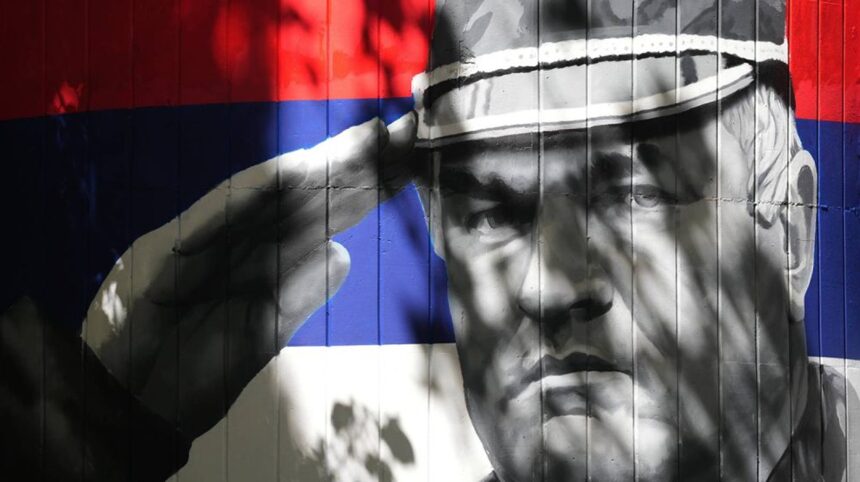
Serbia is preparing to bid farewell to Ratko Mladić, the former Bosnian Serb military commander convicted of genocide and other war crimes, with a ceremony that has sparked outrage across the region and renewed questions about Belgrade’s commitment to confronting its wartime past.
According to Serbian media reports, a commemoration for Mladić will be held on Saturday, September 5, at the Army House in Belgrade, followed by his funeral on Monday, September 7, at Topčider Cemetery.
Mladić died in The Hague while serving a life sentence. He was convicted for genocide, crimes against humanity and other war crimes, including his role in the 1995 Srebrenica genocide, in which more than 8,000 Bosniak men and boys were killed.
Yet instead of allowing his death to mark a moment of reckoning, Serbia is preparing a public farewell that has been widely criticized as an attempt to glorify a convicted war criminal.
Vučić: The problem is not the criminal — it is “security”
Serbian President Aleksandar Vučić has focused publicly on the security arrangements surrounding the funeral, saying authorities expect tens of thousands of people to attend.
“We have to secure everything,” Vučić said, describing the preparations as a major challenge for the security services.
The striking part is what is missing from the discussion: accountability, the victims and the crimes for which Mladić was convicted.
Instead, the Serbian state is preparing to manage the logistics of a large gathering around a man who was sentenced to life imprisonment by an international tribunal for some of the gravest crimes committed in Europe since World War II.
Reports that Mladić would receive state and military honors have already triggered international condemnation. Serbian Justice Minister Nenad Vujić said that Mladić was entitled to a national funeral and military honors, while Vučić himself attacked the Hague tribunal after Mladić’s death.
Brussels has already drawn the line
The controversy has also reached Brussels.
EU Enlargement Commissioner Marta Kos has warned Serbia that glorifying convicted war criminals is incompatible with European values and has no place either inside the EU or in countries seeking membership.
“Glorification of war criminals is contrary to fundamental European values,” Kos said, adding that Serbia would have to decide where it wants to belong.
That puts Belgrade in an uncomfortable position: Serbia continues to pursue EU membership while its authorities are simultaneously facing criticism over the public honoring of a man convicted of genocide.
A funeral that says more than a thousand speeches
The question is therefore not simply where Ratko Mladić will be buried.
It is what Serbia chooses to remember — and what it chooses to honor.
For the families of Srebrenica victims and survivors of the Bosnian war, Mladić is not a symbol of national pride. He is the commander convicted of some of the most horrific crimes of the conflict.
And for the European Union, the message from Brussels is increasingly explicit: European integration cannot be separated from truth, accountability and respect for victims.
Serbia may organize the ceremony. Vučić may deploy the security services to protect it. Supporters may gather in their thousands.
But no ceremony can erase a conviction for genocide.
History has already passed its judgment on Ratko Mladić. The question now is what judgment Serbia wants to make about itself.