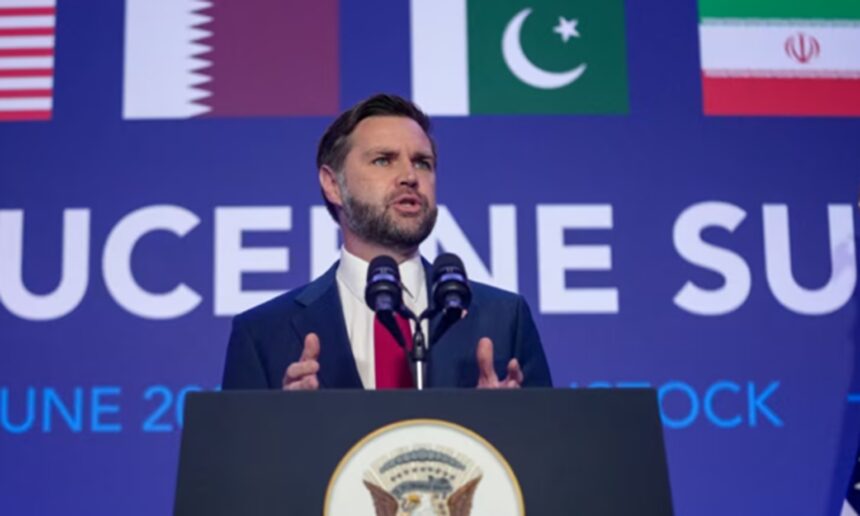
U.S. Vice President JD Vance said that “good progress” has been achieved in negotiations on a roadmap aimed at reaching a comprehensive peace agreement with Iran within 60 days. The reported progress includes ensuring safe passage through the Strait of Hormuz, ending hostilities in Lebanon, and allowing international nuclear inspectors access to Tehran.
“We have laid a very solid foundation for a successful final agreement,” Vance told reporters on June 22 at the Burgenstock resort in central Switzerland after overnight talks between the parties.
“The final agreement is the house. We have laid the foundation; we have not built the house yet, but we have created a successful base for achieving a good outcome for the American people,” he said.
Few key details have been made public, but the emerging framework appears to reflect the ambitious goals outlined in the memorandum of understanding (MOU) signed last week by the presidents of the United States and Iran.
That memorandum left many of the conditions of a 14-point agreement open to interpretation.
Vance stated that Tehran had agreed to allow inspectors from the International Atomic Energy Agency (IAEA) to return to the country and that both sides had worked on establishing a coordination mechanism to keep the Strait of Hormuz open for energy shipments and to clear naval mines in the area, with the aim of preventing disruptions to global oil and gas supplies.
Earlier, mediators from Qatar and Pakistan said that although the formal first round of negotiations had concluded, further technical discussions would continue throughout the coming week.
According to the mediators, working groups will be established to address nuclear issues, sanctions, and dispute-resolution mechanisms to ensure the effective implementation of the memorandum and related agreements.
Iran’s Foreign Ministry, in comments reported by state media, said that the U.S. blockade on Iranian ports had been lifted, that “some frozen assets” had been released, and that a “major development and reconstruction plan” for Iran had begun.
A ministry spokesperson said that a mechanism for ensuring the safe passage of ships through the Strait of Hormuz had been agreed upon, although no further details were provided.
Officials said the talks lasted 18 hours.
Vance, Special Envoy Steve Witkoff, and Jared Kushner, son-in-law of U.S. President Donald Trump, led the American delegation. Iran’s delegation was headed by Parliament Speaker Mohammad Baqer Qalibaf and Foreign Minister Abbas Araqchi.
The mediators added that, based on the memorandum between Washington and Tehran, the parties had agreed to establish a High-Level Committee to provide political oversight of the mediation process.
“The committee has agreed on a roadmap aimed at reaching a final agreement within 60 days, laying the groundwork for the immediate start of additional technical negotiations,” the statement said.
A dedicated communication channel has also been established for the 60-day period to prevent incidents and misunderstandings and to guarantee the safe passage of commercial vessels through the Strait of Hormuz.
In addition, a deconfliction cell involving the United States, Iran, and Lebanon—facilitated by the mediators—will be established to help end military operations in Lebanon, as outlined in the memorandum.
Araqchi echoed Vance’s comments in a post on X, saying that “major progress” had been achieved during the talks.
“Mediation by Pakistan and Qatar has produced significant progress toward ending the war in Lebanon,” Araqchi wrote.
“Exports of oil and petrochemical products have been exempted from restrictions, the blockade has been lifted, some frozen assets have been released, and a major reconstruction and development plan for Iran has been launched,” he added.
Washington has pledged to facilitate the release of a $300 billion reconstruction fund backed by regional countries once a broader final agreement on Iran’s nuclear program is reached.
The agreement—particularly the reconstruction fund and the lack of clarity surrounding Iran’s nuclear program—has drawn criticism from both Democrats and many Republicans in the United States.
Vance responded to those concerns by saying that if Iranian funds are eventually released, the United States will ensure that “Iranian money is used to help the Iranian people and not to finance terrorism.”
Many Israeli leaders have also expressed skepticism about aspects of the negotiations, emphasizing that Israel is not a party to the agreement and pledging to continue military operations against Hezbollah positions in Lebanon.
Hezbollah, which is backed by Iran, is a militant group and political party that controls much of southern Lebanon. It is designated as a terrorist organization by the United States, while the European Union has blacklisted its military wing but not its political branch.