Serbian President Aleksandar Vučić could face a new political dilemma if European Commission President Ursula von der Leyen visits Belgrade in October, potentially during Serbia’s parliamentary election campaign and after Vučić has stepped down from the presidency, as he has repeatedly suggested he plans to do.
According to Nova.rs, von der Leyen is expected to visit Serbia as part of her regular tour of the Western Balkans ahead of the European Commission’s annual enlargement assessment. The exact date has not yet been confirmed.
The potential timing could prove politically sensitive. If parliamentary elections are held on October 25, as Vučić has indicated, the visit could coincide with the final stage of the campaign.
At the same time, if Vučić follows through with his plans to resign as president and potentially seek the position of prime minister, he may no longer be the Serbian official formally responsible for hosting the European Commission president.
Marta Kos already canceled Serbia visit
The issue comes amid heightened sensitivity between Belgrade and Brussels.
European Commissioner for Enlargement Marta Kos recently canceled a planned visit to Serbia following the Serbian authorities’ handling of the funeral and public honoring of convicted war criminal Ratko Mladić.
Kos said the glorification of Mladić, who was convicted of genocide, crimes against humanity and war crimes, was incompatible with European values.
“The glorification of his death is incompatible with the values on which the European path is built,” Kos said, adding that Serbia’s European future requires confronting the past, genuine reconciliation and respect for victims of war crimes.
Against that backdrop, von der Leyen’s possible October visit could attract considerable political attention in Serbia.
Could Vučić delay his resignation?
Duško Lopandić of the European Movement in Serbia told Nova.rs that Vučić’s potential resignation should primarily be viewed as part of his broader political calculations rather than as something directly connected to von der Leyen’s visit.
“He has abused his position as president, his powers, but also the Constitution for years,” Lopandić said, arguing that the timing of Vučić’s resignation could be linked to his plans to run for prime minister and potentially combine parliamentary and presidential elections.
He also warned that von der Leyen’s presence during an election campaign could create the perception of European support for the Serbian authorities.
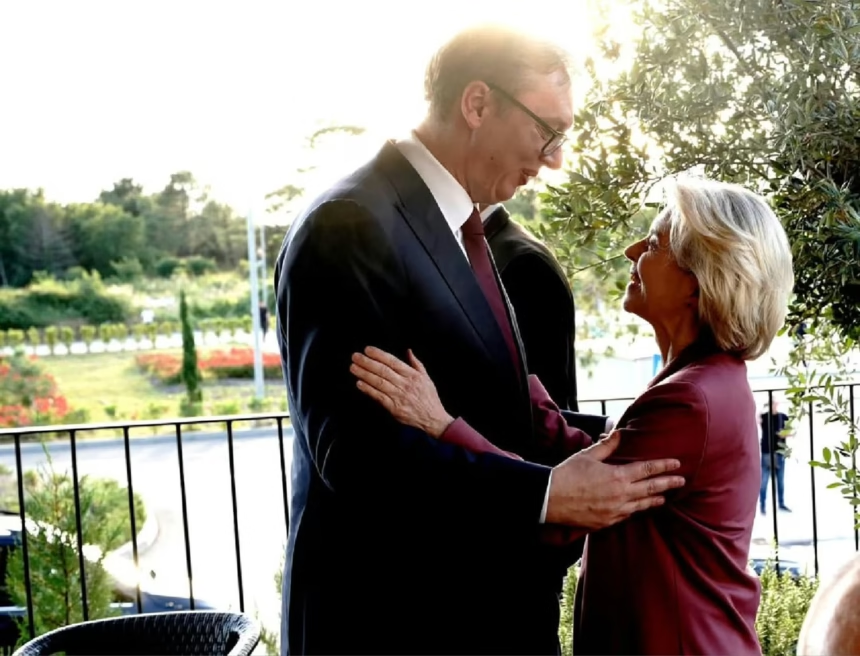
Lopandić pointed to what he described as a previous pattern of excessive closeness between von der Leyen and Vučić, saying there was a risk that such an impression could be repeated.
Nemanja Todorović Štiplija, editor-in-chief of European Western Balkans, offered a different assessment, arguing that von der Leyen’s visit should not automatically be interpreted through the lens of Serbia’s elections.
He noted that the European Commission president has regularly visited all six Western Balkan countries ahead of the Commission’s annual reports on candidate countries.
According to Štiplija, such visits have taken place even when countries were in the middle of election campaigns.
He nevertheless acknowledged that von der Leyen would likely adapt her political messaging to the circumstances in Serbia if the visit coincides with the campaign.
Macut could host von der Leyen
If Vučić resigns before von der Leyen arrives, Prime Minister Đuro Macut would formally be expected to host the European Commission president.
Štiplija said that would be more consistent with the constitutional division of responsibilities, given that von der Leyen heads the EU’s executive branch while the Serbian prime minister leads the country’s executive government.
However, he noted that meetings between von der Leyen and Vučić have traditionally attracted far more political attention than her meetings with the Serbian government.
“The prime minister of Serbia is the one who should talk to her,” Štiplija said, arguing that a meeting between von der Leyen and Macut would be institutionally appropriate if Vučić were no longer president.
Von der Leyen’s relationship with Vučić under scrutiny
Von der Leyen has for years been viewed by critics of the Serbian government as one of Vučić’s most important political allies in Brussels.
The relationship has repeatedly drawn criticism from members of the European Parliament and European political groups, particularly over concerns about Serbia’s democratic standards, media freedom, corruption and electoral conditions.
MEP Thijs Reuten previously argued that Vučić had received too much protection from von der Leyen and European Council President António Costa, calling for the EU to end what he described as a policy of appeasing an authoritarian leader in a candidate country.
European Greens have also called on von der Leyen to take a clearer position toward Vučić and Serbia’s democratic shortcomings.
The political significance of an October visit would therefore depend heavily on its timing and messaging.
If von der Leyen arrives during the final days of an election campaign, her meetings and public statements could become a major political issue in Serbia. If Vučić has already resigned, however, the formal protocol would shift toward Prime Minister Macut — potentially creating an unusual situation in which one of the most important European political visitors to Serbia meets the man formally responsible for government policy while the country’s most dominant political figure campaigns for another office.