Since launching its full-scale invasion of Ukraine in February 2022, the Russian Federation has implemented a highly sophisticated, state-funded social engineering apparatus targeting the most vulnerable segment of the occupied population: Ukrainian children.
Through an intricate network of paramilitary groups, specialized educational curricula, and state-subscribed “Cossack” organizations, Moscow is systematically erasing the national identity of young Ukrainians, transforming them into a loyal, militarized human resource pool for the Russian Armed Forces.
The Evolution of Cossack Paramilitarism (2014–2022)
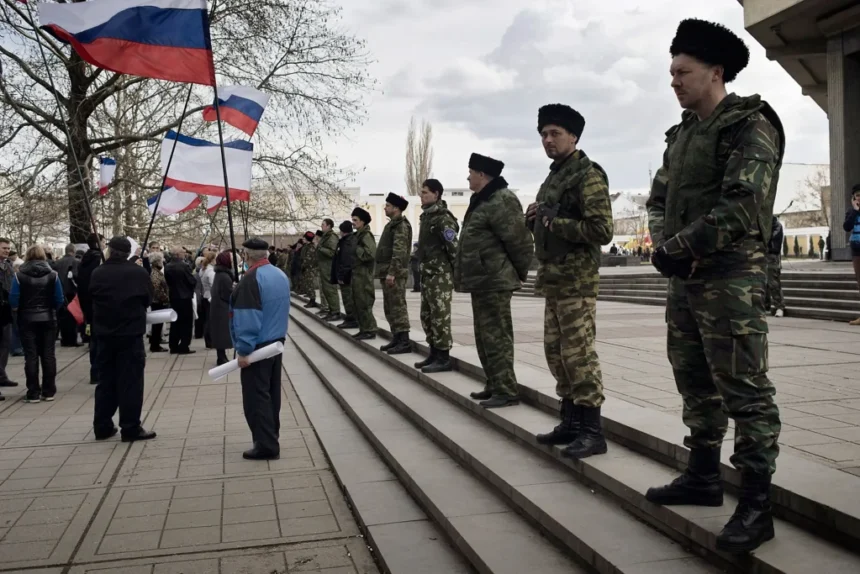
The weaponization of youth did not begin with the 2022 invasion. Following the 2014 illegal annexation of Crimea and the hybrid occupation of the Donetsk and Luhansk regions, the Kremlin deployed pro-Russian “Cossack” groups to anchor its ideological baseline.
The Don Cossacks—descendants of a historical frontier military community along the Don River—were formally co-opted by the Russian state through presidential decrees between 1996 and 1998. In 1995, the modern “Great Don Army” was registered under the Russian Ministry of Justice, led by Ataman Mykola Kozitsyn.
[The Donbas Paramilitary Pipeline (2014)]
Ataman Kozitsyn (Novoçerkask, Russia) ──> Recruits Don Cossacks ──> Infiltrates Donbas
                                                                         │
                                                                         ▼
                                                          Captured 80% of Luhansk (LPR)
                                                                         │
                                                                         ▼
                                                          Established First "Cadet Corps"
In the spring of 2014, Kozitsyn organized armed cells in Novoçerkask, Russia, and dispatched them into eastern Ukraine. These units quickly seized approximately 80 percent of the territory claimed by the self-proclaimed “Luhansk People’s Republic” (LPR).
Once entrenched, these paramilitary formations laid the groundwork for systematic youth indoctrination. Under the administration of LPR leader Leonid Pasechnik, the occupation authorities established three specialized Cossack Cadet Corps, expanding “Cossack education” from early childhood kindergartens through to regional universities.
Post-2022 Expansion: Co-opting the Cradle of Ukrainian Identity
Following the 2022 full-scale invasion, the scale of Cossack mobilization expanded dramatically. According to defense data, approximately 4,000 Cossacks fought in Ukraine within the “Don” and “Tavria” battalions in April 2022. By late 2023, that number surged past 25,000 fighters integrated into the BARS (Russian Army Combat Reserve) system.
| Russian Cossack Demographics (State Registry) | Total Personnel Count |
| Registered Cossacks in the Russian Federation | ~146,000 |
| Mobilization-Ready Active Personnel | ~60,000 |
| Enrolled Cadets in Cossack Training Academies | ~29,000 |
This expansion carries a profound psychological and historical weight. For Ukrainians, Cossacks—specifically the historical Zaporizhian Cossacks—represent the bedrock of free, democratic self-governance and national sovereignty. The Ukrainian national anthem explicitly boasts of “Cossack origin.”
The Kremlin is deliberately exploiting this cultural reverence in newly occupied zones of Kherson and Zaporizhzhia—the historical cradle of Ukrainian Cossackdom. By deploying units like the “Dnipro” battalion, which misuses traditional Ukrainian Cossack symbols, Russia masks an autocratic occupation behind a familiar historical veneer.
[The Indoctrination Architecture]
   Russia's State Policy Strategy for Cossacks 2021–2030 (Presidential Decree)
                                 │
         +-----------------------+-----------------------+
         |                                               |
         v                                               v
[Paramilitary Oversight]                         [Educational Capture]
Mounted "discipline" patrols,                     "Conversations about Important Things"
weapons handling, & live-fire drills.             mandatory political school lectures.
Operating under Russia’s State Policy Strategy for Cossacks 2021–2030, these units execute horse-mounted policing patrols, manage youth military camps, and run live-fire weapon training courses for teenagers in direct coordination with the Russian Orthodox Church.
Classroom Warfare: The Indoctrination of “Generation Z”
This state-sponsored systemic re-education constitutes a severe violation of the international right to education and identity. Documented testimonies collected by The Reckoning Project—a global syndicate of journalists and legal analysts investigating war crimes—reveal how this grid operates on a human scale.
Igor (name altered for security), a young Ukrainian from Crimea, was six years old when Russia annexed the peninsula. He recounted how his entire educational lifecycle was completely repurposed:
- Language and Media Erasure: Instruction was restricted exclusively to Russian. Teachers weekly broadcasted state-curated propaganda videos painting Ukraine as a hostile, illegitimate entity. This was later standardized across all occupied schools via the “Conversations about Important Things” (Razgovory o vazhnom) curriculum.
- The Cadet Blueprint: By the fifth grade, Igor’s entire class was funneled into a cadet program. According to a joint report by Save Ukraine, War Child UK, and the Human Security Centre, 41 percent of 200 rescued Ukrainian youth confirmed being subjected to direct militarization. In Crimea alone, the system ballooned to 244 cadet classes across 78 schools during the 2023–2024 academic year.
- Forced Conscription Ready: Students were trained to rapidly assemble and disassemble AK-47 assault rifles and integrated into Yunarmiya (Youth Army), a national organization boasting two million members.
This militarization serves an immediate tactical purpose. Field data indicates that between February 2022 and July 2025, Russia forcibly mobilized over 46,000 Ukrainian citizens from temporarily occupied territories into its frontline ranks—many of whom were recent graduates of these exact state-run paramilitary youth organizations.
Institutional Accountability and the Balkan Parallel
For observers in the Balkan region, the strategic retraining of children in occupied territories is a painfully familiar tactic, mirroring the identity-stripping and forced assimilation methods utilized during the Yugoslav Wars of the 1990s across Bosnia and Herzegovina, Croatia, and Kosovo.
What distinguishes the Russian Federation’s current campaign is its absolute institutional centralization. This is not an erratic, localized excess by rogue commanders; it is a highly budgeted, formalized state program operating under a direct chain of command leading straight to Russian President Vladimir Putin.
[The Institutional Chain of Responsibility]
        President Vladimir Putin (Executive Decrees)
                     │
        Prime Minister Mikhail Mishustin (Action Plans 2024–2026)
                     │
   +-----------------+-----------------+-----------------+
   |                 |                 |                 |
   v                 v                 v                 v
Ministry of     Rosgvardia        Russian Orthodox   All-Russian Cossack
Education       (Nat. Guard)      Church             Society
Operational execution is driven by Prime Minister Mikhail Mishustin’s Action Plan 2024–2026, legally binding the Ministry of Education, Rosgvardia, and the All-Russian Cossack Society to fund, construct, and expand these cadet networks deep into occupied Ukraine.
International human rights lawyers warn that every academic year that passes without comprehensive, global sanctions targeting the entire All-Russian Cossack network allows Moscow to successfully execute a quiet, bureaucratic cultural genocide—effectively training a generation of Ukrainian children to view their own homeland as an existential enemy.