
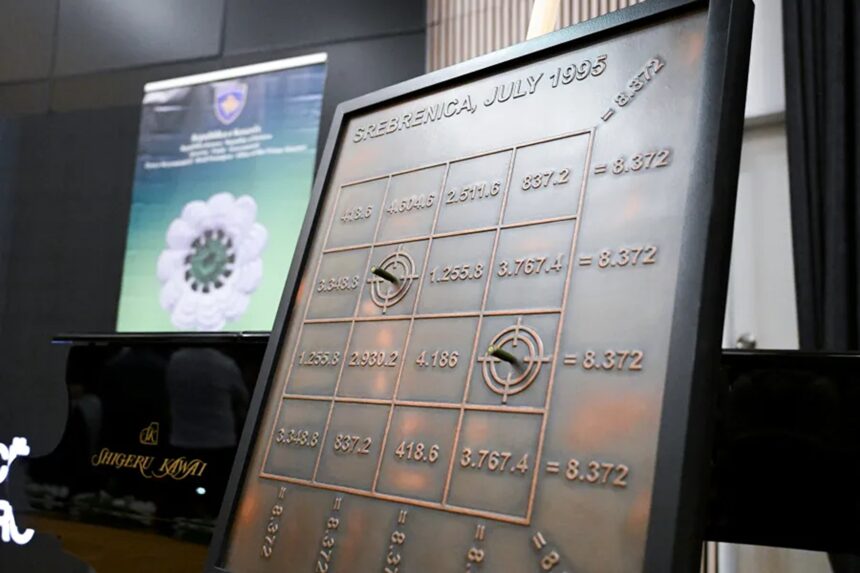
With calls to preserve historical truth, ensure justice for the victims, and reject the denial of atrocities, Kosovo marked the International Day of Reflection and Commemoration of the 1995 Srebrenica Genocide, established by the United Nations General Assembly to honor the victims of the genocide.
The commemorative ceremony was organized by former Deputy Speaker of the Assembly of Kosovo, Emilija Rexhepi, to pay tribute to the victims, reaffirm the importance of truth and justice, and promote a message of peace. As part of the event, a seven-minute documentary dedicated to the Srebrenica massacre was screened.
Rexhepi described the massacre as one of the gravest crimes committed in Europe since the Second World War, stressing that the genocide cannot be relativized or forgotten. She noted that, even three decades later, genocide denial persists and emphasized that no one has the right to remain silent in the face of such a tragedy.
Acting President Albulena Haxhiu echoed this message, stating that Kosovo stands in solidarity with Bosnia and Herzegovina and the families of the victims, emphasizing that without truth there can be neither justice nor peace.
Acting Prime Minister Albin Kurti also warned that denying genocide not only distorts the past but also endangers the future.
The ceremony was attended by Xhemal Smajić, a member of the Parliamentary Assembly of Bosnia and Herzegovina, who said that commemorating the Srebrenica genocide serves as a reminder that the danger remains whenever crimes are denied and ideologies of hatred and division are allowed to persist.
Meanwhile, Shaip Kamberi, an ethnic Albanian member of the Serbian Parliament, stated that resolutions proposed over the years to condemn the Srebrenica genocide have never been allowed to reach parliamentary debate in Serbia.
The Srebrenica genocide, committed in July 1995, has been legally recognized as genocide by international courts. More than 8,000 Bosniak men and boys were killed by Bosnian Serb forces, and July 11 is now observed internationally as a day of remembrance for the victims of the genocide.