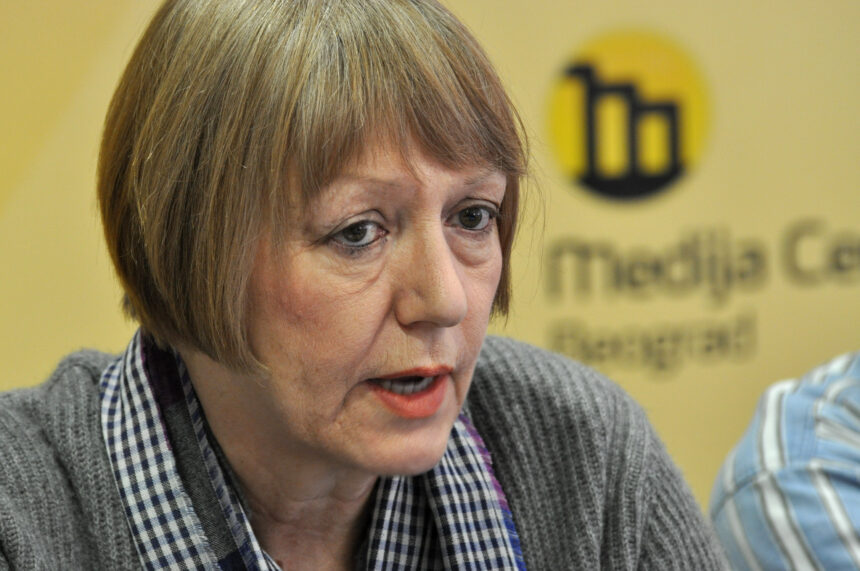
The President of the Helsinki Committee for Human Rights in Serbia, Sonja Biserko, has expressed support for the proposal by Kosovo Prime Minister Albin Kurti to establish a special court that would investigate and prosecute the killings of Bosniak civilians by snipers during the war in Bosnia and Herzegovina.
Although she considers the chances of creating a new international tribunal to be small, Biserko emphasized that the initiative carries strong political and moral significance.
“The chances of creating a new international tribunal are small, but the very idea is meaningful because it shows that the wars of the 1990s have not been socially concluded,” she stated.
She recalled that the International Criminal Tribunal for the former Yugoslavia primarily addressed command responsibility, while many individual cases — including sniper killings during the Siege of Sarajevo — did not receive full judicial closure.
“Sarajevo Safari” and Renewed Debate
Biserko said she is not surprised that the story known as “Sarajevo Safari” has resurfaced decades later. The case was recently revisited by international media, including The Times, citing witness accounts that a wealthy foreign individual allegedly shot civilians in Sarajevo during the nearly four-year siege.
She argued that reopening such cases demonstrates that the past has not been fully addressed and that the memory of crimes remains alive in regional societies.
“If the allegations about ‘Sarajevo Safari’ prove accurate, this would not only be a war crime, but also evidence of a dehumanization that goes beyond ideology, nation, or army — entering the sphere of a culture of violence,” Biserko told Slobodna Bosna.
According to her, these issues are emerging now not because the facts were unknown, but because societies are only now becoming ready to confront them.
On Šešelj and Vučić
Commenting on contradictory statements by Vojislav Šešelj regarding the siege and alleged shootings from the Jewish Cemetery, Biserko described him as an “unreliable” but informed witness.
“Šešelj possesses real information, but his primary motive is political interest, not the search for truth,” she said, recalling his confrontational behavior during his trial in The Hague.
Regarding Serbian President Aleksandar Vučić, who has denied any involvement in the alleged “Sarajevo Safari,” Biserko stressed that no publicly available legal evidence currently proves his personal participation.
“Legally, responsibility is not presumed but proven,” she said.
However, she added that Vučić’s presence at the Jewish Cemetery during the siege carries significant moral weight and keeps the debate over political responsibility open.
Biserko said she does not expect Serbian courts to pursue the matter, noting that after 30 years, proving ballistic evidence and identifying perpetrators is extremely difficult.
International Standing
Biserko also argued that Vučić has lost political capital internationally.
“Manipulation, contradictory messages, and systematic avoidance of a clear geopolitical orientation have led to a loss of trust. Without trust, transactional politics ceases to function,” she said.
While Vučić attempts to balance relations between Washington, Moscow, and Brussels, Biserko concluded that both Russia and Western actors increasingly view him as a politically “expendable” figure.