A new regional survey has found that citizens in Kosovo report the highest sense of personal security in the Western Balkans, while Serbia ranks among the lowest in several key indicators, including trust in institutions and optimism about stability.
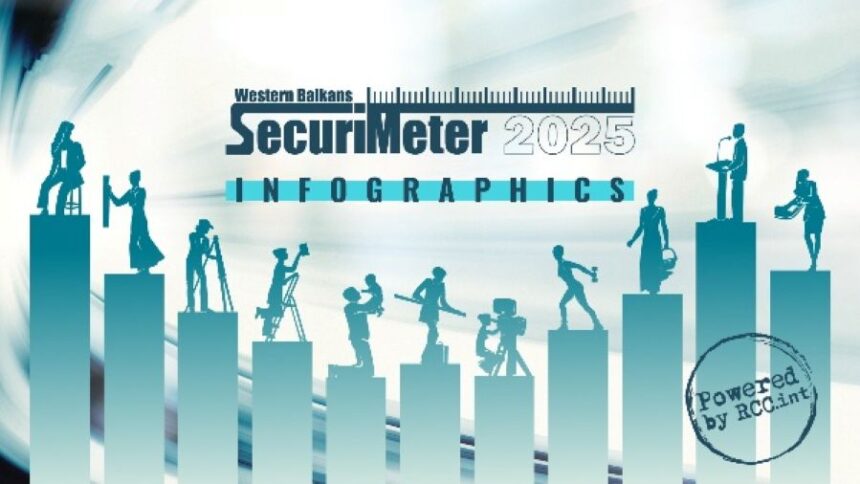
The findings come from the SecuriMeter 2025 report, an annual public opinion survey conducted by the Regional Cooperation Council, which examines security perceptions, economic concerns, and geopolitical orientation across the Western Balkans.
Economic Concerns and Corruption Dominate Public Worries
According to the report, only 25% of citizens across the region say they are satisfied with the current economic situation, highlighting widespread dissatisfaction. Around 45% of respondents report being unhappy with economic conditions, with key concerns including:
- Rising cost of living
- Inflation
- Low wages and pensions
- Emigration and depopulation
Meanwhile, 81% of respondents believe corruption is widespread, and 46% say it has increased over the past three years. The report emphasizes that security in the region is closely tied not only to military or political factors, but also to economic stability and governance.
Kosovo Leads in Perception of Safety
The survey reveals significant differences among countries in the Western Balkans when it comes to personal safety.
Kosovo ranks first, with 58.4% of citizens saying their country is a safe place to live. It is followed by:
- Montenegro – 54.8%
- North Macedonia – 54.6%
- Albania – around 50%
By contrast, Serbia records about 41%, while Bosnia and Herzegovina has the lowest level of perceived personal security at just 32.5%.
Across the region, only 38.4% of respondents consider the Western Balkans as a whole to be safe, while 48.6% view their own country as secure, suggesting that local confidence remains stronger than regional optimism.
Strong Pro-Western Orientation in Kosovo and Albania
The report also highlights clear geopolitical trends in the region. According to SecuriMeter 2025:
- Kosovo and Albania demonstrate a strong pro-Western orientation, with high levels of support for NATO.
- Trust is also relatively higher in the European Union compared with domestic institutions, politicians, and media, which generally receive lower confidence ratings.
- Serbia shows a stronger preference for neutrality or non-alignment, with 27.2% of respondents supporting a neutral geopolitical position.
The survey also notes growing fears in Serbia regarding potential internal conflict during 2025, alongside declining trust in state institutions.
Migration and New Security Threats
Beyond traditional security concerns, the report identifies emerging challenges shaping public perception, including:
- Cyberattacks and data theft
- Disinformation on social media
- The impact of external conflicts
Notably, 46% of respondents believe the war in Ukraine has negatively affected regional security, underscoring how global geopolitical tensions influence attitudes in the Western Balkans.
A Growing “Security Divide” in the Region
The SecuriMeter 2025 report concludes that a clear “security divide” is emerging across the Western Balkans. Countries with strong Western alignment — Kosovo, Albania, Montenegro, and North Macedonia — tend to report higher perceptions of stability and safety, while Serbia and Bosnia and Herzegovina display higher levels of pessimism, insecurity, and preference for neutrality.
According to the Regional Cooperation Council, future regional security policies must address not only traditional threats but also economic stability, the rule of law, anti-corruption efforts, and rebuilding public trust in institutions.