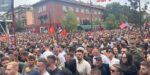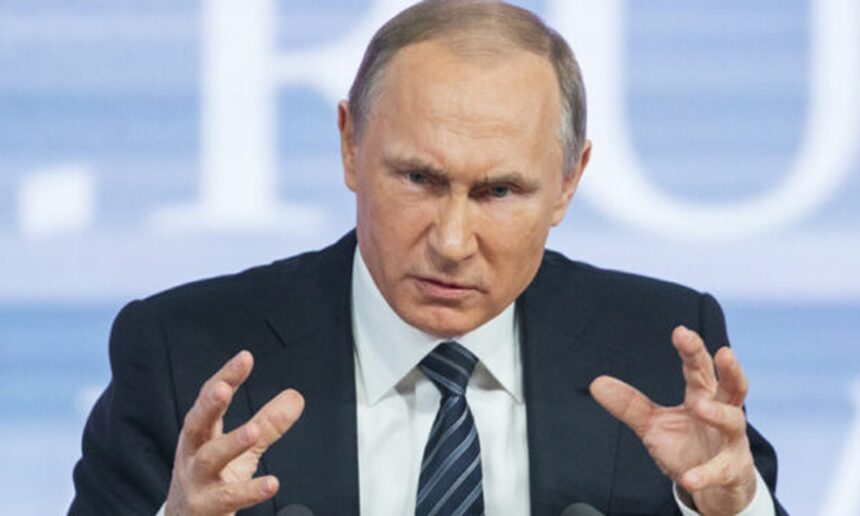
A growing body of research and public demonstrations in Belgrade suggest that Russian President Vladimir Putin continues to enjoy significant support among parts of the Serbian public, even as Russia’s war against Ukraine enters its fourth year.
During recent gatherings marking the anniversary of the invasion, pro-Russian nationalist groups chanted slogans such as “Glory to Russia” and “Death to Ukraine,” while Russian anti-war activists responded with calls of “No to war” and “Russia without Putin.” The contrasting demonstrations highlighted the deep divisions within Serbian society over Russia and the war.
Polls show notable support for Putin in Serbia
According to a recent study by Gallup International Association, around 37% of Serbian citizens express support for Putin, the highest level recorded in the survey among countries where attitudes toward world leaders were measured. Serbia was also the only European country in the study where public sentiment toward Putin was not predominantly negative.
Russian nationals who have relocated to Serbia since the start of the war say they notice this sentiment in everyday life. Some note that older generations appear more influenced by pro-Russian narratives, while younger people tend to show more diverse views.
Propaganda and media influence
Historians and sociologists point to years of pro-Russian messaging and media narratives as a key factor behind Putin’s popularity. Historian Milan St. Protić argues that systematic messaging from multiple directions has shaped public opinion over time, making strong pro-Russian sentiment more likely.
Media analysts also highlight the role of Russian state outlets such as Sputnik and RT (Russia Today), which continue to operate in Serbia even after the European Union banned their broadcasting across member states in 2022 following the invasion of Ukraine.
Studies by the EU delegation in Serbia indicate that only about 8% of citizens blame Russia for the war, while many respondents attribute responsibility to NATO, the United States, or Ukraine itself.
Political balancing between East and West
Serbia’s government, led by President Aleksandar Vučić, has attempted to maintain a delicate geopolitical balance: formally pursuing membership in the European Union while refusing to impose sanctions on Russia.
Belgrade continues to rely heavily on Russian gas imports and maintains close diplomatic ties with Moscow. At the same time, Serbia supports Ukraine’s territorial integrity and has provided humanitarian aid, reflecting a dual approach aimed at preserving both Western and Russian partnerships.
Political analysts say that Russia is often portrayed domestically as a historic protector of Serbian interests, particularly regarding international disputes over Kosovo, which further reinforces pro-Russian sentiment among some segments of society.
A broader fascination with strong leadership
Sociologist Dario Hajrić suggests that Putin’s popularity in Serbia may reveal more about local political culture than about Russia itself. According to him, a long-standing fascination with strong leadership and authority figures has been cultivated by parts of the political establishment, making leaders like Putin appealing to some voters.
Even though meetings between Serbian and Russian leaders have become less frequent since the start of the war, political and symbolic ties remain strong. Serbian officials continue to attend events hosted by Moscow and emphasize cooperation in multiple areas.
As the war continues and geopolitical tensions deepen, public attitudes in Serbia toward Russia and the West remain complex and deeply polarized, reflecting a broader struggle over the country’s political direction and identity.