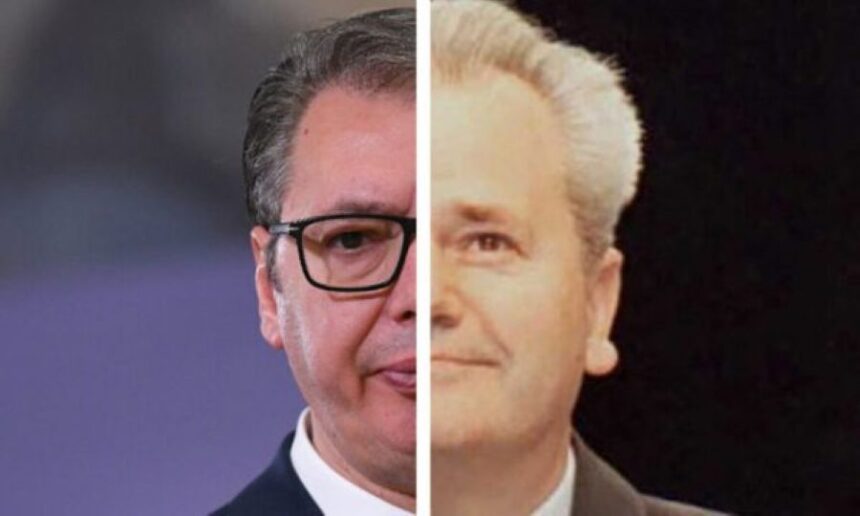
An opinion piece argues that the political mindset shaped during the era of Slobodan Milošević continues to influence Serbia’s current leadership under Aleksandar Vučić.
In a recent commemorative speech dedicated to the late diplomat Vladislav Jovanović, who served during Milošević’s rule, Vučić once again revealed what critics describe as his enduring radical political outlook. Beyond the usual patriotic rhetoric, the speech reportedly reflected open admiration for the political line associated with figures such as Vojislav Šešelj and Milošević himself — a policy direction that, according to the author, led Serbia and the Serbian people in the former Yugoslavia into wars, isolation, destruction, and long-term political setbacks.
According to the analysis by Dragan Šormaz, there have long been claims circulating in Belgrade about a speech Vučić delivered to participants of the “Young Leaders” course organized by his party’s foundation. In that speech, it is said that Vučić described Milošević’s book Godine raspleta (“Years of Dissolution”) as a kind of political bible that helped shape his understanding of national objectives, while also serving as guidance on how to avoid mistakes made during Milošević’s era.
The author argues that Milošević’s book, written in 1989 at a time when the Yugoslav crisis was becoming increasingly visible, functioned less as a political analysis and more as an ideological preparation for national mobilization and the concentration of power. In hindsight, critics see it as part of the narrative framework that later contributed to the conflicts of the 1990s.
The article further claims that Vučić has often drawn parallels between the collapse of the Berlin Wall and the breakup of Yugoslavia with today’s geopolitical shifts, particularly the growing divide between Europe and a more isolated Russia. According to the author, such thinking reflects a broader worldview influenced by the same political matrix that shaped Milošević’s leadership style.
It also revisits Vučić’s political past during the 1990s, when he emerged as a nationalist figure associated with strong rhetoric during the Yugoslav wars. While he later distanced himself from radical politics after the transformation of his political movement, the commentary argues that once he consolidated power in Serbia — gaining strong influence over media, finances, and state institutions — elements of that earlier ideology resurfaced.
The opinion concludes that Serbia now faces a fundamental choice about its future direction: to align with democratic values and pursue integration with Western institutions, or risk continued isolation and geopolitical uncertainty. In the author’s view, the lessons of the past — particularly those linked to the Milošević era — remain highly relevant to the country’s current political trajectory.