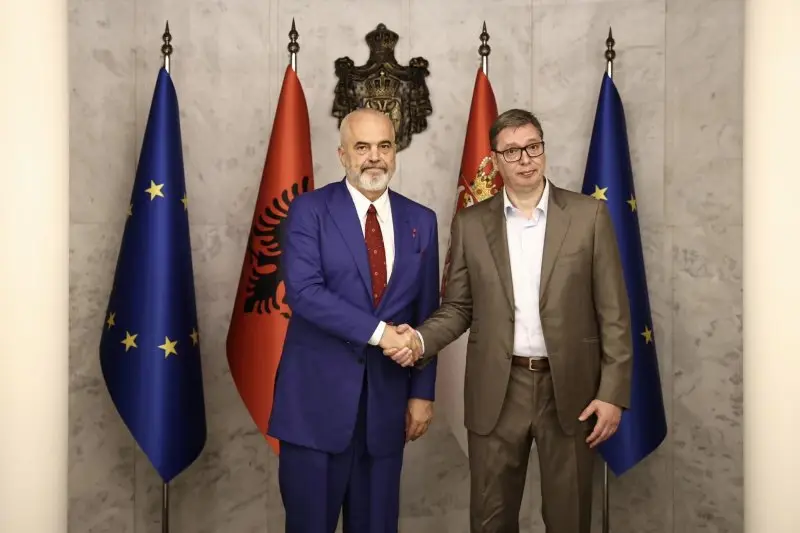
The Prime Minister of Albania, Edi Rama, and the President of Serbia, Aleksandar Vučić, have proposed a new and more “realistic” path for the European integration of the Western Balkans, focusing on access to the European Union’s common market and the Schengen free-movement area rather than immediate full membership in the European Union.
In a joint opinion article published in the German newspaper Frankfurter Allgemeine Zeitung, the two leaders argue that candidate countries that are ready should be gradually integrated into the EU’s internal market and the Schengen area, allowing citizens and economies in the region to benefit sooner from closer economic and mobility ties with Europe.
According to Rama and Vučić, this approach could provide tangible benefits for people and businesses in the Western Balkans, while at the same time strengthening the economic and geopolitical position of the EU itself. They point out that no new country has joined the EU since 2013, a reality they describe as discouraging for the region despite ongoing reforms and cooperation with Brussels.
The two leaders acknowledge that EU member states are concerned about maintaining the Union’s functionality, unity, and decision-making capacity if enlargement continues too quickly. Because of this, they suggest a model that would allow deeper economic and mobility integration without changing the institutional structure of the EU. Under their proposal, candidate countries joining the market and Schengen framework would not receive veto rights, additional European commissioners, or extra seats in the European Parliament.
They emphasize that EU enlargement has historically been a mutually beneficial investment rather than an act of charity, bringing markets, talent, stability, and strategic depth to Europe while offering prosperity and security to new members. In their view, integrating the Western Balkans more quickly into key EU systems could turn today’s geopolitical challenges into a new success story for Europe as a whole.