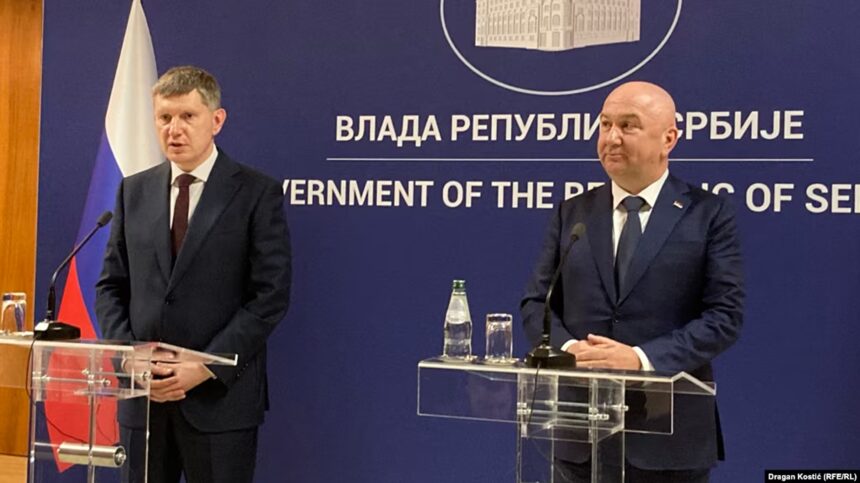
Maksim Reshetnikov, who is under sanctions by both the European Union and the United States, visited Belgrade, where he met with Serbian officials, including Nenad Popović.
During the visit, it was announced that a session of the intergovernmental committee for cooperation between Russia and Serbia will be held in April in Belgrade. Reshetnikov expressed expectations that the meeting would boost cooperation across multiple sectors.
Popović stated that “Serbia will stand with Russia,” a message delivered shortly after U.S. warnings about Moscow’s role in destabilizing the Western Balkans.
According to Bojana Selaković, such visits by sanctioned Russian officials are likely to impact Serbia’s European integration process, noting that they will be reflected in EU reports and considered by European diplomats. She added that Serbia continues to pursue a “multi-vector” policy, maintaining ties with both Western and Russian actors.
Serbia has not aligned with EU sanctions against Russia since the start of the Russian invasion of Ukraine, which has slowed its accession process. The country has not opened any new negotiation chapters with the EU since December 2021.
Energy cooperation remains central to relations between Belgrade and Moscow, especially as Serbia relies heavily on Russian gas. Current short-term supply agreements are set to expire at the end of March, while negotiations for a long-term deal with Gazprom have not yet been finalized.
President Aleksandar Vučić said that global energy market disruptions require sustainable long-term arrangements, while highlighting that Serbia currently pays significantly lower prices for Russian gas compared to market rates.
A previous visit by Reshetnikov in October 2024 led Ursula von der Leyen to cancel a planned meeting with then-Prime Minister Miloš Vučević, citing concerns over Serbia’s deepening ties with Russia.
Meanwhile, U.S. intelligence agencies warned in a recent report that the Western Balkans remain vulnerable to external influence, specifically highlighting Russia’s role in fueling tensions between Kosovo and Serbia, as well as its support for separatist tendencies in Bosnia and Herzegovina.