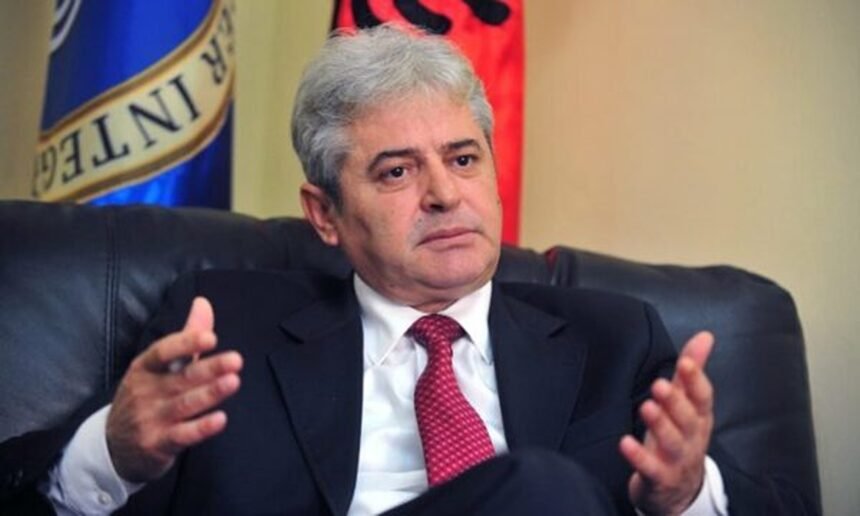
The Constitutional Court in North Macedonia has reactivated efforts to review the Language Law, which regulates the use of the Albanian language in the country. Following this decision, the leader of the Democratic Union for Integration, Ali Ahmeti, reacted through a social media post, calling on the Court not to act as a pre-political institution or an instrument of destabilizing agendas.
“For me, the Albanian language is not and will never be a matter of negotiation. I have said it and I will repeat it without any reservation: the Ohrid Agreement is the foundation of this state, and whoever questions it, questions the very future of the country. Albanian is not a privilege, but an acquired right guaranteed by the Constitution. Any attempt to relativize or limit this right is a direct confrontation with the constitutional order and will not go unanswered,” Ahmeti wrote.
Stable states are built on clear principles, major political agreements, and mutual respect among citizens and the peoples that compose them. When these principles are upheld and strengthened, the state moves forward; when they are relativized, unnecessary debates arise that serve no one.
There are issues that should not be treated with the passion of the day, but with the maturity required by the state. Some topics are not the property of political parties nor objects of competition, but part of a shared agreement to live together equally in a common, European state. One of these issues is the status of the Albanian language as an official language.
For Ahmeti, equality has never been just a slogan—it has been a firm political and moral conviction. A state becomes strong not when one side feels superior, but when every citizen and every community feels respected, recognized, and represented with dignity. This is where the importance of language lies: it is not only a means of communication, but also an expression of identity, dignity, and constitutional equality.
He reiterated that Albanians in North Macedonia have never contested the Macedonian language or identity; on the contrary, they have consistently supported a shared, unitary, Euro-Atlantic, and European future for the country. According to him, equality for Albanians has strengthened the state, not weakened it.
Ahmeti stressed that linguistic equality is a pillar of coexistence. Peace and stability, he said, are built on real equality—not dominance. A state that does not communicate with its citizens in their own language cannot be considered equal.
He warned that attempts to weaken the status of the Albanian language are not merely legal debates but threaten a carefully built balance and public trust. When trust is damaged, the cohesion of the state is also harmed.
Ahmeti also expressed concern over certain institutional approaches, particularly within the Constitutional Court, suggesting that decisions on sensitive interethnic issues may be influenced by outdated majoritarian thinking rather than constitutional principles.
He emphasized that institutions—especially constitutional ones—must act as guardians of equality, not places where it is questioned.
Referring to the Venice Commission, Ahmeti noted that it has not declared the Language Law unconstitutional or contrary to international standards. Instead, its observations relate to implementation challenges such as administrative capacity and financial support, which should not be used to delegitimize the law itself.
He added that international standards represent minimum requirements, not a ceiling for rights. A country aspiring toward Europe should not reduce already acquired rights.
Ahmeti called on political parties to reflect, warning that rhetoric minimizing the Albanian language only fuels division and tension rather than unity. He stressed that no one in the country should feel threatened by equality—neither Macedonians nor Albanians.
He urged for wisdom, restraint, and historical responsibility, emphasizing the need to protect both the Macedonian and Albanian languages, as well as the dignity of all citizens.
“There is no turning back. Acquired rights are not negotiable and cannot be undone. Any attempt to limit the use of the Albanian language is a dangerous regression,” he stated.
Ahmeti highlighted that these rights are also tied to the country’s path alongside international partners such as the EU, the United States, and NATO, making their protection both a political and international responsibility.
He concluded by reaffirming his stance:
“We do not ask for more than what belongs to us, but we will not accept less. Equality is not an option—it is an obligation. Today, the problem is not the law, but the lack of will to implement it.”
He called on the Constitutional Court to refrain from acting as a political instrument and warned that undermining linguistic equality threatens the very foundation of the state.
“This is my position—clear, non-negotiable, and irreversible: there is no dignity without the Albanian language as an official language. Whoever touches this principle touches the very foundation of the state.”